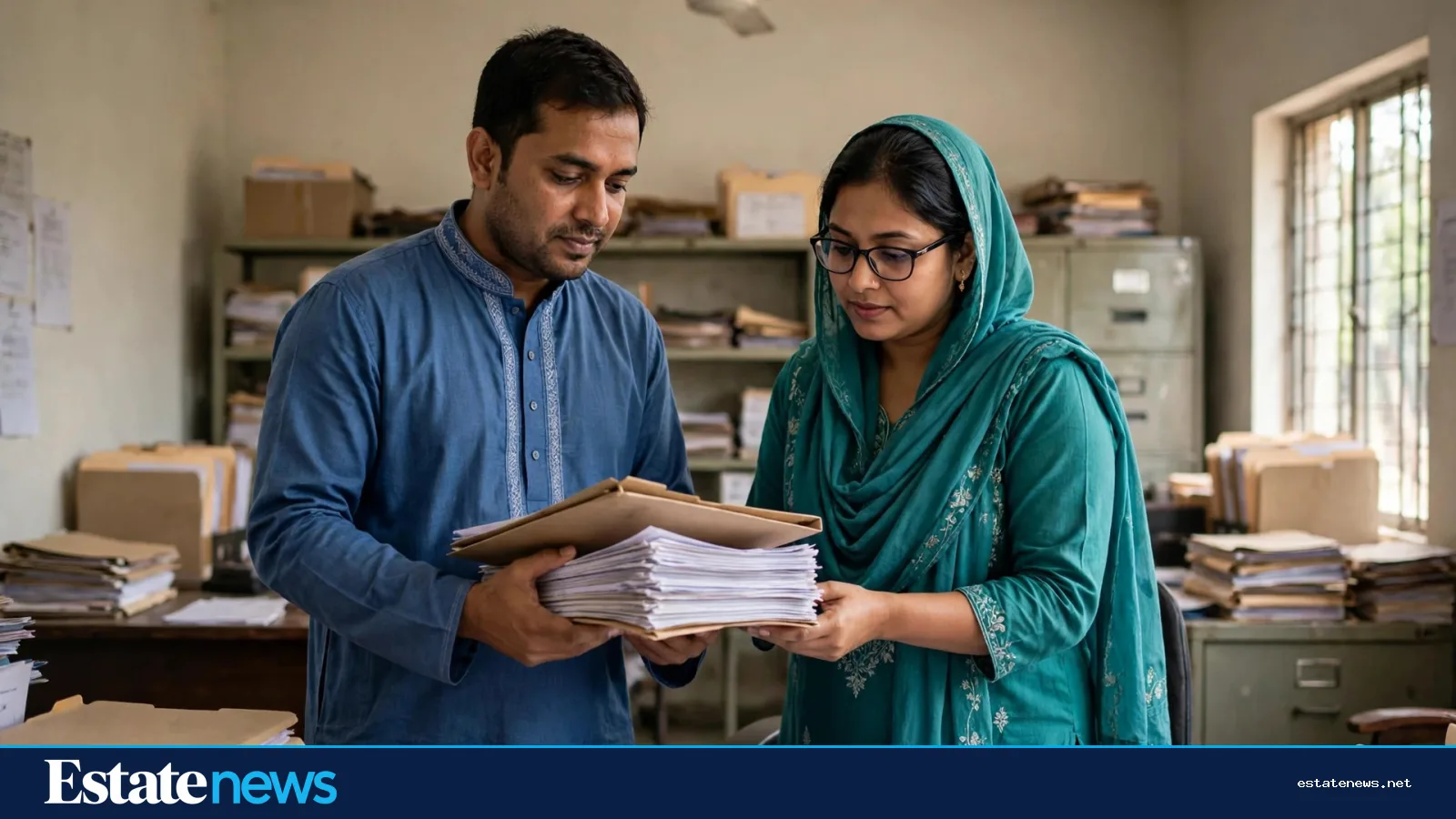
A flat purchase in Dhaka has two finishes. The first is the day the deed is registered at the sub-registry office and the developer hands over the keys. The second is quieter, and many buyers never notice it is missing until they need it. It is mutation, known in Bangla as namjari.
Mutation updates the government's record of rights, the khatian, so that it shows the new owner's name in place of the seller's. Registration transfers the deed. Mutation updates the record. The two are not the same thing, and the record is what the land office, the bank and the next buyer will look at.
Why a flat buyer needs it at all

A flat buyer does not buy a plot. They buy a flat and an undivided share of the land under the building. That share still needs to be recorded in the buyer's name. Until mutation is done, the khatian shows the previous owner, usually the developer or the original landowner, as the holder of that share.
Three problems follow from leaving it undone. The buyer cannot pay land development tax, known as khajna, in their own name, because the tax record still carries the old name. A bank asked for a loan against the flat will find the record does not match the deed, and that mismatch slows or blocks the loan. And when the buyer later sells, the next buyer's lawyer will ask for the mutation record first, because a clean chain of title runs through it.
Mutation is a revenue record, not a title deed by itself. Courts have restated that a khatian carries only a presumption of ownership, not proof of title. That does not make it optional. It makes it one link in a chain, and a missing link is what breaks a sale.
How the process works
Bangladesh moved mutation online through the Ministry of Land's e-mutation portal at mutation.land.gov.bd. The application goes to the Assistant Commissioner (Land), known as the AC (Land), of the office that covers the mouza where the land sits. For a Dhaka flat, that is the circle or upazila land office for the area.
The usual documents are the registered deed in the buyer's name, the earlier deeds in the ownership chain, known as baya deeds, the previous khatian, the land development tax receipts, the buyer's national identity card, and a passport-size photograph. For a flat, the deed of apartment and the allocation of the undivided land share form part of the papers the buyer files. Requirements can vary by office, so the current list on the portal is the one to follow.


Once filed, the application is checked by the Union or City Land Office, compared against the existing record, and decided by the AC (Land). A hearing may be called if there is an objection or a question about the record. If approved, the buyer receives a mutation order, a DCR, the duplicate carbon receipt, and an updated khatian in their own name. The DCR carries a QR code and is downloadable online.
Fees are paid online. Cash payment at land offices was ended when online payment of mutation fees became mandatory in October 2022, and the portal shows the amounts due at filing and on approval. Published guides quote different totals, so the figure on the portal at the time of application is the one to trust, not a number remembered from an old article.
In some cases the buyer does not need to apply at all. Under a 2020 circular, the AC (Land) can open an e-mutation case directly from the deed copy and land transfer notice sent by the sub-registry, and the buyer is informed by message. That automatic route does not cover every transfer, so buyers should check whether a case has been opened for their deed rather than assuming it has.
How long it takes, and what to do when it stalls
The government has set a target of disposing of mutation cases within about 28 days, and has asked Deputy Commissioners to explain cases that take longer. In practice, a clean application with a clear chain of title moves faster than one with a disputed record or a missing paper. Older published guides quoted 45 to 60 days, and that range still describes difficult cases.
If an application stalls, the first step is to check its status on the portal. The second is to find out what is missing: a baya deed, a tax receipt, a mismatch between the deed and the khatian. Most delays have a paper reason, and a paper reason has a paper fix.
A few habits protect a buyer before the purchase, not after. Check the seller's name and the dag number on the current khatian through the land records portal before signing. Keep the chain of baya deeds from the start, not as an afterthought. Pay the khajna and keep the receipts. And treat the mutation application as part of the purchase itself, filed in the weeks after registration, not as a chore for some later year.
The keys open the flat. The mutation record opens everything that comes after: the tax receipt, the bank loan, the resale. It is the cheapest paperwork in the whole purchase, and the most commonly forgotten. Do it while the file is still warm.