Asking prices are the first numbers a Dhaka homebuyer meets, and the most misunderstood. They appear on listings, in conversations with brokers and in newspaper reports, and they are often quoted as though they were the market itself. They are not. An asking price is what a seller hopes to receive. A deal price is what a buyer actually pays. The distance between the two is where negotiation, urgency and the real condition of a flat all live.
Estate News' area-price tracker follows asking prices for that reason: not to declare what homes are worth, but to show what sellers are asking, area by area, so buyers can compare like with like. The November snapshot below is drawn from medians of listings in each area. A median is the middle listing, not an average pulled up by a few very expensive homes, and it is a fairer guide to what a typical listing asks. These are asking figures, not transaction prices, and they should be read that way throughout.
The November snapshot

Gulshan and Dhanmondi sit at the top of the tracker, both at Tk20,000 per square foot in asking medians. Gulshan's position reflects its long-standing role as Dhaka's premier commercial and diplomatic address, where land is scarce and demand from businesses, diplomats and wealthy families is steady. Dhanmondi's matching figure reflects a different strength: a mature residential area with schools, hospitals, parks and a deep stock of family homes, where owners are rarely forced sellers and can afford to ask firmly.
Banani follows at Tk13,888 per square foot. Banani shares much of Gulshan's commercial character but with a broader mix of apartment stock, including older buildings whose asking prices sit below the newest towers. That mix is visible in the median: a single figure that blends the area's premium and its ordinary stock.
Uttara stands at Tk12,500 per square foot. Uttara's appeal is scale and planning: wide roads, sectors, schools and a large community of families, with a wide range of buildings from older blocks to newer towers. Its median sits between the premium core and the city's more affordable north, which is roughly where its housing stock sits too.
Bashundhara Residential Area records Tk9,865 per square foot. As a planned neighbourhood with its own internal roads, commercial areas and institutions, Bashundhara offers a self-contained residential life at a figure below the older premium areas, which is part of its attraction for families who want planning without the Gulshan or Dhanmondi price tag.
Mirpur, at Tk8,700 per square foot, is the most affordable of the six. Mirpur's stock is large, its neighbourhoods are varied, and its transport links, including metro rail, serve a large population of salaried families. For a buyer priced out of the premium areas, Mirpur is where the city's housing ladder still has rungs within reach.
What the gap between areas really says
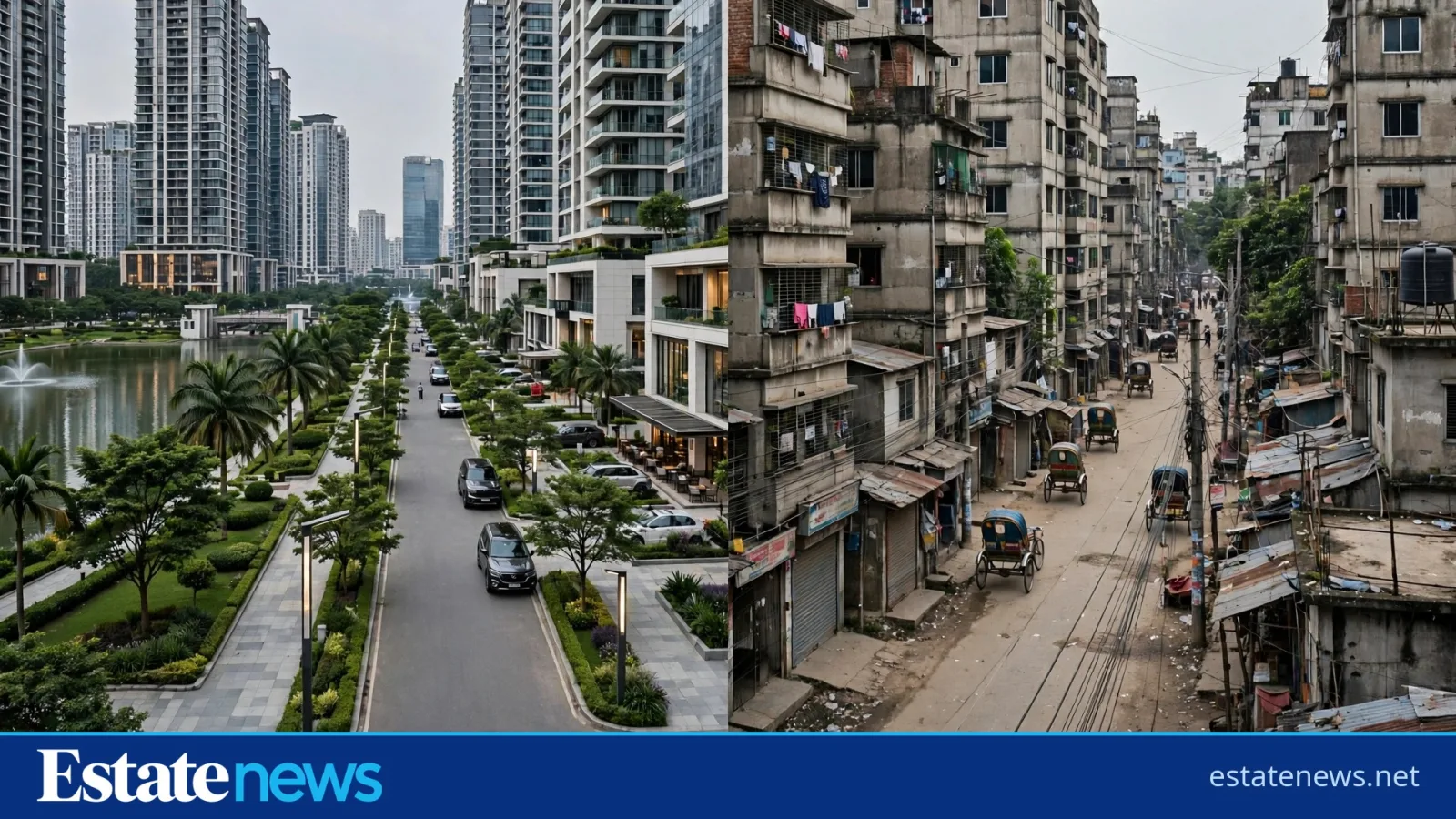
The gap between Gulshan and Dhanmondi at Tk20,000 and Mirpur at Tk8,700 is more than a curiosity. It describes two different housing markets within one city. At the top, buyers are paying for scarcity: limited land, established neighbourhoods and a social and commercial infrastructure that cannot be replicated quickly. At the more affordable end, buyers are paying for space and practicality: a home near work, family and transport, at a figure a salaried household can contemplate.
Neither market is the "real" Dhaka. A buyer comparing areas should therefore compare what each figure buys, not just the figure itself. A smaller flat in a premium area and a larger flat in Mirpur or Bashundhara may cost similar totals while offering entirely different lives: one close to the commercial centre, the other with room for a growing family. The right choice depends on the household, not on the ranking.
The gap also cautions against reading a single area's figure as a trend. A median can move because the mix of listings changed — more new towers listed this month, fewer older flats — rather than because every home in the area became more expensive. That is why this tracker reports a snapshot with its method stated, rather than a claim about direction.
What changed, and what has not
This November snapshot is presented as a fresh reading, not as a claim of a measured rise or fall against October. Listing medians move for many reasons, and a responsible tracker does not invent a change figure where the comparison has not been made on identical terms. What readers can take from November is the shape of the market: the same ordering, with the premium core at the top, Uttara and Banani in the middle, and Bashundhara and Mirpur offering the more affordable routes into ownership.


That stability is itself informative. Dhaka's asking prices have not collapsed, nor have they run away in a single month. For a buyer, a stable asking landscape is good news: it means time to compare, to inspect and to negotiate, rather than pressure to decide before a price moves.
Before you treat an asking price as a deal price
An asking price is a starting point for a conversation, not a verdict. Before treating any figure as the price of a home, a buyer should check several things.
Condition and age: A newly finished flat and a twenty-year-old flat in the same area are different products. Ask what the asking figure includes and what it leaves out.
Floor, facing and layout: Higher floors, better light and efficient layouts command different figures within the same building. Compare similar flats, not just similar areas.
Total cost, not just the rate: Multiply the rate by the actual size, then add registration, loan and moving costs. A lower rate on a larger flat can cost more overall.
How long it has been listed: A flat listed for months at one figure, with no takers, is telling the market something. A freshly listed flat at a firm figure may simply be testing demand.
The seller's position: An owner who must sell soon negotiates differently from one who can wait. Neither position is visible in the listing, which is why direct conversation and comparison matter.
Registered evidence: Wherever possible, compare asking figures with registered transaction evidence for similar properties, and take professional advice before committing.
How to use this tracker
Use the November figures as a map, not a destination. Start with the area that fits your daily life — your workplace, your children's schools, your family's neighbourhood — then compare asking medians within that area and a neighbouring one. Visit buildings, inspect flats in person, and let the asking price guide your shortlist rather than decide it.
Estate News will update this tracker regularly, stating its method each time, so readers can follow the shape of the market without being misled by any single month's figure. The honest use of asking data is to narrow the search, strengthen a negotiation and keep expectations grounded — and on those terms, even an imperfect number is useful, as long as everyone knows what it is.
Follow Estate News on Facebook for daily property, market and money updates: https://www.facebook.com/profile.php?id=61593817347872