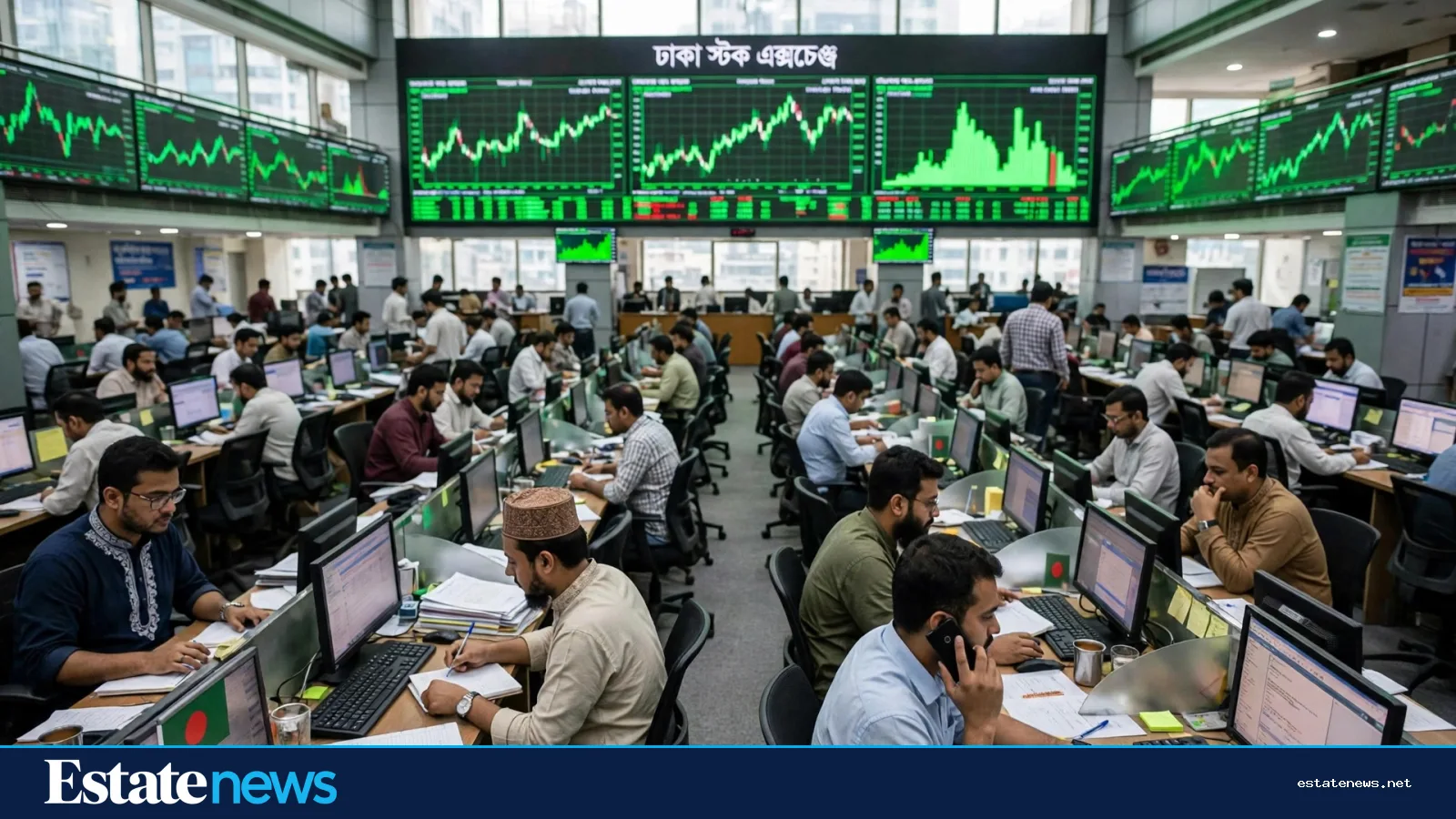
The Dhaka Stock Exchange opens for trading today after the Friday and Saturday weekend, and it does so on a steadier footing than it had a week ago. The DSEX closed Thursday at 5,413.04, up 71.41 points, or 1.34 percent, from 5,341.63, according to Dhaka Stock Exchange data. It was the second straight daily gain after a four-session losing streak that had taken the index to a five-month low of 5,333 on 2 November.
Turnover rose with the index. Thursday's turnover reached Tk 645.43 crore, up 23.6 percent from Tk 522 crore the previous session. Of 395 issues traded, 249 advanced, 81 declined and 65 were unchanged. The DS30 index of blue chips closed at 2,068.63, up 31.01 points, and the DSES Shariah index finished at 1,047.71, up 10.83 points.
Banks led, and that matters for housing

Banks led the sector gains, rising 2.8 percent on the day, according to Prime Bank Securities. Textiles accounted for 21.6 percent of turnover, and ceramics rose 4.8 percent. The banking lead is the detail homebuyers should notice, because banks set the price of home loans. A banking sector that investors are buying into is a sector with room to lend, and lending is what turns a saved deposit into a set of keys.
The other piece of news came from the regulator. The Bangladesh Securities and Exchange Commission has eased restrictions on selected frozen beneficiary owner accounts, The Business Standard reported on 5 November. Frozen accounts keep money and shares locked away from their owners. Easing them puts some of that money back into circulation, and in a market as sentiment-driven as Dhaka's, the signal counts as much as the sums involved.
What a rising index does to a flat buyer
A stock market recovery does not cut the price of a flat. It does something quieter. Households that hold shares feel less squeezed, and that feeling shows up in decisions they had been putting off: a booking, a site visit, a conversation with a bank about a loan. Developers watch the same mood. When the market falls for days in a row, buyers wait. When it steadies, some of them stop waiting.


There is a direct link too. Listed developers and building-materials companies trade on the DSE, so their share prices are a daily verdict on the housing business itself. A rising market lifts their valuations and, over time, their ability to raise money for new projects. A falling one does the opposite. The two-day recovery is far too short to call a turn, but it breaks a slide that had been feeding caution through the whole property chain.
The caution is not gone. The index is still far below the levels of better years, and the four-session losing streak that ended on Wednesday is a reminder of how quickly sentiment turns. Buyers who borrow to buy a flat should watch the loan rate, not the index. The index tells you how the market feels. The loan rate tells you what the flat will cost every month.
The household wealth behind the headlines
Remittance money runs underneath all of this. Bangladesh received $2.874 billion in remittance in October 2026, up 12.1 percent from a year earlier, according to Bangladesh Bank data, and $11.465 billion across July to October. Much of that money ends up in land and flats, either as a deposit paid from abroad or as savings held for a future purchase. A steady stock market and strong remittance inflows together give families a firmer base to plan from.
Exports add to the same picture. Export earnings reached $17.04 billion in July to October, up 6 percent from a year earlier, with garments at $13.71 billion. November to February is the peak order season for exporters, when around 40 percent of annual orders arrive. If that season delivers, the income behind housing demand holds up.
For today, the practical read is simple. Trading resumes with the index at 5,413.04 and turnover recovering. That is a better starting point than the 5,333 low of 2 November, and a worse one than any buyer would wish for. Watch today's close, watch the banks, and keep the deposit plan going either way. A flat is bought over years, not on one green day at the exchange.
This is general information, not financial advice.