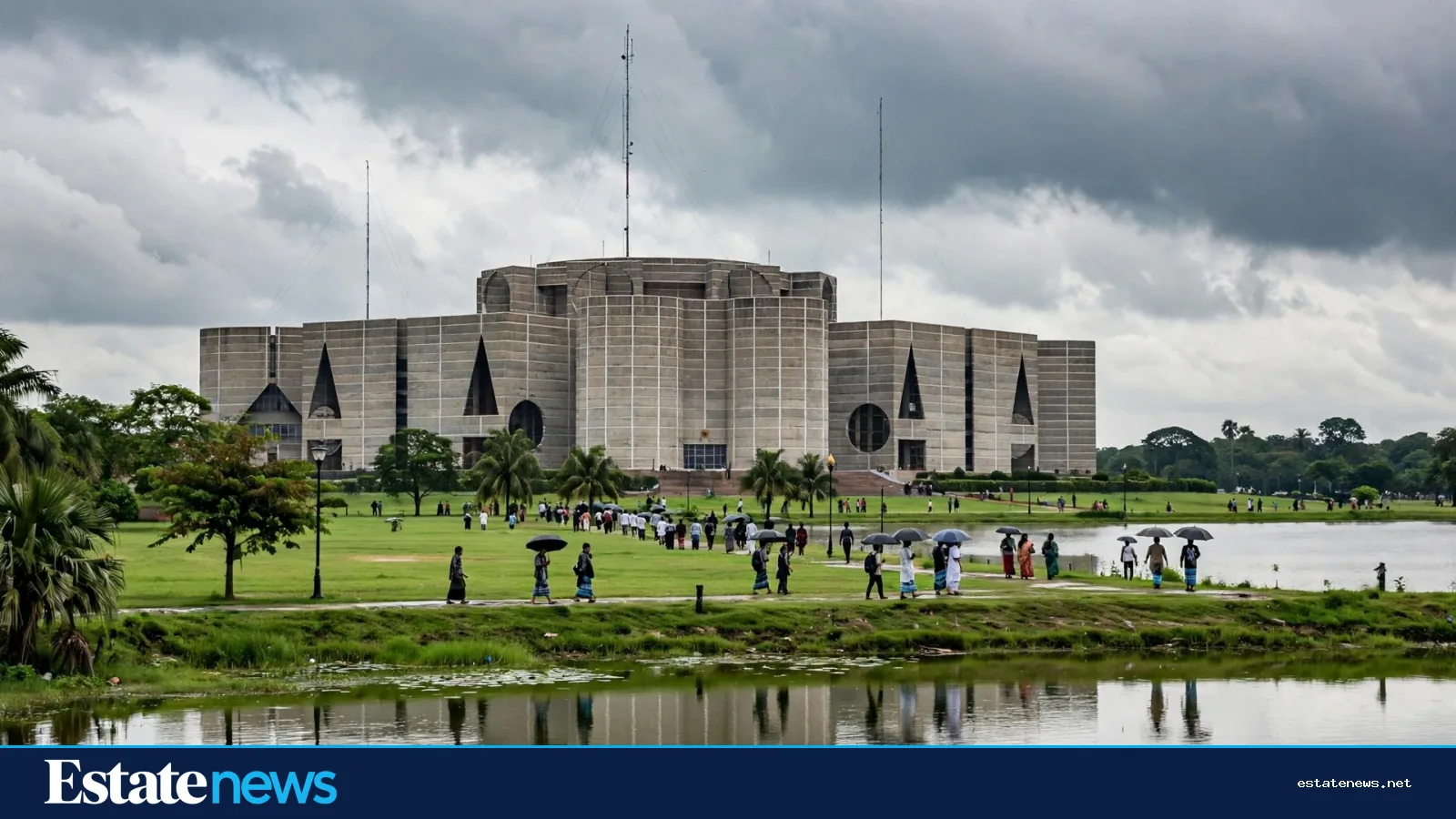
Stand on the lawn at Sher-e-Bangla Nagar on a monsoon afternoon and the building looks as if it has risen out of the water. Great blocks of concrete, cut with circles and triangles, face an artificial lake that runs along three sides of the main building. The sky moves across the water. Visitors walk the grass in small groups, stopping to take photographs, and the building behind them does not look like any other parliament house in the world.
That is the point. The Jatiya Sangsad Bhaban, the home of Bangladesh's National Parliament, was designed to be unlike anything else in Dhaka, and more than forty years after it opened, it still is.
A design from another country, a building for this one

The architect was Louis Kahn, an American architect born in Estonia, who was asked in the early 1960s to design a new parliament complex for what was then East Pakistan. Kahn submitted a preliminary design in 1960. The government approved it, land was acquired in 1961, and construction began that year. The work was meant to house the federal legislature of a united Pakistan. History had other plans.
Construction stopped during the Liberation War of 1971. Kahn died in 1974, when the project was about three-quarters complete, and the work was carried on under David Wisdom, who had worked with Kahn. The building was completed on 28 January 1982 and first used by the parliament of Bangladesh on 15 February 1982. It had taken more than twenty years from first design to first sitting.
Kahn designed the whole complex, not only the main chamber block. Lawns, the lake, and residences for members of parliament were part of the same plan. The complex covers about 200 acres, making it one of the largest legislative complexes in the world. Its bounds are four well-known roads: Lake Road to the north, Rokeya Sarani to the east, Manik Mia Avenue to the south and Mirpur Road to the west.
Concrete, light and water
The building's material is plain to see. Reinforced concrete, with brickwork in parts of the complex, forms massive walls and geometric openings. Circles, triangles and rectangles are cut into the concrete, and light comes through them in shapes that move across the floors as the day passes.
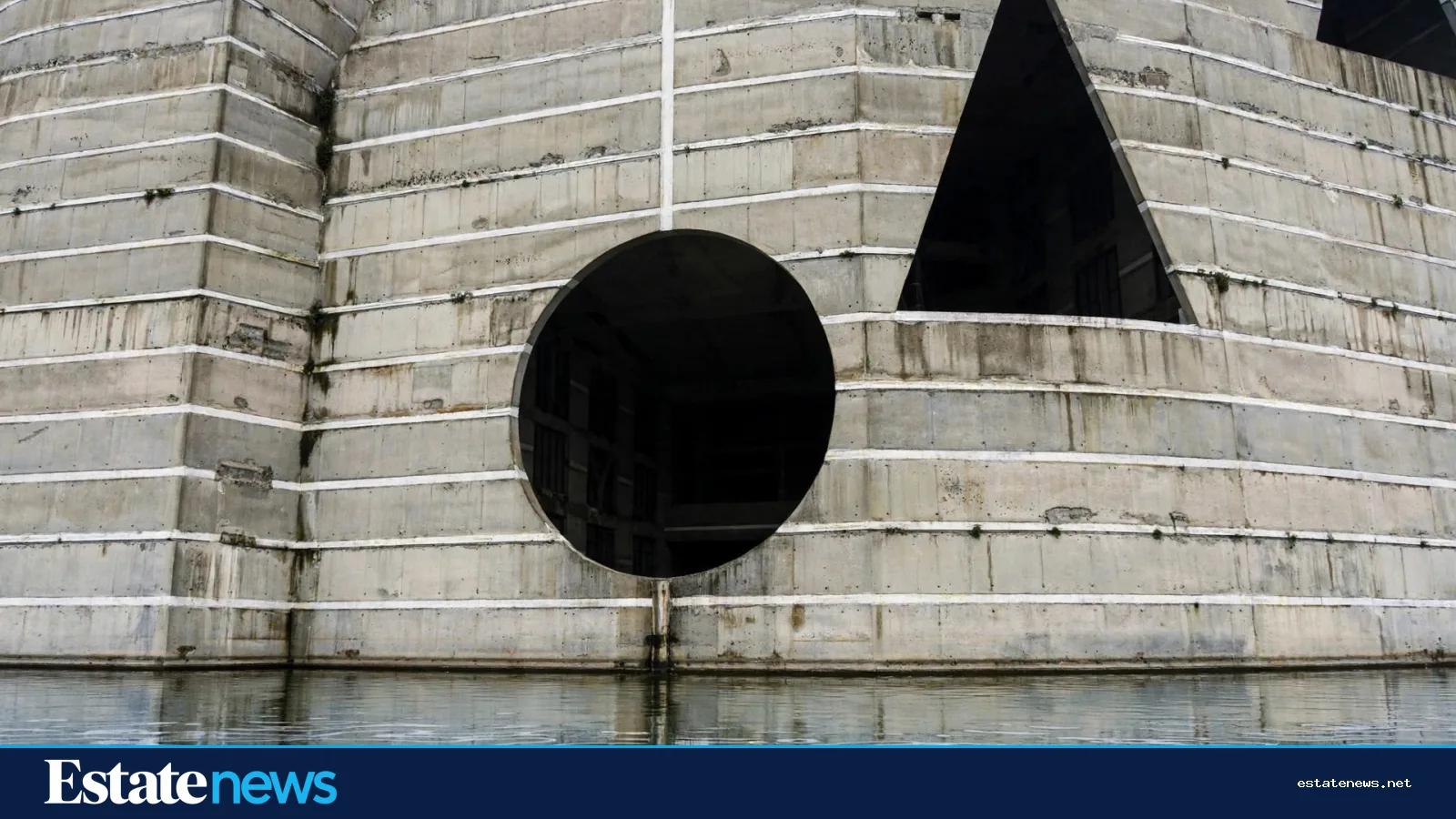


Marble appears in the finishes, and the geometry of the plan is strict. The main block rises above the lake, and the water reflects it. The lake is not a decoration added at the end. It runs along three sides of the main building and extends to the members' hostel complex, and it was drawn into the design from the start. Kahn's lake recalls the rivers and water of Bangladesh, and on a still morning the building seems to float.
Visitors often ask why a parliament house should sit in water. The answer is in the setting. Dhaka is a city of rivers, and the lake gives the building a ground of its own, separate from the traffic of Mirpur Road and Manik Mia Avenue. It also gives the public a place to stand and look.
What stands there today
The building is in daily use as the seat of the Jatiya Sangsad, the National Parliament. Sessions meet in the main chamber, and the complex holds the offices and meeting rooms that a parliament needs. Security around the building is tight, and the public cannot walk through the chamber block as they might through a museum. The view from the lawns and the lake edge is the view most Dhaka residents know, and it is the view that appears on postcards, television backdrops and school textbooks.
Why it matters to Dhaka
The Sangsad Bhaban matters to Dhaka for reasons beyond its function. It is the building that put Bangladeshi architecture on the world map. Students of architecture from many countries come to study it, and it is named in lists of the great buildings of the twentieth century.
It matters, too, as a public place. The lawns and the lake edge are among the few large open spaces in a crowded city where a family can walk without paying an entry fee. On winter afternoons the grass fills with visitors. On monsoon days the clouds gather over the lake and the concrete turns a deeper grey.
Kahn never saw it finished. He died eight years before the first session sat in the chamber he designed. What he left was a building that still works as a parliament and still surprises as a piece of architecture, a concrete parliament on a lake, holding its ground in the middle of a fast-growing city.