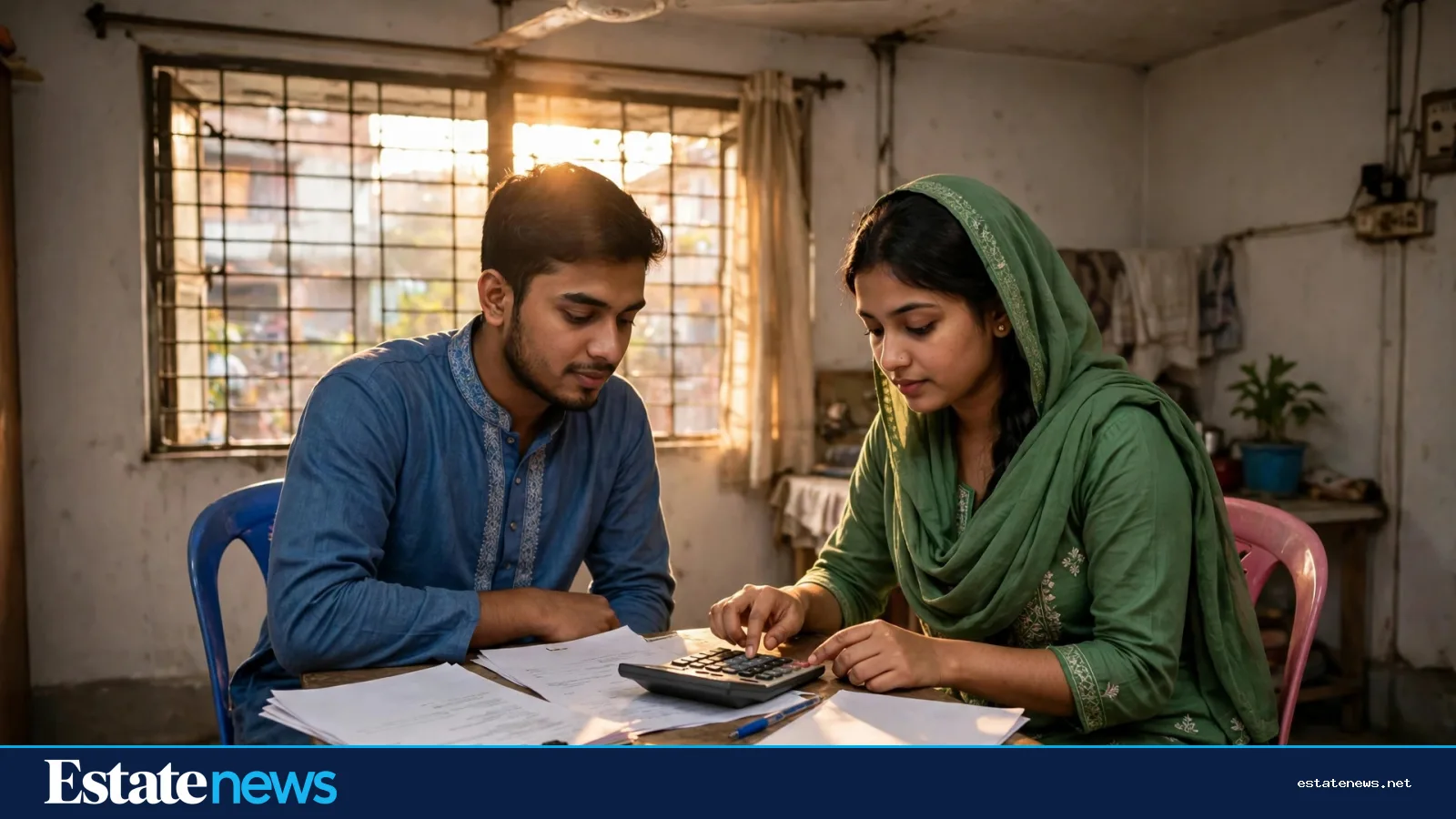
Start with a salary of Tk 60,000 a month. A common planning rule of thumb says a household should keep its home loan instalment at about 40 per cent of income. That is not a bank rule. Banks set their own limits, and they look at job stability, existing loans and the value of the flat. But 40 per cent is a useful place to begin the sums, and it gives an instalment of Tk 24,000. Round it to Tk 25,000 a month, and the question becomes simple: how much loan does Tk 25,000 a month buy?
The answer depends on the rate and the tenure. Take a 20-year loan, which is 240 monthly payments. The EMI formula is the standard one: EMI equals the loan amount multiplied by the monthly rate multiplied by (1 plus the monthly rate) raised to the power of 240, divided by ((1 plus the monthly rate) raised to the power of 240 minus 1). Run the numbers backwards from an EMI of Tk 25,000, and the loan amounts come out as follows.
At 11 per cent a year, a Tk 25,000 monthly EMI over 20 years supports a loan of about Tk 24,22,038, or Tk 24.22 lakh. The borrower pays Tk 25,000 a month for 240 months, which is Tk 60,00,000 in total. The interest in that total is about Tk 35,77,962, or Tk 35.78 lakh. The interest is larger than the loan itself.
At 12 per cent a year, the same Tk 25,000 EMI over 20 years supports a loan of about Tk 22,70,485, or Tk 22.70 lakh. Total payments stay at Tk 60,00,000, and the interest rises to about Tk 37,29,515, or Tk 37.30 lakh. One percentage point of rate costs the borrower about Tk 1,51,553 of loan amount, and adds about Tk 1,51,553 of interest on the same monthly payment.
The loan is not the price
A loan of Tk 24.22 lakh does not buy a flat worth Tk 24.22 lakh. It buys most of one, and the rest comes from the buyer's own money. Take a flat priced at Tk 30 lakh. At 11 per cent, the loan covers Tk 24.22 lakh, so the deposit is about Tk 5.78 lakh. At 12 per cent, the loan covers Tk 22.70 lakh, so the deposit rises to about Tk 7.30 lakh. The rate moves the deposit as well as the loan.
Then comes registration. On the deed value in a city corporation area, the charges run to about 7.5 per cent: stamp duty 1.5 per cent, registration fee 1 per cent, local government tax 2 per cent, plus VAT of 2 per cent on a new flat up to 1,600 sq ft, according to the registration-cost guide on this site. On a Tk 30 lakh flat, that is about Tk 2.25 lakh. Add it to the deposit, and the cash a buyer needs before moving in is about Tk 8.03 lakh at 11 per cent, or about Tk 9.55 lakh at 12 per cent. That cash has to be saved before the loan starts, not after.


What the monthly budget really looks like
Tk 25,000 out of Tk 60,000 leaves Tk 35,000 for everything else. Rent stops once the family moves in, which is the point of the exercise, but service charges start. A building with a lift, a generator and a guard charges for them every month, and the charge rises with the building's age. Water, gas and electricity stay. So does food, transport, school fees and the small emergencies that arrive without warning.
A household that takes the full Tk 25,000 EMI with no savings behind it is running on a thin margin. A month without overtime, a medical bill, or a broken fridge can push the budget over. The safer test is to live on Tk 35,000 a month for three months while still paying rent, and see whether the household manages. If it does not, the EMI is too high, whatever the bank is willing to lend.
Rates move, and so does the EMI
Home loan rates in Bangladesh are mostly floating, which means the rate agreed at the start is not the rate paid for 20 years. When rates rise, the bank usually extends the tenure first and raises the EMI second. A borrower should ask, in writing, what happens to the EMI and the tenure if the rate moves by one point in either direction. The answer belongs in the file, not in a conversation.
It is also worth comparing more than the rate. Processing fees, early-settlement charges, the valuation of the flat, and the time the bank takes to disburse all change the real cost. What banks are offering flat buyers this month is the place to start that comparison, and the registration-cost guide sets out the charges that sit on top of the price.
A Tk 60,000 salary can carry a home loan of about Tk 24 lakh at today's rates, with roughly Tk 8 lakh of deposit and registration costs to save first. That is a serious sum, and it takes time to gather. But it is a sum a family can plan for, month by month, with the numbers in front of them instead of a guess. This article is information only, not financial advice, and a buyer should check the terms with the bank before deciding.