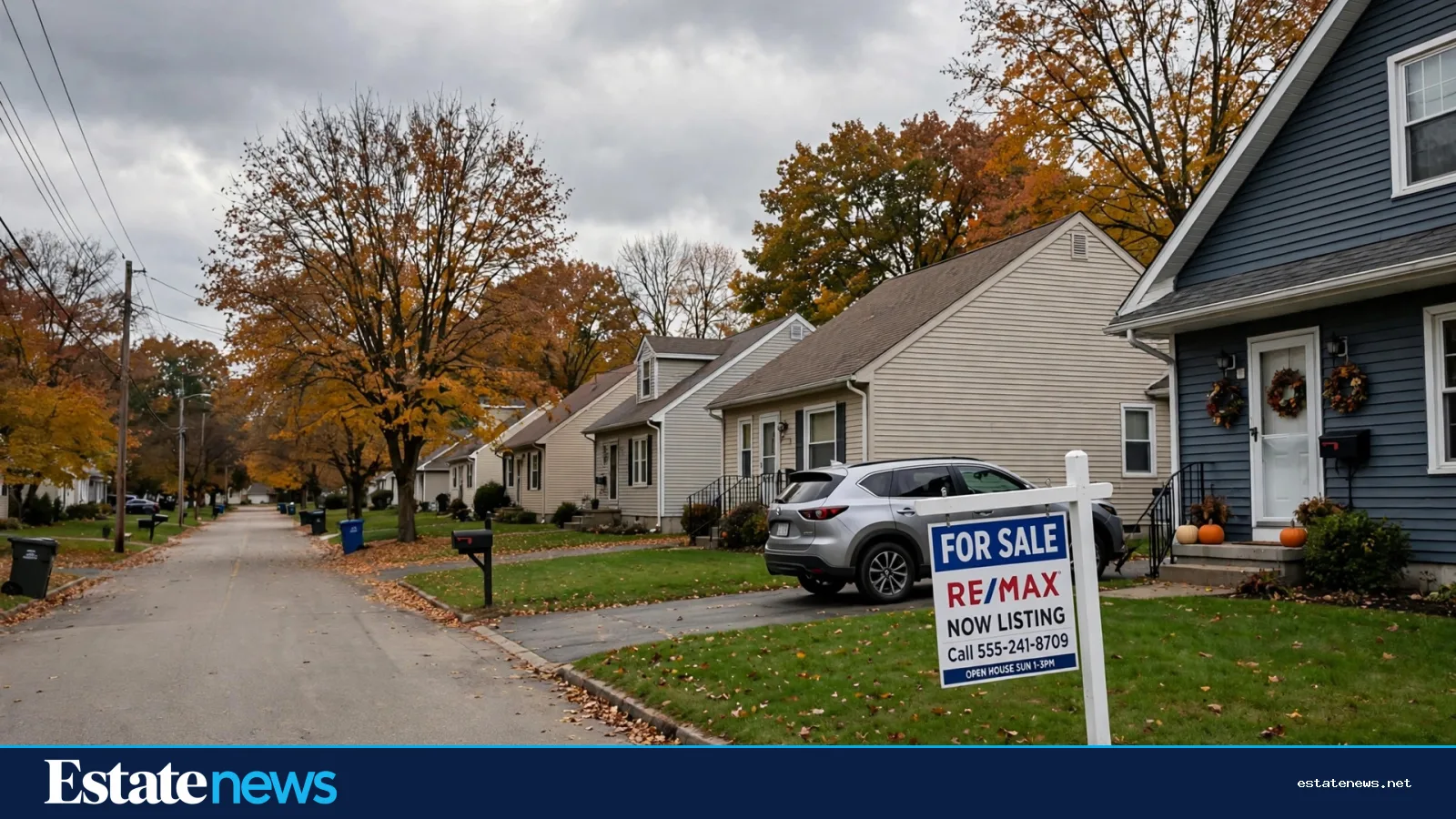
In the United States, the housing market has gone quiet. Not dead, but waiting. The National Association of Realtors reported on 20 October that its Pending Home Sales Index fell 7.3 percent in September from August, and 11.3 percent from a year earlier. The index stood at 66.0, the lowest reading since the series began in 2001. An index of 100 equals average contract activity in 2001. Every region of the country declined.
Pending sales count contracts that have been signed but have not yet closed. They are the market's forward look: a signed contract today is usually a completed sale in one or two months. When signings fall this far, closings follow. That is why the number drew attention, even though closed sales had actually risen in the same month. Existing-home sales reached a 3.99 million annual pace in September, up 1.5 percent on the month, but the pipeline behind them was thinning.
The reason, in the words of the association's chief economist, Lawrence Yun, is borrowing costs. "Market conditions weakened in September due to fast-rising mortgage rates," he said. The average 30-year fixed mortgage rate climbed from 5.98 percent in late February to 7.40 percent in mid-October, according to Freddie Mac, its highest level in nearly three years. It has since eased a little. Freddie Mac's survey put the 30-year fixed rate at 7.18 percent in the week of 5 November, down from 7.24 percent the week before. Yun has suggested rates could be near a peak, while adding that energy prices and inflation remain uncertain. Buyers and sellers, he said, may simply be holding back until rates move in their favour.

A buyer's market, in most big cities
The waiting is visible in the balance between sellers and buyers. Redfin reported 62.6 percent more home sellers than buyers in the United States in September, the largest gap since its records began in 2013. Forty-one of the 50 largest metropolitan areas are now buyer's markets, with Miami, Nashville and Houston showing the widest gaps. New-home sales fell 0.6 percent on the month and 5.3 percent on the year in September, and the median new-home price was $400,400, down 3.9 percent on the year.
Prices, though, have not fallen with sales. The median price of an existing home in the third quarter was $432,900, up 1.7 percent on the year, with prices up in 78 percent of metropolitan areas. Yun put that down to a limited supply of distressed property keeping prices steady even while mortgages are hard to get. A buyer waiting for a bargain may wait a long time. The market is slow, not cheap.
The Federal Reserve held its target rate at 3.75 to 4.00 percent at its meeting on 28 October, with two members dissenting in favour of another rise. Its next meeting is on 8 and 9 December. Mortgage rates follow the bond market more than the Fed's overnight rate, but the Fed's direction still sets the mood. For now, that mood is caution.


What it means for Bangladeshi buyers abroad
For a Bangladeshi buyer in the United States, or a non-resident Bangladeshi weighing a home abroad against one in Dhaka, the American market now offers time. A buyer's market means more choice, more room to negotiate, and less pressure to decide in a weekend. It does not mean prices are about to fall sharply. The price figures say otherwise.
The comparison with Dhaka is worth making carefully. A flat in Dhaka is bought with a home loan at roughly 9 to 13 percent, and a buyer there faces a different set of pressures: land title, developer delivery, registration costs. An American buyer faces a mortgage near 7 percent and a market where sellers outnumber buyers. The two markets are not substitutes for each other. A family chooses between them on the basis of where it lives, where it works, and where its children will grow up, not on a single month's sales figure.
What September does offer is a lesson in patience. American buyers are waiting for rates. Bangladeshi buyers abroad can afford to do the same, and to use the waiting time well: checking the title, the neighbourhood, the school district, the commute, and the true monthly cost once tax, insurance and maintenance are counted. A slow market rewards the buyer who arrives prepared. A fast market rewards the buyer who arrives first. This one, for now, rewards preparation.
This article is informational only, not financial advice. The next pending-sales release, covering October, is due on 18 November, and it will show whether September was a pause or the start of a longer wait.
Read more: "America's housing market turns as prices dip" and "Singapore's housing model, and what Dhaka can borrow".