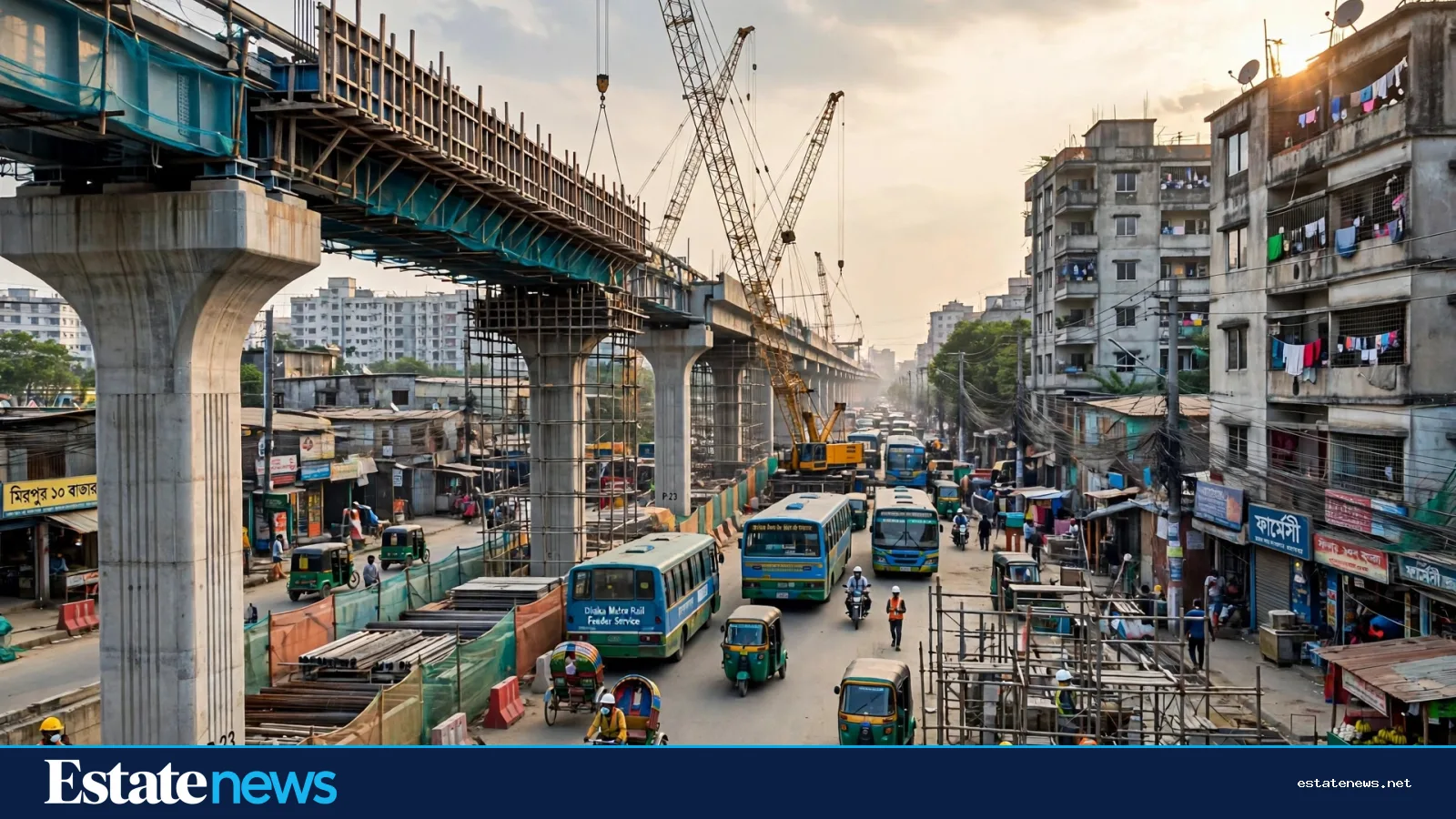
Dhaka's metro map took a concrete step forward on 27 October. At Metro Rail Bhaban in Diabari, Dhaka Mass Transit Company Ltd signed four depot and civil-works contract packages for MRT Line-1 and MRT Line-5 Northern. These are not announcements of intent. They are contracts with named builders, named sites and a schedule to keep.
Line-1 will run 31.2 kilometres, mostly underground from Kamalapur to the airport, with an elevated branch to the Purbachal Terminal. Line-5 Northern will run 20 kilometres from Hemayetpur to Bhatara, with 14 stations. Together the two lines are expected to cost about Tk 2 trillion. Line-1 is targeted for completion in 2033. Line-5 Northern is targeted for December 2032.
The 27 October signing covered the groundwork that makes the rest possible. For Line-1, the Pitalganj depot facilities package went to a Sinohydro and SEBCL joint venture, and a 5-kilometre elevated guideway with three stations between Nadda and Mostul went to a consortium of CREC, MIL and MBEC. For Line-5 Northern, the Hemayetpur depot package went to a Concord Pragati and Hanil joint venture, and another package went to the same CREC, MIL and MBEC consortium. Separately, Larsen and Toubro won the Line-1 track and electrical package and the signalling, telecom and platform screen door package, announced the same day.

What Line-5 Northern will carry
Line-5 Northern is the line to watch first, because its depot is already taking shape. Land development at the Hemayetpur depot was 87.54 percent complete as of October 2026, according to DMTCL figures reported that month. The line is designed to carry about 1.23 million passengers a day. The run from Hemayetpur to Bhatara is planned to take about 32 minutes.
That matters in a city where the same journey by road can take two hours on a bad day. Hemayetpur sits at the western edge of the city, Bhatara at the eastern edge, and the line passes through Mirpur, Gulshan and the northern residential belt in between. For families in those areas, the metro is not an abstract project. It is the difference between a commute that works and one that eats the day.
Line-1 is the longer and harder build. Most of it runs underground, from Kamalapur through the heart of the city to the airport, with the branch out to Purbachal. Underground work in Dhaka means dealing with water, old utilities and dense neighbourhoods above the tunnel. That is why the completion target sits at 2033, a year after Line-5 Northern.
The southern line, and the money behind it


A third piece of the same network moved forward in September. The southern route of Line-5, from Gabtoli to Dasherkandi, runs 17.20 kilometres with 15 stations. The Executive Committee of the National Economic Council approved it in September 2026 at Tk 455.04 billion. South Korea's export-import bank, KEXIM, has agreed to review a proposed loan of about 1.1 billion dollars for the line, after the finance minister met the bank's chairman during a visit to Korea that began on 31 October.
The financing question is the one to keep an eye on. Metro lines of this size are paid for over years, through a mix of government funds and foreign loans, and the pace of construction follows the pace of disbursement. A contract signed is a real step, but the work still depends on money arriving on schedule. Readers should judge the lines by what gets built, not by what gets announced.
What this changes for neighbourhoods
For now, the honest thing to say is that the metro changes how people move, and that change takes years to show up in a neighbourhood. The depot at Hemayetpur is rising. The guideway between Nadda and Mostul has a builder. Stations along Line-5 Northern will bring footfall to the streets around them, and that footfall will shape what shops open and who wants to live nearby.
What the metro does not do, on its own, is set flat prices. Prices follow supply, interest rates, incomes and the delivery record of builders, and a station opening is only one of those forces. Anyone who tells a buyer that a flat near a future station is certain to gain value is selling a promise, not a fact. The lines are worth following because they will reshape daily life in Dhaka. Their effect on any single building's price is a separate question, and it should be answered with evidence when the trains actually run.
The next dates to watch are practical ones: depot construction at Hemayetpur and Pitalganj, the first tunnel boring on Line-1, and the financing decision on the southern route. Each of those will say more about 2032 and 2033 than any ceremony. Dhaka has waited a long time for a metro network that reaches across the city. The contracts signed on 27 October are the point where waiting turned into building.
Read more: "Jhilmil, RAJUK's township south of Dhaka" and "how Dhaka's builders track a project from a phone".