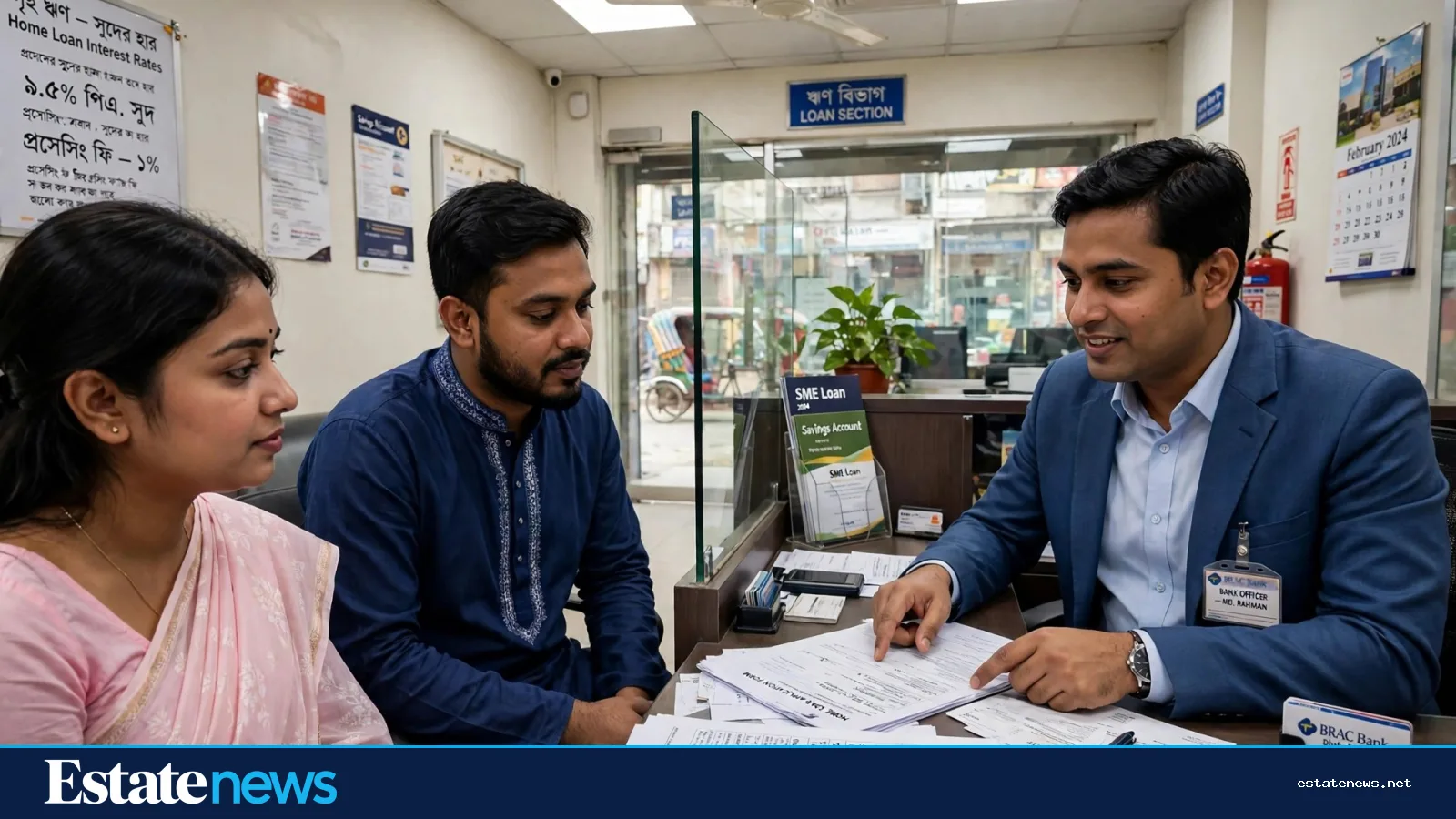
Two banks are now competing openly for the home loans of other banks, and the gap between their offers and the rates many borrowers still pay is wide enough to notice. Dutch-Bangla Bank will take over personal and home loans from other banks at 8.99 percent, and lend to new borrowers at 9.5 percent, until 28 February 2027. BRAC Bank offers loan takeovers at 9 percent with zero processing fees, valid until 31 December 2026. For a borrower paying 11 percent or more on an old loan, the arithmetic is the story.
Take a loan of Tk 70 lakh over 20 years. The monthly instalment, the EMI, follows a fixed formula: the loan amount, multiplied by the monthly interest rate, multiplied by a factor that depends on the tenure, divided by that factor minus one. At 11 percent a year, the monthly rate is 0.11 divided by 12, or 0.00917. Over 240 months, the factor comes to about 8.94, and the EMI works out to about Tk 72,253 a month. At 8.99 percent, the monthly rate is 0.00749, the factor comes to about 6.00, and the EMI works out to about Tk 62,936 a month. The difference is about Tk 9,317 a month, which rounds to about Tk 9,300. Over the full 20 years, that gap adds up to about Tk 22.4 lakh, the difference between paying about Tk 1.73 crore in total and about Tk 1.51 crore.
Those are rounded figures; a bank's own calculation may differ by a few taka. The shape of the answer does not change. A two-percentage-point cut on a long loan is a second rent payment, or a school fee, returned to the household every month for years.

Why the offers are appearing now
The background is the policy rate. Bangladesh Bank cut it to 9.5 percent in August 2026, down from 10 percent, and bank home-loan rates now sit roughly between 9 and 13 percent. Takeovers appeal to banks because the borrower has a payment history. The Dutch-Bangla Bank offer runs to 28 February 2027; the BRAC Bank offer, with no processing fee, runs to 31 December 2026.
Bangladesh Bank's 70:30 rule still applies: a bank lends up to 70 percent of a flat's price, and the single-borrower housing-loan ceiling can reach Tk 4 crore where the bank's classified housing-loan ratio is 5 percent or below. A takeover changes only the rate, and sometimes the remaining tenure.
What to check before switching


A lower rate is the start of the decision, not the end of it. Ask first what the new rate really is. Some offers are fixed for a period and then move with the market. Some are variable from the start, which means the EMI can rise if rates rise. A borrower who switches from a fixed 11 percent to a variable 8.99 percent has swapped a known cost for a cheaper one that can change, and should be comfortable with that trade.
Next, count the cost of the switch itself. BRAC Bank charges no processing fee on its takeover, which removes one cost at once. Other banks charge a fee, and there may be charges for closing the old loan, for fresh documentation, and for a new valuation of the flat. Ask for every charge in writing before signing, and compare the total against the monthly saving. A fee of Tk 50,000 is recovered in about six months at a saving of Tk 9,300 a month. A larger fee takes longer, and if only a few years remain on the loan, the saving may never cover the cost.
Then look at the remaining tenure. A takeover saves the most when many years are left, because the lower rate applies to every remaining payment. With five years left, the saving is smaller in total, and the paperwork may not be worth it. Check whether the new bank wants the loan secured the same way, and whether the flat's papers, the deed, the approval and the mutation, are in order. A bank will ask, and a borrower whose papers are incomplete will lose time.
Who should act, and who should wait
The clearest case is a borrower with a large balance, many years left, and a rate of 11 percent or more. That borrower should get written offers from both banks and compare the monthly figure, the fees and the tenure. A borrower already paying 9 percent has little to gain.
New buyers should note the 9.5 percent rate too: on the same Tk 70 lakh over 20 years it gives an EMI of about Tk 65,200 a month. Compare it with other banks before booking. Our guide to what a Tk 1 crore home loan really costs and our EMI calculator show the same arithmetic at other loan sizes.
This article is information, not financial advice. Rates change and offers carry conditions. What the numbers show is that the gap between an old loan and a new offer is now large enough to be worth a phone call. A borrower who never asks keeps paying the old rate. One who asks, and checks the fine print, may keep about Tk 9,300 a month.