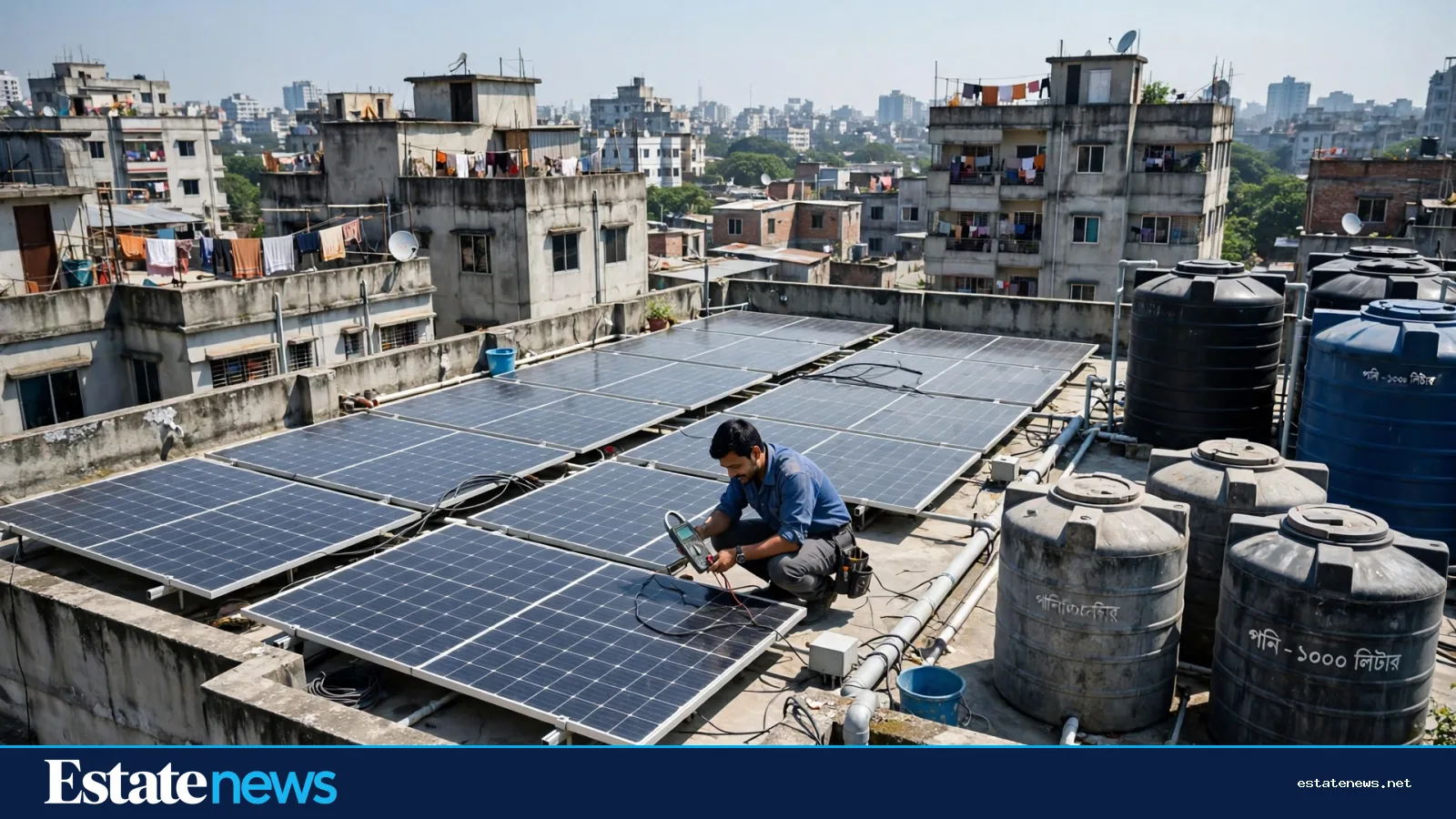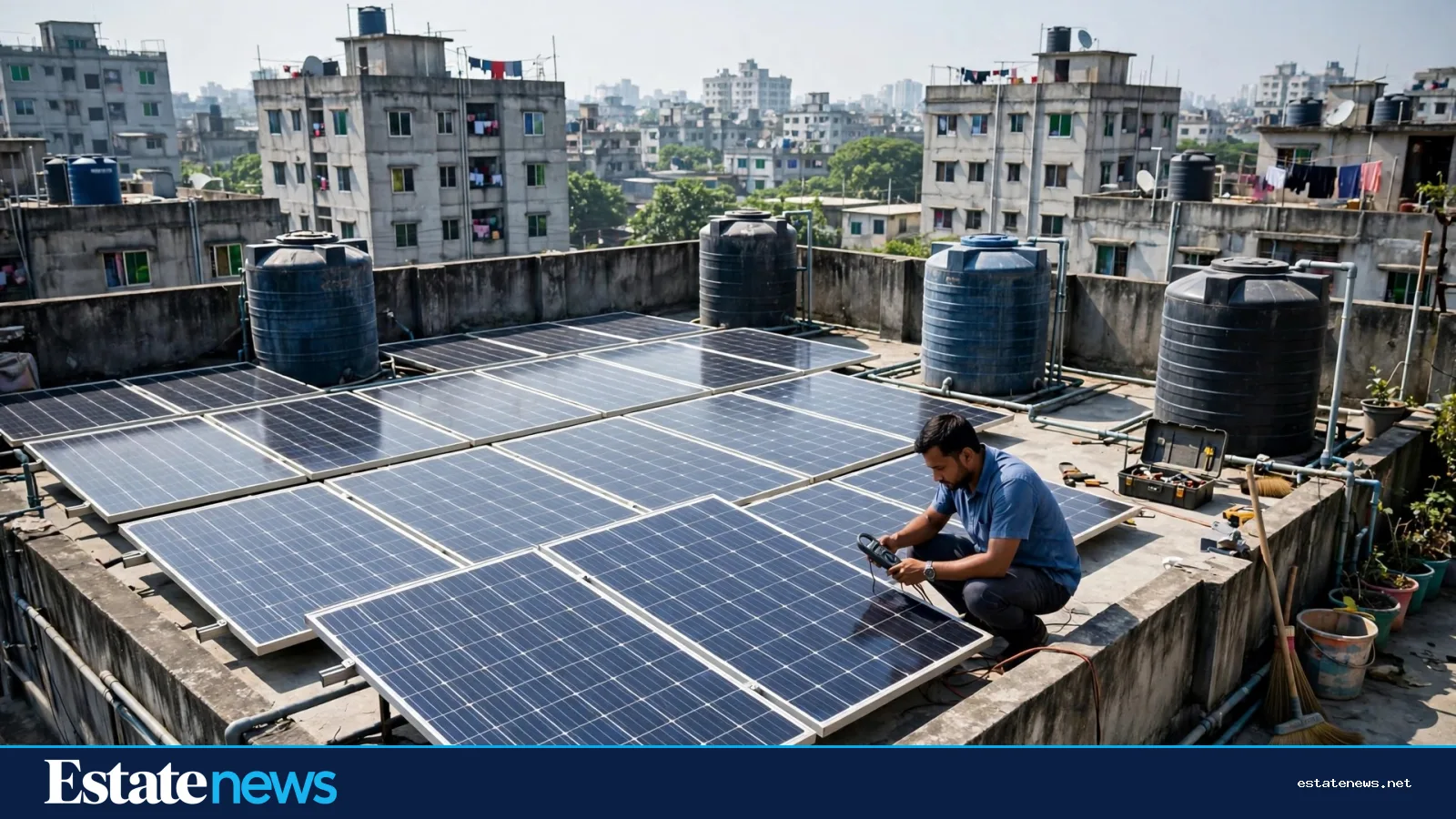
Dhaka's rooftops are the most underused asset in the city. Every apartment building has one, most of them hold little more than water tanks, a drying line and a tangle of cables. The government wants to put solar panels on them, 4,000 megawatts of rooftop solar within a year, and the law to make it happen is already in place. The Special Solar Power Installation Ordinance, 2026, alongside rooftop incentives, concessional financing and reduced import taxes on solar equipment, has set the ambition. The question now is whether the machinery underneath the ambition works.
A Daily Star analysis on 17 November, by strategic consultant Tariq Alam, puts the gap plainly. Legislation and incentives alone will not deliver 4,000 megawatts. Reaching that target needs around Tk 25,000 crore of investment, commercially viable projects, bankable agreements, financing and coordinated execution. The challenge is to turn policy into an investable national programme. The analysis sets out four priorities, and each of them lands directly on a Dhaka building owner's roof.
One framework for each kind of roof

The Ordinance sets up a framework mainly oriented towards public-sector installations, while its definitions also cover residential buildings and commercial and industrial rooftops. The analysis argues that implementation guidelines tailored to each market segment would help wider participation and investment. A government school and a garment factory and a six-storey apartment block in Mirpur do not buy solar power the same way, and the rules should not pretend they do.
Public institutions should follow prescribed competitive procurement procedures and standardised tripartite agreements. Private commercial and industrial customers should select solar developers through competitive commercial processes, keeping flexibility in procurement and contracts, subject to technical, financial and safety qualifications. Residential installations need the simplest framework of all, supported by targeted capital subsidies, affordable consumer loans, streamlined approvals and reliable installation and maintenance services. For a flat owner in Dhanmondi, that means the process has to be as easy as ordering a water tank, not as hard as getting a building permit.
The 5 megawatt limit in the Ordinance should apply to individual installations, the analysis argues, without restricting investors from developing and financing portfolios of multiple projects. Fifty rooftop installations of 2 megawatts each could be aggregated into a single 100 megawatt investment portfolio. That matters for Dhaka, where no single rooftop is large, but a hundred rooftops together are.
Agreements a bank will lend against
The Ordinance requires a tripartite agreement among the customer, the service provider and the competent authority, based on a standard contract format to be prescribed by the government. The analysis says the government should publish that format as soon as possible, giving investors and lenders the contractual clarity needed to mobilise financing and speed up implementation. For public-sector installations under the OPEX model, the published agreement should clearly establish electricity tariffs and adjustment mechanisms, payment obligations and security, contract duration, rooftop access, termination compensation and lender step-in rights. It should also clarify the competent authority's responsibilities, including whether it provides any payment guarantee or other financial security.
For private commercial and industrial installations, model bilateral power purchase agreements could complement the contractual framework, supported by standard utility interconnection and settlement arrangements. The contractual framework should address ownership, performance obligations, change in law and dispute resolution. Standard agreements should be developed in consultation with commercial banks, development finance institutions and investors, and tested for bankability before procurement begins at scale. A bank will not lend against a contract it has not seen.


The Tk 1,500 crore concessional financing initiative provides an initial foundation, but it represents only a fraction of the investment required. Mobilising capital at scale will require commercial banks, development finance institutions and institutional investors, supported by longer-tenor financing, portfolio-level credit guarantees and appropriate payment-security mechanisms. Financing should also accommodate solar project portfolios comprising multiple installations, rather than treating every rooftop as a separate lending transaction. The Tk 10.50 per unit incentive for eligible surplus electricity provides an additional revenue opportunity for rooftop solar investors. For commercial and industrial installations, the main economic benefit comes from consuming solar electricity on-site and avoiding utility purchases, often at higher tariffs. For households, affordability, financing and electricity bill savings remain the primary considerations. The February 2027 commissioning deadline should be reviewed, the analysis says, to allow sufficient time for project development, financing and construction.
Utilities have to want it too
Distribution utilities are central to rooftop solar deployment through technical approvals, grid connection, metering and electricity settlement. Yet rooftop generation can reduce their electricity sales while adding administrative and operational responsibilities, creating potential disincentives to deployment. The regulatory framework should therefore align utility incentives with national rooftop targets, including performance-linked rewards for timely approvals and commissioned capacity, alongside recovery of legitimate implementation costs. Clear approval deadlines, transparent grid-capacity criteria and published monthly commissioning targets should underpin accountability. Utilities should also help identify and aggregate suitable public rooftops into investment portfolios, reducing fragmented procurement and development costs.
Battery energy storage systems, recognised in the recent incentive framework, require clear technical standards, metering arrangements and appropriate economic incentives. Storage can improve self-consumption, manage peak demand and support grid stability, but its deployment should reflect project economics and grid requirements rather than become a uniform obligation.
One office to run the programme
The Ordinance establishes a National Policy Council and local coordination committees. The analysis proposes an operational programme management unit to support that structure by translating policy objectives into commissioned capacity. The unit should have clear authority to coordinate ministries, public institutions, distribution utilities and financing agencies, with responsibility for resolving implementation bottlenecks. A single accountable institution would help streamline approvals, facilitate investment and accelerate project implementation. The first task should be to establish a verified pipeline of investment-ready rooftops. For government premises, this requires coordinated surveys covering structural suitability, available space, electricity consumption, grid connectivity and access permissions. Building on SREDA's monitoring responsibilities under the Ordinance, a national digital platform should track projects through site verification, approvals, financing, construction, connection and commissioning.
The money behind the ambition is already moving. Estate News reported on the Asian Development Bank's backing for six solar and battery projects totalling more than 1,000 megawatts, expected to mobilise more than $1 billion in private investment, with a target of 20 percent of electricity from renewables by 2030 and 30 percent by 2040. Phase one is the 130 megawatt Sonagazi solar project in Feni, with a 26 megawatt-hour battery system, and the tender is expected this year. Separately, the Financial Express reported on 17 November that the ADB is also mulling a $200 million lending package for the rooftop-solar ambition. The government sought $2 billion to add 3,000 to 4,000 megawatts of rooftop solar before next summer, and a Tk 15 billion fund has been created, Tk 10 billion repurposed from SME allocation and Tk 5 billion from operating loans. Current renewable generation capacity is 2,188 megawatts.
For a Dhaka flat owner, the practical question is simpler than the policy. Can the roof take the panels, will the distribution company connect them without a year of paperwork, and will the bill actually fall? Estate News's 14 November guide to net metering explains how a household sells surplus power back to the grid, and the property-apps piece on what to check before trusting a listing and the smart-locks piece on what Dhaka flats actually need both make the same point from different corners of the home. The technology is ready. The roofs are there. What rooftop solar needs now is paperwork that works as fast as the sun.