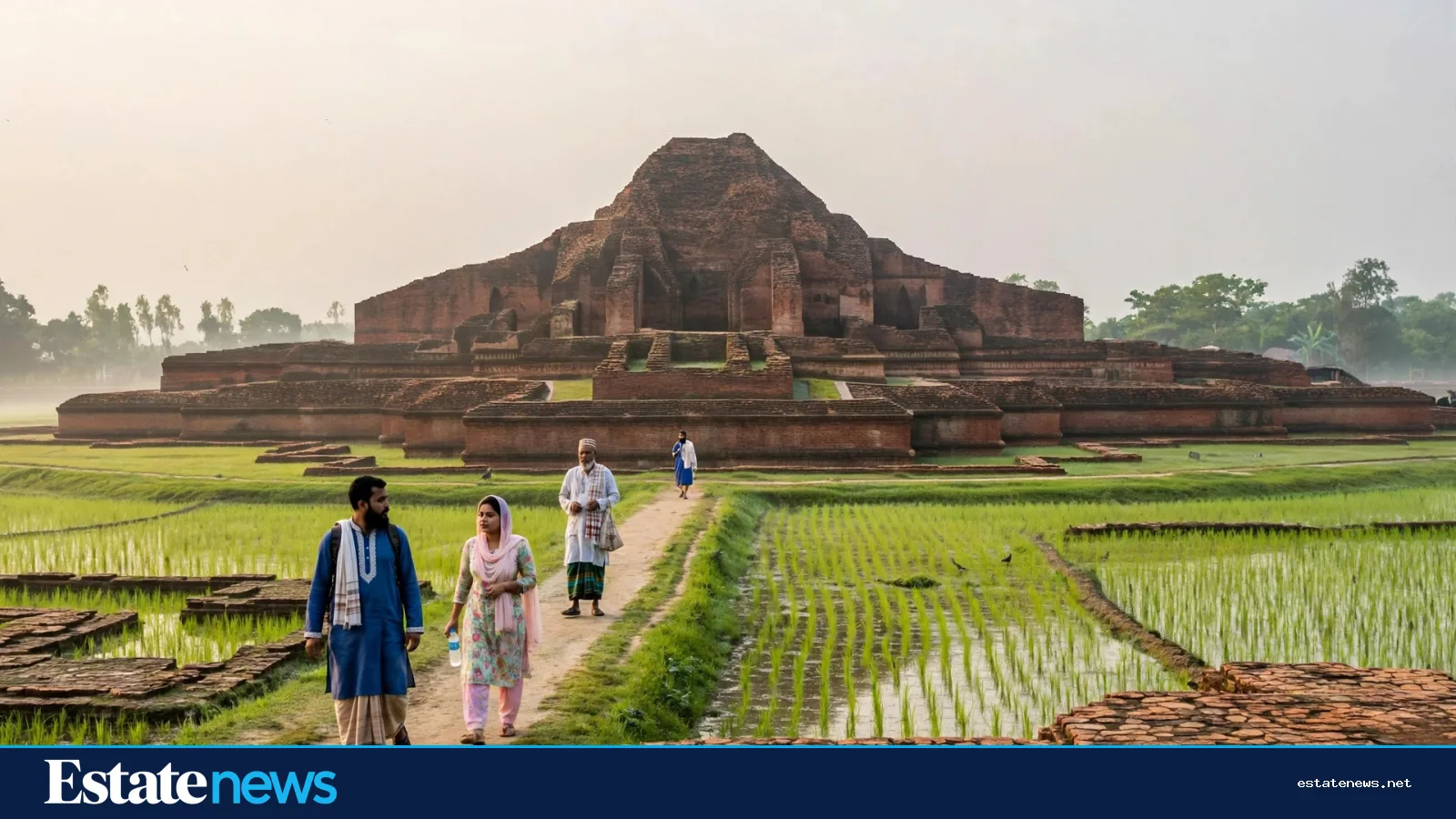
From the road through Badalgachhi, the first thing you see is a hill where no hill should be. The land around Paharpur is flat, green and open, paddy on every side, and then the ground rises into a great terraced mound of brick. It is not a hill. It is the central temple of Somapura Mahavihara, and it has stood there for about twelve centuries.
The monastery covers about 27 acres in the village of Paharpur, in Badalgachhi upazila of Naogaon district. At its centre stands a cruciform temple, its terraces stepping up toward the sky. Around it run the low walls of more than a hundred monastic cells, where monks once lived, studied and prayed. The whole site is one of the largest Buddhist monasteries south of the Himalayas, and since 1985 it has been a UNESCO World Heritage site, listed as the Ruins of the Buddhist Vihara at Paharpur.
A king's monastery

Clay seals found in the ruins carry an inscription naming Dharmapala, the second king of the Pala dynasty, who ruled from about 781 to 821. On that evidence, historians identify Somapura as his foundation. Tibetan histories add a wrinkle: they say his successor Devapala built it after his conquest of the region. The seals settle the question in Dharmapala's favour for most scholars, but the argument itself says something useful about the place. Kings wanted to be connected to it, and they wanted it known.
The Pala kings ruled Bengal and much of eastern India, and under them Buddhism in this region had its strongest centuries. Somapura was not a quiet retreat. It was a working centre of learning, the kind of place scholars compare with Nalanda and Vikramashila across the border in India. Monks came from far away to study here. The scholar Atisa, who later travelled from Bengal to Tibet to teach, resided at Somapura. That journey, from a monastery in Naogaon to the high valleys of Tibet, gives a measure of how far the reputation of this place reached.
The monastery kept that standing for centuries, remaining an intellectual centre of the Buddhist world until about the 12th century, when the political ground shifted and the monks left. The buildings fell into ruin, and the jungle and the earth took them back. Before excavation, the great temple stood covered in soil and growth, a mound in the fields. Local people called the place Paharpur, and the name is locally said to come from "pahar", the Bangla word for hill. That derivation is local tradition rather than a documented fact, but it fits what anyone arriving here would have seen.
Brick, terracotta and a plan
What survives is a plan as much as a building. The monastery is laid out as a great square, with the cells running around the inside of the outer wall and the temple rising in the middle. A visitor walks the same route the monks walked, from the gate, past the rows of small rooms, toward the centre.


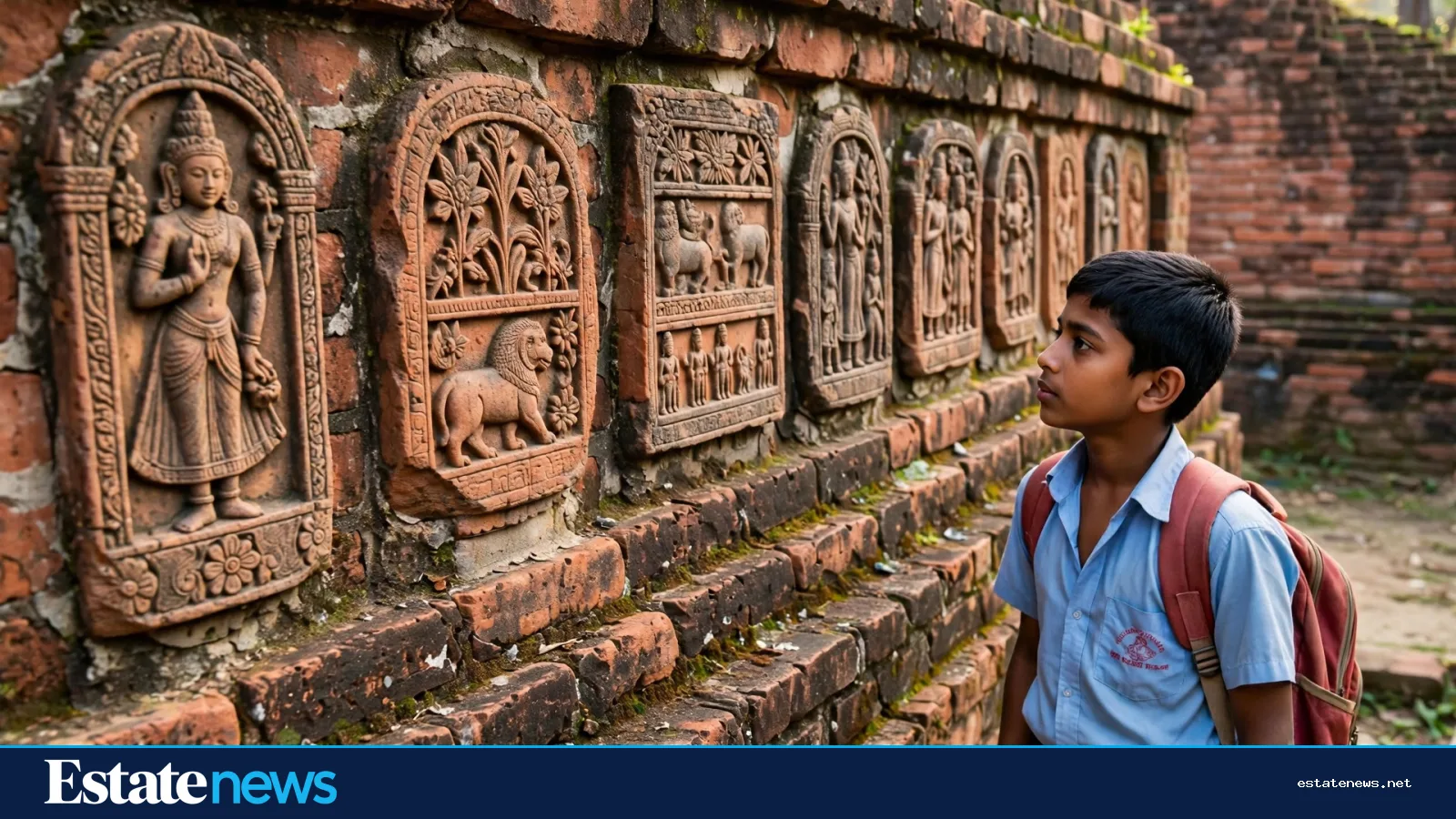
The terracotta plaques set into the temple walls carry the other half of the story. They show figures, animals, scenes from daily life and from old tales, pressed into clay and fired hard. Many have weathered badly, and some are gone altogether, but enough remain to show the skill of the craftsmen who made them. They are the most human part of the ruin. The temple speaks of kings and doctrine. The plaques speak of hands, and of a workshop, and of people who knew their trade.
What stands there today
Paharpur today is a working archaeological site, cared for by the Department of Archaeology, and it is also a place people come to on ordinary days. School groups arrive by bus from Rajshahi and Bogura. Families walk the paths between the cells. Buddhist monks from Bangladesh and abroad come to pay respects. The site has a quiet that surprises visitors who know Dhaka. The wind moves over the paddy, the brick holds the heat of the afternoon, and the temple stands where it has always stood.
Naogaon gains from the site in a way that goes beyond pride. Visitors need food, transport and a place to stay, and the road from Rajshahi or Bogura makes Paharpur a straightforward day trip. The district is known for its paddy and its mangoes. The monastery gives it a second reason for people to come, and a reason for young people from the area to learn the history of their own district.
Why it still matters
Somapura matters because it is evidence, in brick, that Bengal was once a centre of learning whose reach crossed mountains. That is not a small thing for a country that is still writing its own story about its past. The monastery also matters because it is one of the few places in Bangladesh where the history before the sultans and the Mughals is visible, walkable and open to anyone. Most of that history survives only in books. At Paharpur, you can stand in a monk's cell and look up at the temple he looked at.
The temple will not be rebuilt, and it should not be. Its power is in its ruin, in the way the terraces rise out of the fields and stop short of the sky. What can be done is slower and less dramatic: keep the water out, keep the plaques from crumbling, keep the paths open, and keep telling the story straight.