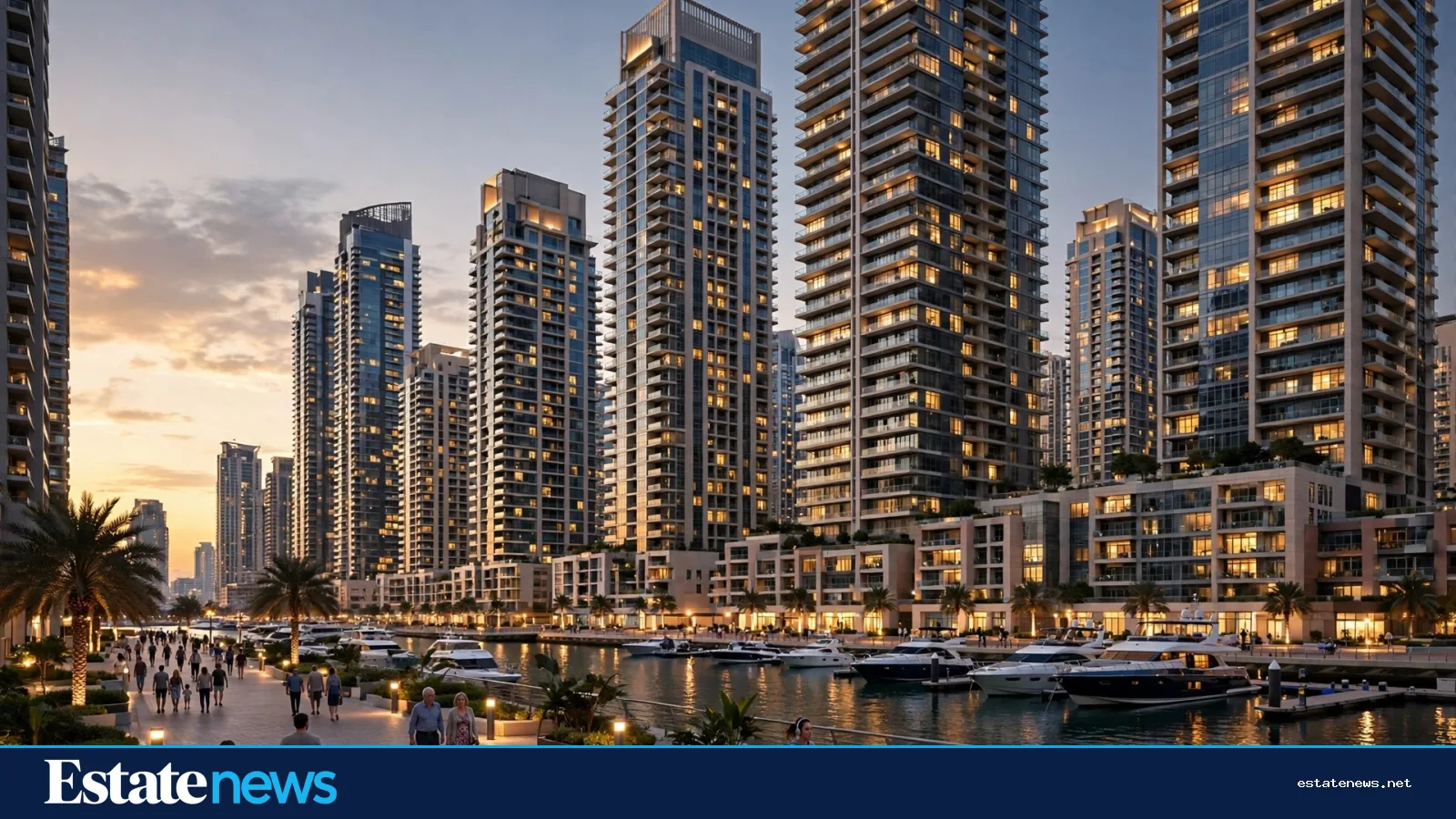
Dubai sold fewer homes in October than it has in a long while, and rented more of them than ever. The two numbers sit side by side in the latest data from the Dubai Land Department, and together they describe a market that is changing shape rather than falling apart. Sales are cooling. Rentals are setting records. For a Bangladeshi buyer looking at Dubai from Dhaka, the split matters more than either number on its own.
Dubai recorded 9,999 home sales worth AED 21.27 billion in October 2026, according to Projectory's analysis of Dubai Land Department data. That is down 1.0 percent in number and 0.2 percent in value on September, and 45.5 percent fewer sales than October 2025. The median price per square foot edged up 0.8 percent to AED 1,650, while the median home price slipped 2.2 percent to AED 1.25 million. The week of 2 to 8 November told the same story in miniature: 2,061 sales worth AED 3.93 billion, down 10.7 percent in number. The market has not stopped. It has slowed, and the slowdown is now visible in the year-on-year comparison.
Ready homes are selling, off-plan is waiting

Inside the headline number, one part of the market is moving in the opposite direction. Ready apartments had their best month since February, with 2,988 sales worth AED 5.28 billion, up 25.7 percent in value. Jumeirah Village Circle led by number of sales, and Business Bay led by value. Buyers, it seems, want a home they can move into, not a promise of one in three years. That is a shift in mood. When the market was running hot, off-plan sales carried the growth. Now the money is going to finished homes, where the buyer can see the flat, check the building and collect the keys.
The rental market tells the other half of the story. In the third quarter, 21.4 percent of rental transactions came in at a lower rent, up from 4.8 percent in the first quarter, as about 38,000 new homes arrived in nine months. Average rent stood at AED 77.3 per square foot a year in September, still 5.5 percent higher than a year earlier, but down from 11.5 percent growth in September 2025. Rents are still rising, but the pace of the rise has halved in a year. The new supply is doing its work.
Rental contracts are heading for a record. There were 339,557 freehold rental contracts from January to October, up 6.8 percent on the year, with 44,841 in October alone, 21,987 new leases and 22,854 renewals. Another 38,420 contracts in November and December would beat 2025's record of 377,976. People are still arriving in Dubai, and they still need somewhere to live. They are renting first, and buying later, or not at all.
The big developer is still making money


Emaar Properties, Dubai's largest developer, reported profit before tax of AED 19.8 billion for the first nine months of 2026, up about 18 percent, according to its announcement on 5 November. That is the other side of the cooling sales number. The biggest developer in the market is still earning more, not less, because its pipeline of earlier sales is still being delivered and its rental and hospitality businesses keep growing. A cooling sales market does not mean a struggling developer, at least not the largest one.
The UAE Central Bank kept its base rate at 3.9 percent on 28 October, after the US Federal Reserve paused. That matters for buyers who borrow. A rate cut would have made mortgages cheaper and pulled buyers back into the market. A hold keeps the cost of borrowing where it is, and the market cools a little further. Cavendish Maxwell, cited by Khaleej Times on 2 November, and Property Finder, cited by Arabian Business on 9 November, both read the same data the same way: a market adjusting, not a market in trouble.
What it means from Dhaka
For a Bangladeshi buyer, the Dubai numbers carry two lessons. The first is about price. A market where sales have fallen 45.5 percent in a year but the median price per square foot has still risen 0.8 percent is a market where sellers are holding their prices and buyers are waiting. That is not a bargain hunter's market. It is a negotiator's market, where the buyer who is ready to move can ask for a better deal on a ready home, and where the seller of an off-plan unit may be more flexible than the headline price suggests.
The second lesson is about rent. A city where rental contracts are heading for a record, and where one in five new rental deals is at a lower rent than before, is a city where a bought flat can still find a tenant, but where the rent that tenant pays is no longer climbing as fast as it was. Anyone buying in Dubai to let the flat out should run the numbers on today's rents, not on the rents of 2024. Estate News's piece on Dubai's super-prime sales, published on 17 November, showed the top end of the market still setting records even as deals fell by a third. The 16 November piece on Dubai rents, drawing on CBRE, showed the same split from the other side: rents falling 7 percent in some parts of the market while offices boomed. The October data fits that picture. The top end holds. The middle adjusts. The rental market absorbs the people who keep arriving.
This is a different angle from the super-prime story and from the CBRE piece. Those looked at the extremes. This is the middle of the market, the 9,999 sales in a month, the flats in Jumeirah Village Circle and Business Bay, the families signing rental contracts. Estate News's Bangla guide to buying a flat in Dubai, published on 2 November, walks through the sums a Bangladeshi buyer has to get right before signing. The October numbers add a new line to that guide: buy the flat you can see, check the rent it can actually earn today, and do not count on the price rising while you wait. This article is informational only and is not financial advice.