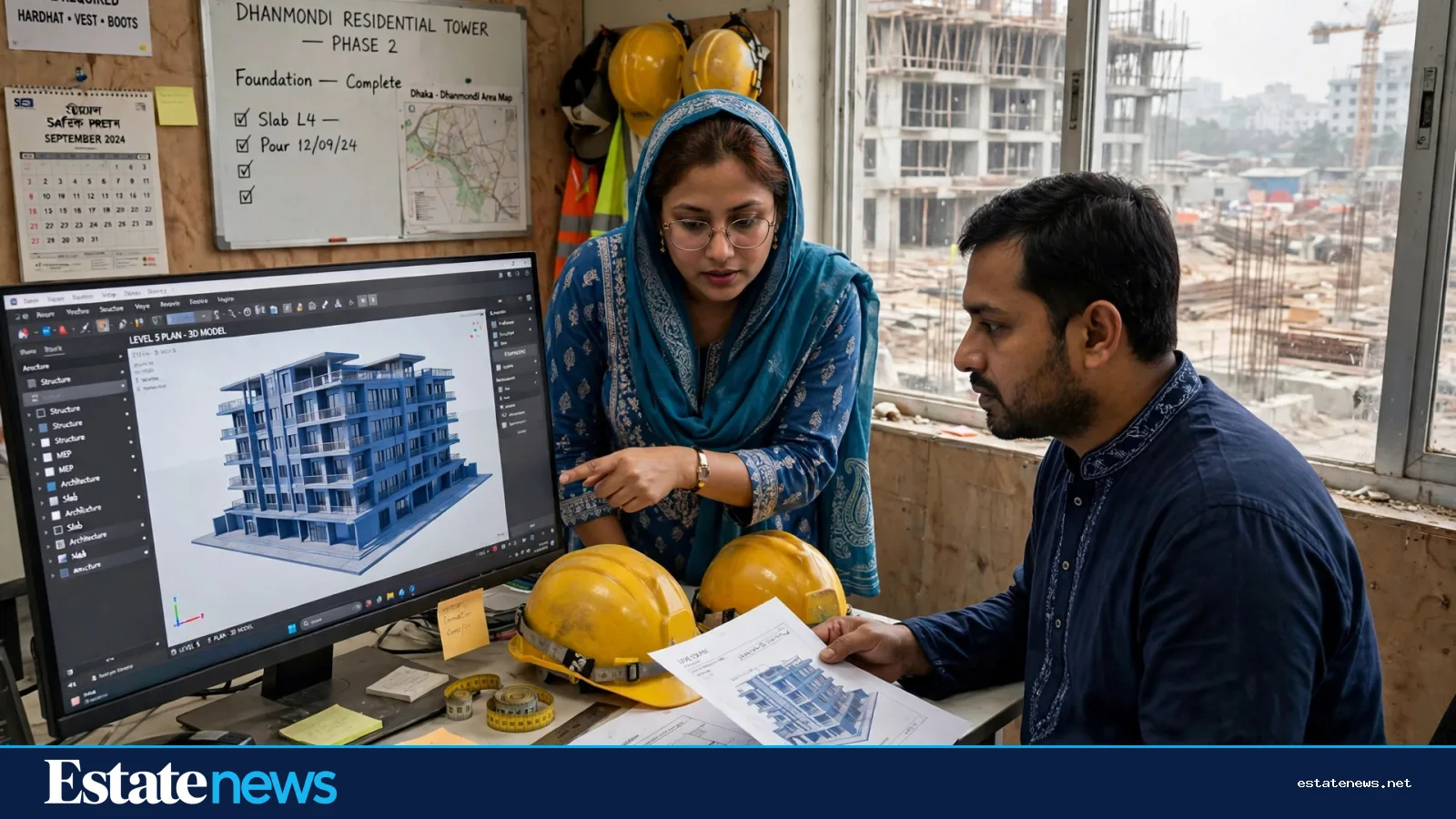
On a Dhaka construction site, the most expensive mistakes are the ones found late. A beam runs where a pipe needs to go. A lift shaft is a few inches short. A staircase lands where a door was drawn. By the time anyone notices, concrete has been poured, and fixing it means breaking it. Building Information Modelling, known as BIM, exists to catch these clashes while they are still lines on a screen.
BIM is a shared 3D digital model of a building. It is not a single drawing. It is one model that the architect, the structural engineer, the electrical and plumbing teams and the builder all work from. When the architect moves a wall, the model shows what happens to the pipes inside it. When the structural engineer thickens a beam, the model shows whether the ductwork still fits. Everyone sees the same building, in three dimensions, before a single brick is laid.
Clash detection is the part buyers should care about

The most useful thing BIM does on a real site is clash detection. The software checks the model for places where two parts of the building occupy the same space. A water pipe crossing a beam. An air-conditioning duct running through a column. A cable tray blocking a staircase headroom. In the old way of working, these clashes were found on site, often by a foreman standing under a half-built slab with a drawing in one hand and a measuring tape in the other. With BIM, they are found in the office, where moving a pipe costs nothing.
For a buyer, the value is indirect but real. A building designed with clash detection has fewer mid-construction changes. Fewer changes mean fewer delays, and fewer delays mean a handover closer to the date in the agreement. It also means fewer of the small defects that show up after handover, the pipe that had to be rerouted around a beam and now leaks at the joint, the duct that was squeezed into a ceiling and now rattles.
Quantities, costs and a paper trail
A BIM model also counts. It knows how much concrete, steel, brick and tile the building needs, because the model is built from those materials. That makes quantity estimation faster and harder to fudge. A builder who knows the quantities can price the work more accurately, and a buyer who asks for the cost breakdown gets numbers that come from the model rather than from a rough guess.
The model also leaves a record. When the building is finished, the model shows where every pipe, cable and duct runs inside the walls. Years later, when a plumber needs to find a concealed pipe, that record matters. In Dhaka, where most buildings have no reliable as-built drawing, a BIM record is a genuine improvement. It is not a guarantee of good construction. A model is only as honest as the people who build it. But a building with a proper model is easier to maintain, easier to repair, and easier to sell to a buyer who asks the right questions.


What it costs, and who uses it in Dhaka
BIM software is expensive, and so is the training. A small developer building one project a year may not recover the cost. A larger firm running several projects can spread it across them. The cost has fallen as cloud-based tools have spread, and some firms now hire BIM work out to specialist teams rather than keeping it in-house. That is the Dhaka-budget version: buy the modelling for the projects that need it, rather than buying the whole system at once.
How widely BIM is used in Bangladesh is hard to say. No published survey gives a reliable figure for adoption among Dhaka developers, so this article makes no claim about it. What is visible is that the larger firms, and the firms working with foreign consultants, use it on their bigger projects, and that engineering graduates in Dhaka are learning it as part of their training. The direction is clear even if the numbers are not.
What a buyer can actually ask
A buyer cannot inspect a BIM model the way they can inspect a flat. But they can ask three questions. First, was this building designed with a 3D model, and can the developer show the coordination drawings? Second, who checked the model for clashes before construction started? Third, will the buyer receive as-built drawings, or a copy of the model record, at handover? A developer who answers plainly is showing how the building was thought through. A developer who cannot answer is telling the buyer something too.
BIM will not fix a dishonest builder or a bad site. It is a tool, and tools do what their users make them do. But on a well-run site, it removes a whole class of mistakes before they become concrete. In a city where so many housing disputes begin with something discovered too late, that is worth more than any single feature in the brochure.
Read more: Smart homes in Dhaka — https://estatenews.net/proptech/smart-homes-in-dhaka-what-is-actually-worth-paying-for-and-what-is-just-gadgetry | নির্মাণে ড্রোন আর ডিজিটাল নকশা — https://estatenews.net/proptech/nirmane-dron-ar-dijital-nksha-biaiem-oo-ntun-przukti-bangladese-kee-bdlate-pare | Digital land records and e-services — https://estatenews.net/proptech/digital-land-records-and-e-services-what-buyers-can-now-check-online-and-what-still-needs-a-visit-in-person