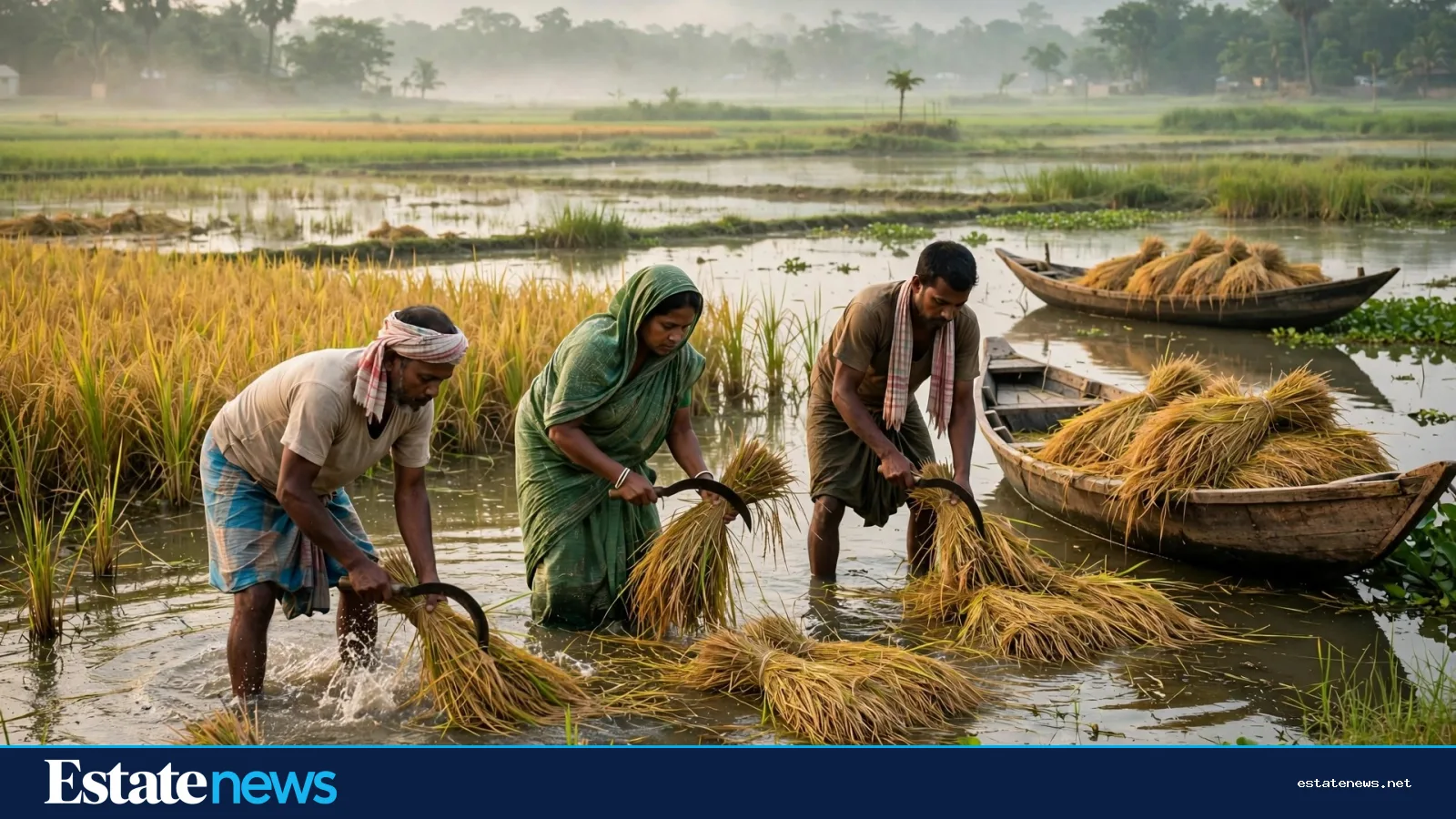
In the haor, the year turns on a single race. The Boro rice must be cut before the water comes. Every April, flash floods from the upstream hills can roll across the wetlands of the northeast and drown a crop that is half ripe or nearly ripe. A farmer can do everything right for five months and still lose the harvest in a week. This season, the race has a new runner.
The runner is BRRI dhan-118, a rice variety developed by the Bangladesh Rice Research Institute for the haor itself. It matures in 145 to 150 days, and it can be sown and harvested seven to 10 days earlier than the conventional varieties farmers have used for years. Sown in the first week of November, it can be cut by early April, ahead of the floods that usually arrive that month. The variety was released for cultivation in the haor region in February this year, at the 115th meeting of the National Seed Board.
Seven to 10 days does not sound like much. In the haor, it is the difference between a harvest and a loss. The crop that stands in the field in April is the crop the flood takes first, and a week of head start moves the cutting ahead of the water. The variety was bred for exactly this problem: it tolerates cold during its reproductive stage, so it can be sown early, when winter still bites, and still set grain.

Cold mornings, then the cut
The cold is the other half of the problem. Sowing early in the haor means the young crop faces winter temperatures that can sterilise the grain as it forms. BRRI dhan-118 was developed to handle that. According to BRRI, it can produce yields even when the average temperature during the reproductive stage stays below 20 degrees Celsius, and it can tolerate such temperatures for seven to 10 consecutive days. Sown early, between 25 October and 1 November, trials showed it producing around six tonnes per hectare even in those conditions.
The average yield is 6.77 tonnes per hectare, according to BRRI, and under favourable conditions with proper management it can reach up to 8.5 tonnes. That is around 1.1 tonnes more per hectare than BRRI dhan-28, one of the most widely grown Boro varieties in the country. The comparison matters because dhan-28 is the variety many haor farmers know best. The new seed does not ask them to learn a new crop. It asks them to sow a familiar one a little earlier, and to cut it a little sooner.
The government has moved to put the seed in farmers' hands. Seedbeds have been prepared in 1,600 demonstration plots across seven haor districts during the current Boro season: Kishoreganj, Netrokona, Sylhet, Moulvibazar, Sunamganj, Habiganj and Brahmanbaria. BRRI plans around 5,000 demonstration plots across 50 upazilas in the haor region for the coming Boro season, under an 18-month expansion programme running from May 2026 to October 2027, with a budget of Tk 42.86 million. The variety is new, and the institute is candid that it has not yet reached farmers on a large scale. It is too early to judge how farmers will take to it.


What a safe harvest is worth
The haor region grows about 16 percent of Bangladesh's Boro rice, according to BRRI. When the flood takes a haor harvest, the loss lands twice: once on the families who grew it, and once on the country's rice supply. A safer harvest in the haor is a steadier supply of rice in the months after April, and steadier prices in the kitchen markets where most families buy it.
Those prices are already on every household's mind. A kitchen-market survey on 13 and 14 November found coarse rice selling at Tk 50 to 58 a kilogram and fine rice at Tk 70 to 85 a kilogram. Those were survey figures for those two days, not today's prices, but they show the range a family is working with. A Boro crop that comes in on time does not set those prices by itself. It keeps the supply behind them from thinning out at the worst moment.
There is a wider lesson in the haor this season, and it is not only about rice. The north of the country has already seen what short-duration varieties can do. In Rangpur division, early-maturing Aman rice has let farmers grow an extra crop a year, and the old seasonal hunger known as monga has faded from the districts where the varieties took hold. The haor is a harder place to farm than the north, with water instead of dry land as the enemy. The same idea is being tested there now: breed for the calendar, not against it.
Estate News has followed the household side of the same story. "এলপিজির দাম বাড়ল, সবজি কমল: সংসারের হিসাব নভেম্বরে" tracked what November did to the family budget, gas and vegetables included. "Inflation at 8.27%: Food Eases, Housing Costs Climb and the Flat Budget Feels It" set out the October inflation figures and what they meant for a flat budget. And "Exports at $17 Billion in Four Months: The Trade Numbers Behind Factory-Town Housing" looked at the trade numbers that sit behind the country's factory towns. The haor harvest connects to all three: the rice a family eats, the prices it pays, and the money the country earns.
For the farmers standing in the shallow water with sickles in hand, the new variety is not a promise. It is a week. A week earlier to sow, a week earlier to cut, and a harvest that is in the boat before the water rises. If the demonstration plots do what the trials did, that week will be worth more than any subsidy. It will be the difference between a crop and a memory of one.