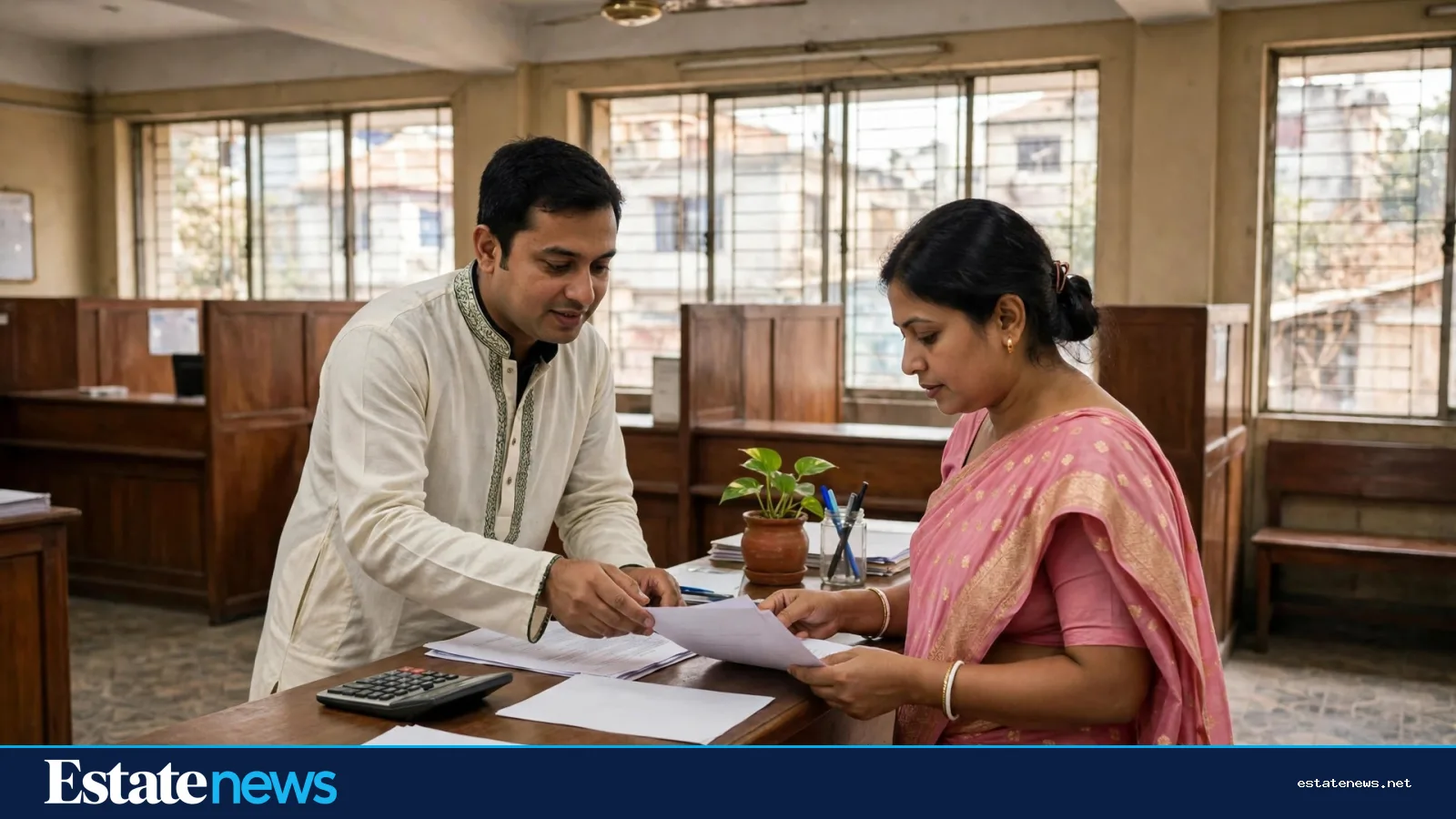

A couple sits at a bank desk in Dhaka with a file of papers between them. The officer is pointing at a row of figures. The husband is doing the maths in his head. The wife is looking at the monthly figure, not the total. They have found a flat. Now they have to find a loan, and the loan has a question in it that nobody explained when they started looking: fixed or reducing?
The question matters more than the rate. Two loans can carry the same headline rate and cost very different amounts over twenty years. The difference is in how the interest is calculated, and most buyers only discover it when the first year's statement arrives.
Home-loan rates reported this week ranged from 9.72 percent to 15 percent, according to Estate News coverage of the market, with the policy rate at 9.50 percent. That range is wide enough to change a monthly payment by tens of thousands of taka. The calculation method can change it again. Ask about both, before signing anything.

What reducing balance means
Most home loans in Bangladesh are calculated on a reducing balance. The bank charges interest on what you still owe, not on what you borrowed on the first day. Every month you pay an EMI, a fixed monthly instalment. Part of it pays the interest for that month. The rest pays down the principal. Next month, the balance is smaller, so the interest is smaller, and a little more of your EMI goes to the principal. Slowly, the balance falls faster.
Take a Tk 1 crore loan over 20 years. At 11 percent on a reducing balance, the EMI works out to Tk 1,03,219 a month. Over 240 months that adds up to about Tk 2.48 crore in total, which means about Tk 1.48 crore of interest on top of the Tk 1 crore borrowed. At 14 percent, the same loan costs Tk 1,24,352 a month, about Tk 2.98 crore in total, and about Tk 1.98 crore of interest. Three percentage points of rate adds roughly Tk 21,000 to the monthly payment and about Tk 50 lakh to the total. That is the arithmetic that decides whether a flat is affordable.
A smaller loan shows the same pattern. A Tk 50 lakh loan at 15 percent over 20 years costs Tk 65,839 a month. The total comes to about Tk 1.58 crore, so the interest alone is about Tk 1.08 crore, more than double the amount borrowed. The monthly figure looks manageable. The total is the number to stare at.
What fixed really means


A fixed-rate loan is a different promise. The rate stays the same for an agreed period, so the EMI does not move when the market moves. That certainty has a price: the rate is usually set higher than the starting rate of a floating loan, and the borrower pays for the calm.
There is also a second meaning of fixed that buyers must watch for. Some lenders quote a flat rate, where interest is calculated on the original loan amount for the whole tenure, instead of on the shrinking balance. On a flat-rate loan, the interest never falls as you repay. The EMI looks lower at first, because the calculation is simpler, but the total cost is far higher than the same rate on a reducing balance. The two methods share a word, fixed, and they are not the same thing. Ask the officer, in plain words, whether the interest is charged on the reducing balance. Get the answer in writing.
Estate News worked through the same Tk 1 crore loan in "What a Tk 1 Crore Home Loan Really Costs Over 20 Years", and the rates across banks in "Home Loan Rates in Bangladesh: The Same Loan Costs Very Different Amounts". The lesson of both pieces is the same: the rate on the poster is the start of the conversation, not the end of it.
The questions to ask at the desk
Four questions cover most of the ground. Is the rate fixed or floating, and for how long? Is the interest calculated on a reducing balance? What fees sit on top of the EMI, for processing, for early repayment, for late payment? And what happens to the EMI if the rate changes, does the monthly payment rise, or does the tenure stretch?
The last question is the one buyers forget. On a floating loan, a rate rise can be handled two ways. The bank can raise the EMI and keep the tenure the same, or it can keep the EMI the same and add years to the loan. The second option feels kinder in the month it happens. It costs more over the life of the loan, because the borrower pays interest for longer. Know which one your bank does before the rate moves, not after.
Then there is the down payment, which is the part of the price the loan does not cover. "The Down Payment Plan: How Long to Save for a Dhaka Flat" sets out how long it takes to save it. A bigger down payment means a smaller loan, a smaller EMI, and less interest in total. It is the cheapest way to cut the cost of a loan, and the hardest, because it has to be saved before the flat is bought.
No loan is free, and no rate is a promise about the future. A 20-year loan will outlive several governments, several rate cycles, and at least one change in the borrower's own income. The EMI that fits today has to fit in a bad year too. Leave room in the monthly budget for the month when the rate rises or the overtime stops. This article is not financial advice, and a bank officer's calculation for your loan, on your income, is worth more than any worked example. But the worked examples tell you what to ask, and the questions are the same for every buyer: what is the rate, how is it calculated, what are the fees, and what does the loan cost in total, not just this month.