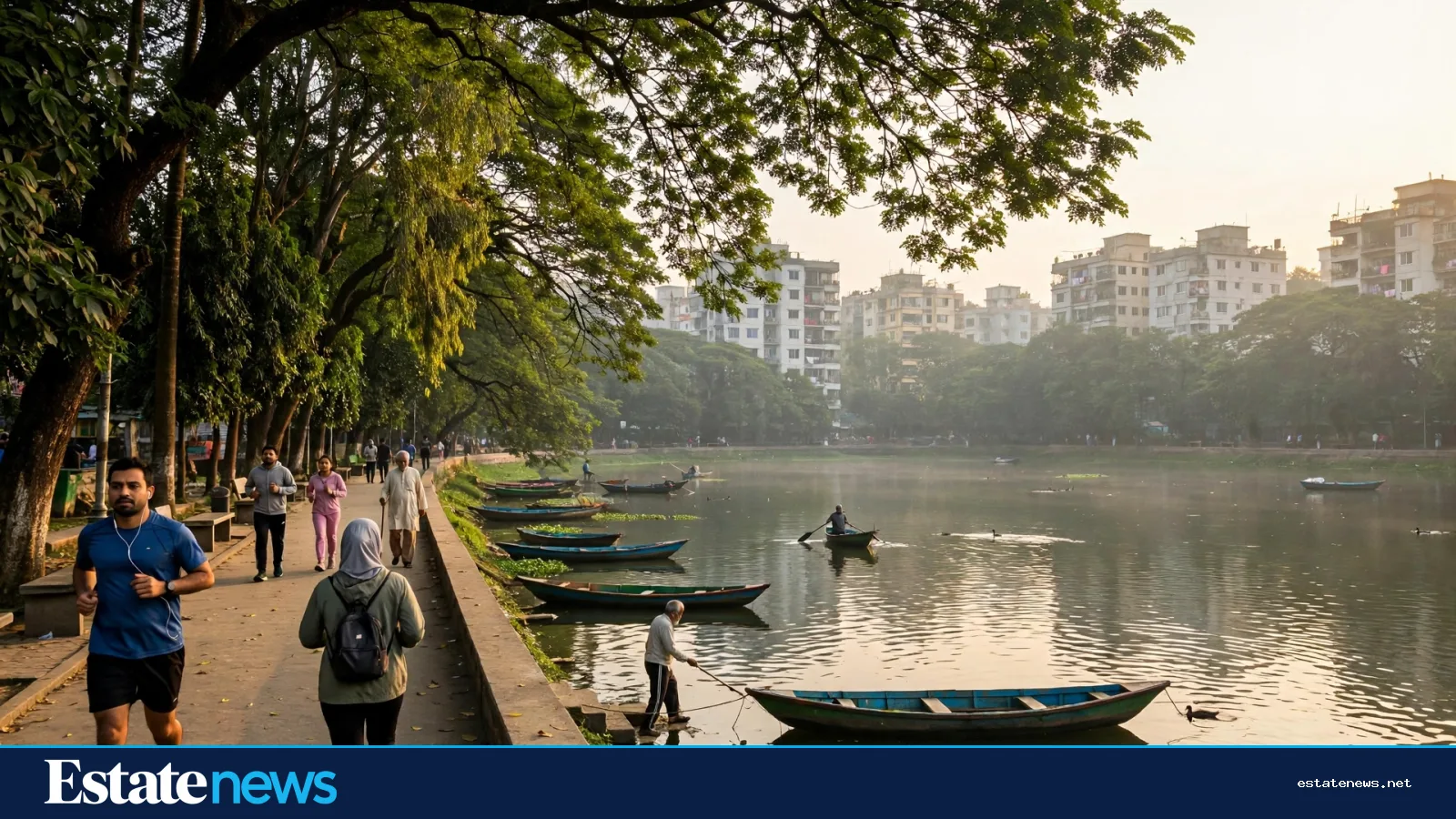
Before the sun is properly up, Dhanmondi Lake already has a crowd. Walkers move in both directions along the path, some brisk, some slow, some in pairs deep in conversation. A few joggers pass. Vendors set out tea. On the water, the light changes by the minute, and the apartment blocks behind the trees turn from grey to gold. It is the same scene, more or less, every morning, and that sameness is part of the point. In a city that rebuilds itself constantly, the lake gives one neighbourhood a fixed centre.
Dhanmondi was not an accident. It was laid out in the 1950s as a planned residential area, and the lake was part of the plan from the start, taking up about 16 per cent of the area's land. The water itself is older than the plan. According to Banglapedia, it was once an abandoned channel of the Karwan Bazar river, a waterway that old Dhaka maps from 1859 and 1924 already show near this spot. The planners kept it, shaped it, and built streets around it. Three kilometres long, between 35 and 100 metres wide, stretching from Road 2 near Jigatola to Road 27, the lake now runs like a spine through the neighbourhood, with Sat Masjid Road on one side and Kalabagan on the other.
That geography still decides how Dhanmondi works. A family choosing a home here is rarely choosing a flat alone. They are choosing a distance: how far to the lake path, how far to the school gate, how far to the main road when the morning traffic thickens. Ask residents what they value and the answers circle the same things, in different words. Space to walk. Trees. A place where children can be taken out without a car. A neighbourhood that feels known.

A lake with a working day
The lake's day has its own shifts. Morning belongs to walkers and exercisers. Midday is quieter, with students and shoppers crossing the bridges and office workers cutting through on their way to Sat Masjid Road. Late afternoon brings families, and evening brings the largest crowd of all: young people, couples, groups of friends, and the food stalls that serve them. Rabindra Sarobar, the open-air amphitheatre near the Road 8 bridge, adds another layer, hosting concerts, plays and cultural programmes through the year.
None of this happened by itself. The lake was redeveloped in 1996 and opened to the public in its current landscaped form in 2000, and a further round of improvement work followed between 2011 and 2013, with cleaning, re-excavation, new bridges, drains, lighting, tree planting and walkways. A Dhaka South City Corporation project begun in May 2021 added a new walkway and renovated restaurants and food courts. Each round of work has tried to solve the same problem: how to keep a public water body usable in a dense, fast-growing city.
Streets that serve the lake, and the lake that serves the streets
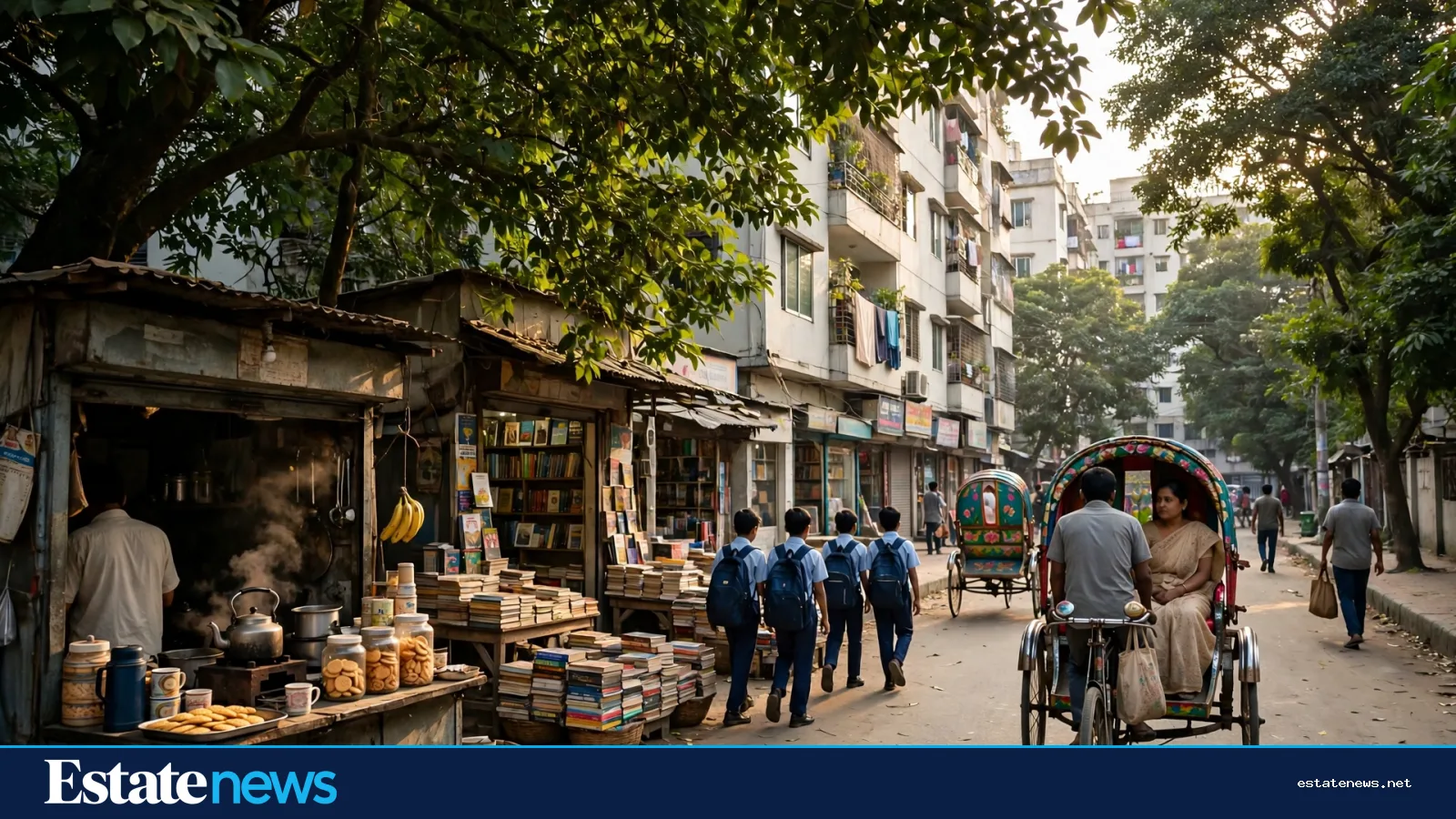
Step off the lakeside path and Dhanmondi changes character street by street. Sat Masjid Road carries the commercial weight: banks, restaurants, clinics, coaching centres, shops of every kind. The inner roads are quieter, lined with apartment buildings old and new, small mosques, schools and the everyday businesses a family actually uses: the pharmacy, the grocery, the tailor, the tea stall where the same faces gather.
That mix is why the area suits families with school-age children and older parents alike. Schools and coaching centres cluster here, hospitals and clinics are within reach, and the grid of numbered roads makes the area legible even to a newcomer. A visitor can be told "Road 27, near the lake" and find their way. In much of Dhaka, directions are far harder than that.


Housing around the lake reflects the area's age. Older low-rise houses and early apartment blocks stand beside newer towers, and the lake-facing side of a building has long carried a premium in local conversation, though no single published figure captures it reliably. What can be said with confidence is that demand here is driven by use, not speculation alone: families buy to live near the lake, near schools, near work, and near the relatives who already live a few roads away. That kind of demand is steadier than demand built on resale hopes.
The pressures nobody can ignore
A feature about Dhanmondi that only praised the lake would be dishonest, because the lake's problems are visible to anyone who walks it. Pollution has been a recurring concern, with The Daily Star reporting in 2019 on the need for serious attention to save the lake from pollution. Walkways crack and subside where lake water overflows in the monsoon. Management is split across several authorities: the Ministry of Housing and Public Works holds formal ownership, Dhaka South City Corporation handles development and maintenance, the Department of Environment covers environmental protection, and the Fisheries Department looks after fishery development. Shared responsibility can mean shared neglect, and residents' groups have repeatedly pressed for clearer care and funding.
Traffic is the other pressure. The roads around the lake, especially Sat Masjid Road and Mirpur Road, carry far more vehicles than the 1950s plan imagined. Parking, congestion at school hours, and the squeeze on footpaths are daily facts of life. Families who love the lake still weigh those facts when they choose a flat, and many choose an inner road over a main-road frontage precisely to escape them.
Why the lake still wins
And yet, people stay. They stay because the lake gives Dhanmondi something most Dhaka neighbourhoods cannot offer: a daily encounter with open space that does not require a ticket, a membership or a car. A grandmother can walk in the morning. A child can learn to ride a bicycle on a path where cars do not go. A young couple can sit by the water in the evening and feel, for an hour, that the city has room for them.
That is also why the lake matters beyond Dhanmondi. Dhaka has few large public water bodies left, and fewer still that are woven into daily life the way this one is. Every debate about the lake's cleaning, its walkways and its management is, at heart, a debate about what kind of city Dhaka wants to be: one that fills its water and builds over it, or one that keeps some water open and builds a life around it.
Dhanmondi made its choice in the 1950s, when it set aside a sixth of its land for a lake. The neighbourhood has spent seventy years living with that choice, repairing it, arguing about it, and walking beside it every morning. The water is still there. So are the walkers. In Dhaka, that counts as a kind of success.