Method first, because the number without it misleads
Construction cost figures travel fast in Dhaka. A single per-square-foot number gets quoted in a sales office, repeated in a family discussion, and treated as a fact about a building that has not been built yet. The trouble is that the number hides at least three different things: the price of materials on a particular date, the cost of labour for a particular kind of building, and the margin between a published range and what any single buyer actually pays. This tracker starts with method for that reason. It states what each figure is, where it came from, and what it cannot tell a reader.
Two rules govern every figure in this piece. Published ranges are labelled as published ranges, with source and date, and a midpoint is labelled as a midpoint, not as a market price. Asking figures and completed transaction figures are kept separate throughout: a dealer's quote, a listing's asking price and a price actually paid on completion are three different observations.

Materials: the latest published ranges, carried forward honestly
No new published November price series for rod or cement was available at the time of writing, so this tracker does not present a November table as if one existed. Instead, it carries forward the latest published ranges in Estate News' tracker file, dated 31 October 2026, and labels them as such. Readers planning a build should treat these as planning ranges to check against current dealer quotes, not as quotes for today.
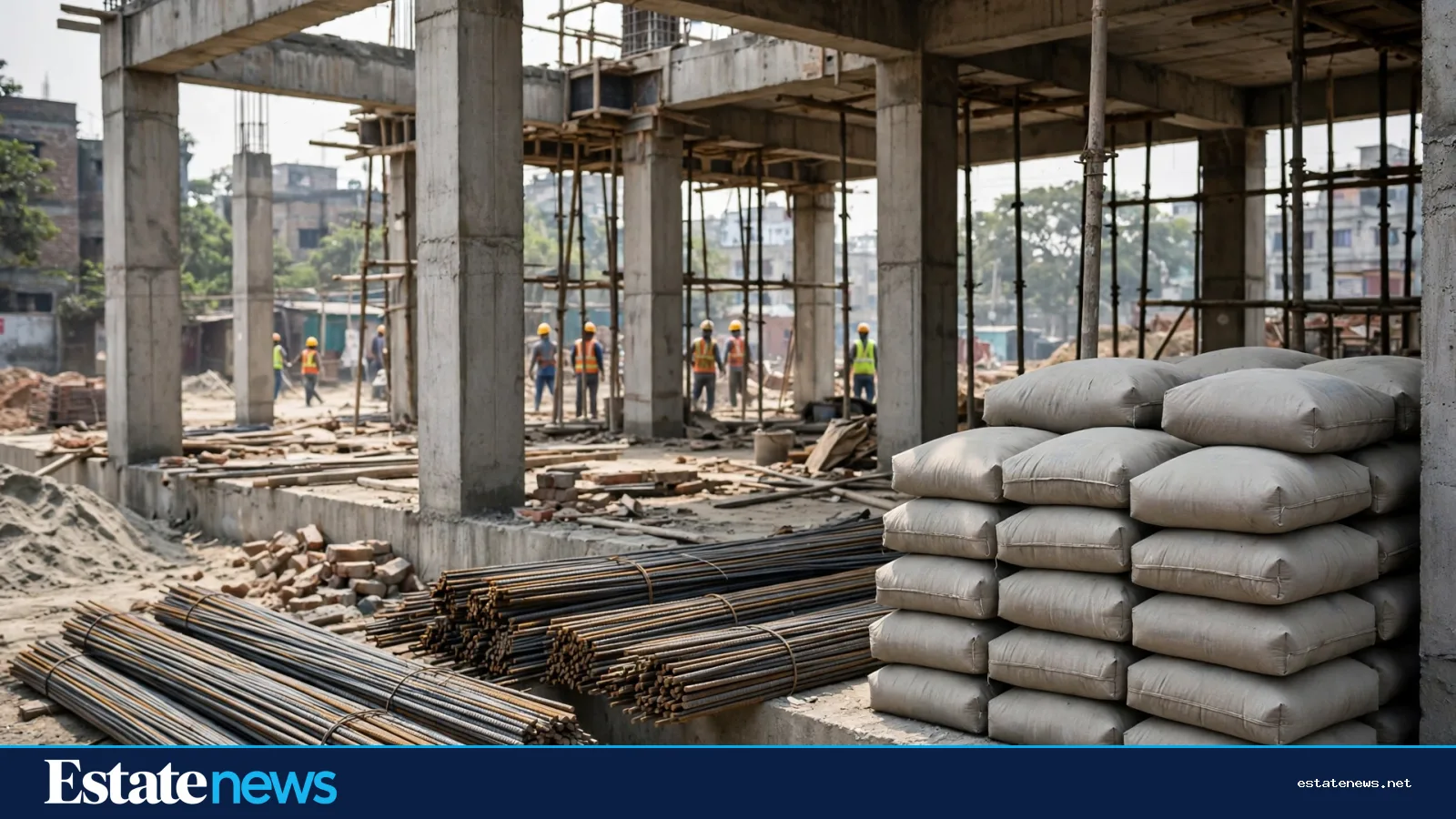
For rod, the tracker records higher-quality steel rod at a published range of Tk 92,500–94,500 per tonne, with a midpoint of Tk 93,500 per tonne. The range comes from Trading Corporation of Bangladesh data as reported by The Financial Express on 10 October 2026, and the tracker note describes it as indicative only, not an official fixed rate. For cement, the tracker records a 50 kg bag at a published Dhaka retail range of Tk 540–580, with a midpoint of Tk 560 per bag, from the same Financial Express reporting on 10 October 2026, again labelled indicative only.
Why do these two materials deserve the headline? Because they move first when global costs move, and they move together. Rod prices respond to scrap and billet costs, freight and the exchange rate. Cement prices respond to clinker and energy costs, also largely imported or energy-linked. When either range shifts, builders feel it within weeks, because both materials are bought continuously through a project, not once at the start. A budget locked in January and materials bought in June can sit in different price ranges, and the agreement should say who carries that difference.
A note on reading ranges: the midpoint is a convenience, not a discovery. A dealer quote below the range may reflect a different grade, a bulk discount or a stock clearance. The range tells a reader where the middle of published prices sat on a stated date. It does not tell a reader what any particular supplier will charge tomorrow.
Labour: the cost driver with no single published price


Labour has no published range to carry forward, and this tracker does not invent one. What can be said, honestly, is what drives labour costs on a Dhaka building site, and why two similar buildings can carry different labour bills.
Skilled trades set the pace. Masons, rod binders, shuttering carpenters, electricians and plumbers are not interchangeable, and their availability varies by season, project type and location. A high-rise in Mirpur and a low-rise house in Savar draw on overlapping but different labour pools, and a project needing experienced high-rise shuttering crews will pay for that experience. Unskilled labour is more plentiful but still varies with the season: monsoon months slow outdoor work, and days lost to rain are paid for somewhere in the budget, as idle time, extended schedules or overtime.
Supervision is the part of labour cost most often forgotten. A site engineer, a foreman and a storekeeper do not lay bricks, but their absence shows up as wasted material, rework and delay. Builders who budget only for the hands on the tools tend to discover the gap mid-project, when it is most expensive to fix. The same applies to safety: helmets, scaffolding and edge protection cost money, and cutting them saves money only until an accident or a failed inspection stops the work.
For a family building a house, ask for labour priced by stage, not as a single lump sum, and check what happens when the schedule slips. Who pays for idle days during rain? Who pays if the project extends by three months? An agreement answering those questions before work starts is worth more than a low headline rate that collapses at the first delay.
How to use this tracker without fooling yourself
A tracker is useful as a starting point, not as a verdict. Before committing to a budget, a builder or family should collect fresh dealer quotes for rod and cement in their own area, confirm the grade and brand behind each quote, and add delivery charges where they apply. Labour should be quoted by stage, with supervision, safety and delay terms written down.
Two comparisons should be avoided. Do not compare a published range midpoint with a single dealer's quote and call the difference a saving or a rip-off; the two are different kinds of observation. Do not compare a per-square-foot cost for a basic house with one for a high-rise apartment and treat the gap as inefficiency; structure, services, lifts, fire safety and finishes explain most of it. Like-for-like comparison, same grade, same building type, same date, is the only comparison that means anything.
This tracker will be updated when a new published range appears, with its source and date stated and the old range kept visible. Until then, the honest November position is the one stated here: rod and cement ranges from 10 October 2026, carried forward and labelled as such, labour described by its drivers rather than dressed up as a figure, and asking prices kept apart from transaction prices throughout.