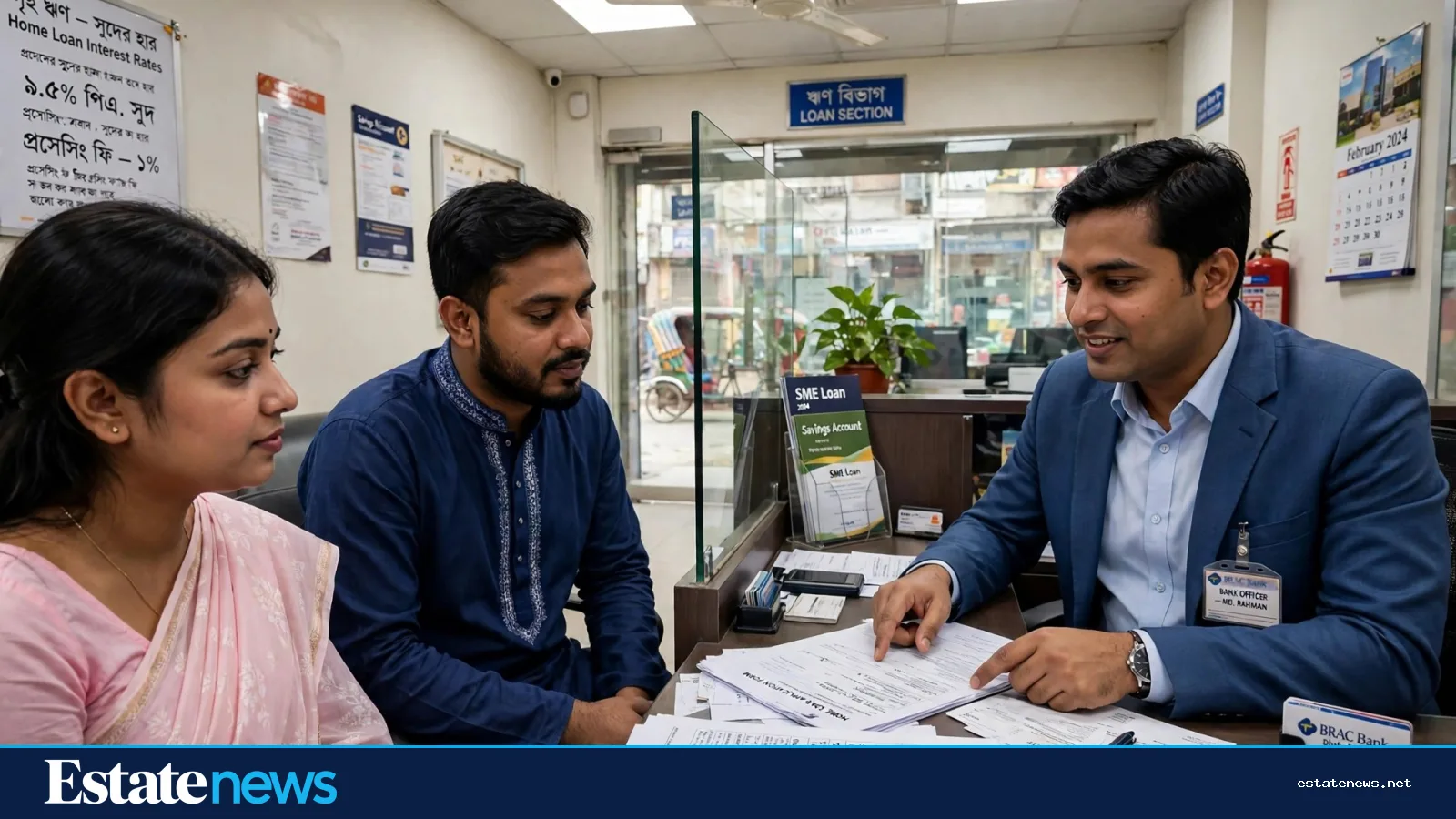

At the Abashan Mela, the property fair where Dhaka's developers meet their buyers, the president of REHAB, Ali Afzal, put a number to a complaint every flat buyer in Bangladesh knows by heart. Home loans in Bangladesh, he said, carry interest of 14 to 15 percent. In richer countries, the same kind of loan costs about 4 percent. The gap is not a small one. It is the difference between a flat that a family can afford and one that stays out of reach, and it shapes the whole housing market in ways that are easy to miss until the monthly instalment arrives.
A home loan is the biggest financial decision most Bangladeshi families ever make. The flat costs more than a lifetime of salary for many buyers, and the loan stretches over twenty years or more. At 14 percent, the interest alone can cost more than the flat itself over the life of the loan. That is why the rate matters more than the price tag.
Where the rate comes from
The starting point is Bangladesh Bank's policy rate, which now stands at 9.5 percent after a cut from 10 percent in August 2026. The policy rate is the rate at which the central bank lends to commercial banks, and it sets the floor for what banks charge their own customers. When the policy rate sits near 10 percent, no bank can lend for a home at 4 percent. The money itself costs too much.
Banks then add their own costs on top. A home loan is a long loan, and a long loan carries risk: the borrower's income can fall, the flat's value can change, the economy can turn. Banks price that risk into the rate, and they add the cost of running their branches and keeping the loan on their books for two decades. The result, in practice, is that bank home-loan rates in Bangladesh run roughly between 9 and 13 percent, with some borrowers paying more depending on the bank and the terms.
Compare that with a borrower in a richer country, where the central bank's rate sits low, inflation is steady, and banks compete hard for home-loan customers. A rate near 4 percent is normal there. The difference is not about one bank being greedy. It is about the whole cost of money in the economy.
The rules that shape the loan
The rate is only one part of the loan. Bangladesh Bank's rules shape how much a family can borrow and on what terms. The 70:30 debt-equity rule means the bank finances up to 70 percent of the flat's value, and the buyer must bring the other 30 percent as their own money. On a flat worth Tk 1 crore, that is Tk 30 lakh the family must have saved before the bank lends a taka. For many buyers, the down payment is the harder wall. The monthly instalment comes later. The down payment comes first.
There is also a ceiling on how much one borrower can take. Under a Bangladesh Bank circular from January 2026, the ceiling rises to Tk 4 crore where the bank's classified housing-loan ratio is 5 percent or below, and falls to Tk 3 crore or Tk 2 crore at higher ratios of bad housing loans. The rule ties a bank's lending room to the quality of its existing housing loans.


These rules are meant to keep the housing loan book safe. They also mean the system is careful with whom it lends to, and how much. A family with a steady salary, a clean credit record and a proper down payment will find a bank willing to talk. A family without those things will find the door harder to open.
The wait before the loan even starts
Before a loan is even discussed, there is another cost that buyers pay in time. Building plan approvals, the REHAB president noted at the same fair, take two years instead of the promised 30 days. Two years of waiting means two years of rent paid while the flat is not built, two years of prices moving, and two years in which the loan the buyer planned for may no longer fit. A slow approval system does not show up in the interest rate, but it shows up in the buyer's pocket just the same, and it adds risk for the developer and the bank, which always ends up in the price of the loan.
What a buyer can actually do
None of this means a family should give up on buying. It means the family should shop for the loan the way it shops for the flat. Rates differ between banks, and the difference of one or two percentage points over twenty years is worth more than a small discount on the price. Some banks run takeover offers from time to time, letting a borrower move an existing loan to a lower rate, so it pays to ask what is on offer when the time comes.
The practical checks are simple. Ask the bank for the full cost, not just the headline rate: processing fees, insurance, legal charges, and what happens if a payment is late. Ask how long the approval takes, and what papers are needed. And keep the down payment honest: a loan built on borrowed money is built on sand.
The 14 to 15 percent rate is a fact of the Bangladeshi market today, not a law of nature. It will come down when the cost of money comes down, and that depends on inflation, on the policy rate, and on how safely banks can lend. Until then, the buyer who understands the rate, and plans around it, is the buyer who finishes paying for the flat instead of paying for the loan.
This article is for information only and is not financial advice. A home loan is a long commitment, so speak to your bank and, if needed, an independent adviser before signing.