The government's top project-approval body has cleared ten projects worth Tk 24,110.66 crore in a single sitting. The Executive Committee of the National Economic Council, ECNEC, approved the package on Wednesday, 25 November, at the Bangladesh Secretariat, chaired by Prime Minister and ECNEC Chairperson Tarique Rahman. Five of the projects are new, four are revised versions of existing schemes, and one is a time extension. The money comes from three places: Tk 12,775.99 crore from the government, Tk 8,944.21 crore in project loans, and Tk 2,390.47 crore from the implementing agencies' own resources.
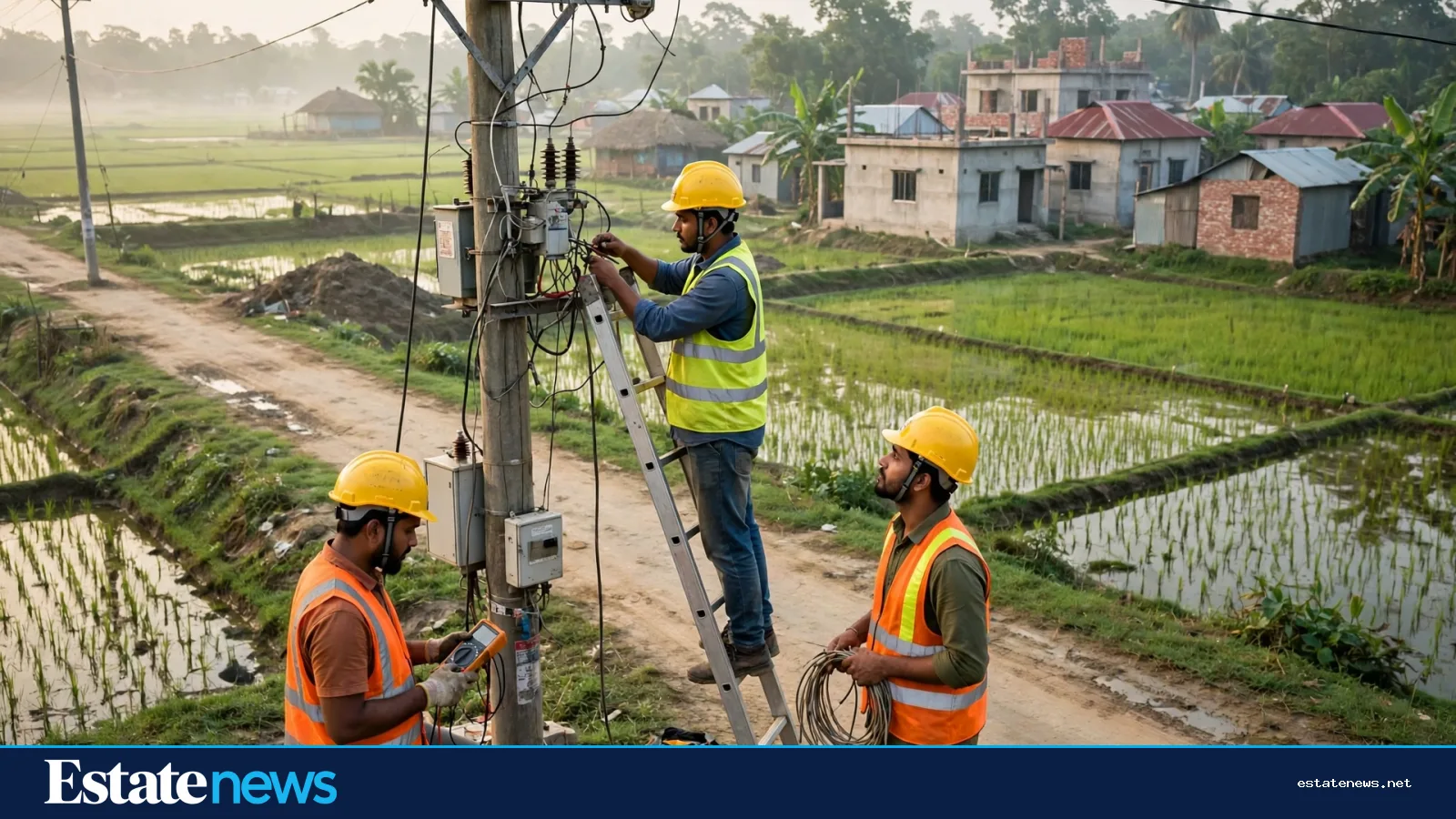
More than half of the money goes to one thing: electricity. Two power distribution projects, worth Tk 13,580 crore, will add 2,681 MVA of distribution capacity. One expands the distribution network of 13 Palli Bidyut Samitis around Dhaka, under the Rural Electrification Board. The other modernises and upgrades the board's distribution system across Chattogram and Sylhet divisions. For a family moving into a new flat outside Dhaka, or a factory owner wiring a new shed, that capacity is the difference between a connection that holds and one that trips every evening.
Hospitals, roads and the coast

The rest of the package spreads across health, local government, welfare, disaster management and water. Health takes two projects. One is the second revision of the scheme to set up full-fledged cancer, heart and kidney treatment centres in all eight divisional cities. The other is the second revision of the 500-bed medical college hospitals in Jashore, Cox's Bazar, Pabna and Noakhali, along with the vertical extension of the National Institute of Gastroliver Diseases and Hospital, adding its 11th and 12th floors.
Local government takes three. There is rural infrastructure development in Pabna, and a separate scheme for Chattogram and Cox's Bazar, plus the second revision of the project covering Noakhali, Feni and Lakshmipur. Social welfare gets a fourth time extension for the Bangladesh Poverty Alleviation Organisation's health service centre in Char Fasson. Disaster management gets the fourth revision of the project to make rural earthen roads last longer, by paving them with herring bone bond. Water resources gets the rehabilitation of coastal polders 64/2A and 64/2B in Pekua upazila, Cox's Bazar, for flood control, drainage and irrigation.


Two proposals did not make it through. A bridge in Barishal and a public library were returned for further review and will be resubmitted. The Prime Minister also directed price assessment firms to vet mega-project procurements, to curb cost overruns, according to the Daily Waadaa.
What it means beyond Dhaka
The power money is the part that touches housing most directly. New flats and new factories outside the capital need reliable electricity before they need anything else, and the distribution network around Dhaka and in the south-east has been the weak link for years. A 2,681 MVA addition does not fix the grid on its own. It does give the Rural Electrification Board room to connect the housing and industrial growth that is already happening on Dhaka's edges.
The hospital and road projects work the same way, slower and quieter. A 500-bed medical college hospital in a district town makes that town a place a family can settle in. A paved rural road makes a village reachable in the rain. A rehabilitated polder keeps a coastal family's land dry. None of these is a housing project. All of them decide where housing can grow.
Estate News has followed the port and trade infrastructure that frames this spending in "Chattogram Port: DP World to Take Over New Mooring Terminal in March 2027", and the project Bangladesh still does not have in "The Deep-Sea Port Bangladesh Still Does Not Have". The metro reshaping the capital is the subject of "MRT Line-1: The Underground Metro Redrawing Dhaka's Map". The ECNEC package will now move to the implementing agencies. The test, as ever, is not the approval. It is the delivery.