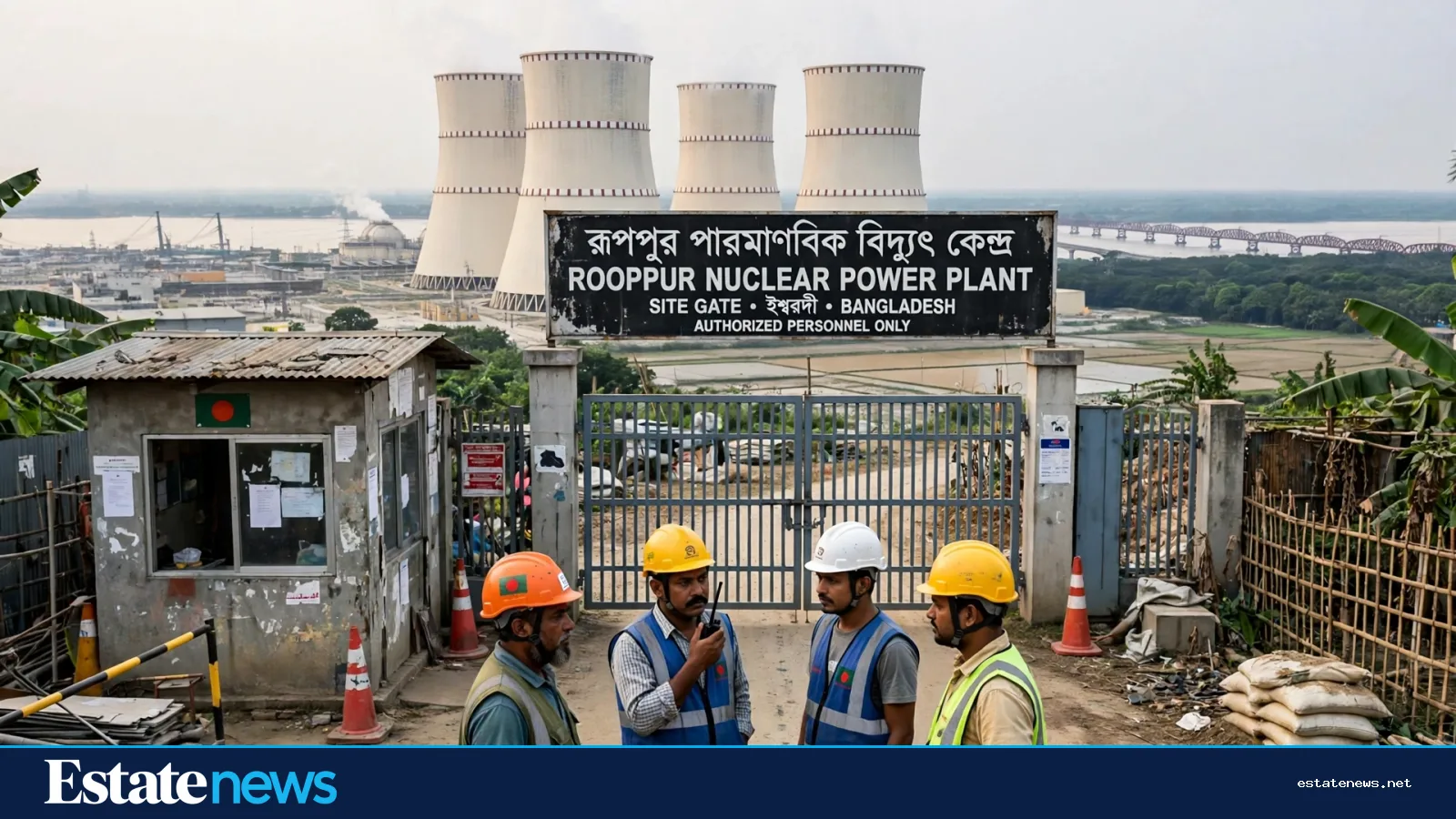
The trucks came before sunrise. At 5:48 on Tuesday morning, three specialised lorries carrying uranium from Russia entered the Rooppur Nuclear Power Plant site at Ishwardi in Pabna, under Bangladesh Army supervision and tight security from other law enforcement agencies. Rosatom's site in-charge, Ruhul Quddus Tutul, confirmed the arrival to reporters, and The Business Standard carried the news the same day.
Eight consignments of nuclear fuel have now reached the site. One is an additional shipment for the plant's first unit, and seven are for the second unit. A total of nine consignments are scheduled, which leaves exactly one delivery to go. The fuel is the last big piece of the plant's long construction story falling into place, consignment by consignment, on the bank of the Padma.
What the nine deliveries cover

Rosatom's plan, reported alongside the delivery, is to send 163 uranium assemblies for Unit 2 in seven cargo flights, plus 48 assemblies for Unit 1 refuelling in two flights. The plant has two VVER-1200 units of 1,200 megawatts each, a total of 2,400 megawatts, built by Russia's state nuclear company Rosatom. That is the largest single power project the country has ever built, and the fuel deliveries are the point at which a construction site starts becoming a power station.
Unit 1 has already begun supplying electricity to the national grid on a trial basis. Reports put the trial supply at Tk 7 crore worth of electricity over a 30-hour trial, according to The Bangladesh Mail. A trial run is not full commercial operation. It is the stage where engineers test the machine against the real grid, watch how it behaves under load, and fix what shows up before the plant is asked to run day after day.


Why 2,400 megawatts matters to a flat
Power is the quiet constraint behind almost every property story in Bangladesh. A factory that loses power loses a shift. A flat that loses power loses its lift, its water pump and its fans in the same hour. Dhaka's builders plan around that reality, with generators and backup systems priced into every project, and the cost lands on the buyer in the service charge.
Steady baseload power is what a nuclear plant is built to provide. Unlike a gas plant waiting on imported fuel or a solar array that stops at dusk, a reactor runs around the clock once it is up. If Rooppur reaches full operation, it takes pressure off a grid that leans heavily on gas and imported fuel, and it gives factories and households a steadier supply to plan around. The effect will not arrive in one day. It arrives unit by unit, test by test, and Tuesday's delivery was one more step in that sequence.
The plant sits at Ishwardi, far from the capital, but its power will travel the national grid to the cities where the demand is. That is the same grid story Estate News has followed at the ports and the terminals, from "Chattogram Port: DP World to Take Over New Mooring Terminal in March 2027" to "The Deep-Sea Port Bangladesh Still Does Not Have" and "Everest Takes the Wheel at Chattogram Container Terminal From Today". Roads, ports and power plants are different projects, but they answer the same question: can the country's infrastructure keep up with the buildings going up on it.
One consignment remains. When it arrives, the fuel story is complete, and the attention shifts to the slower work of testing, licensing and bringing both units to full power. The dawn convoy on Tuesday was a reminder that the country's first nuclear plant is no longer a drawing. It is a site with fuel in it, a unit already feeding the grid on trial, and a finish line that is now one delivery away.