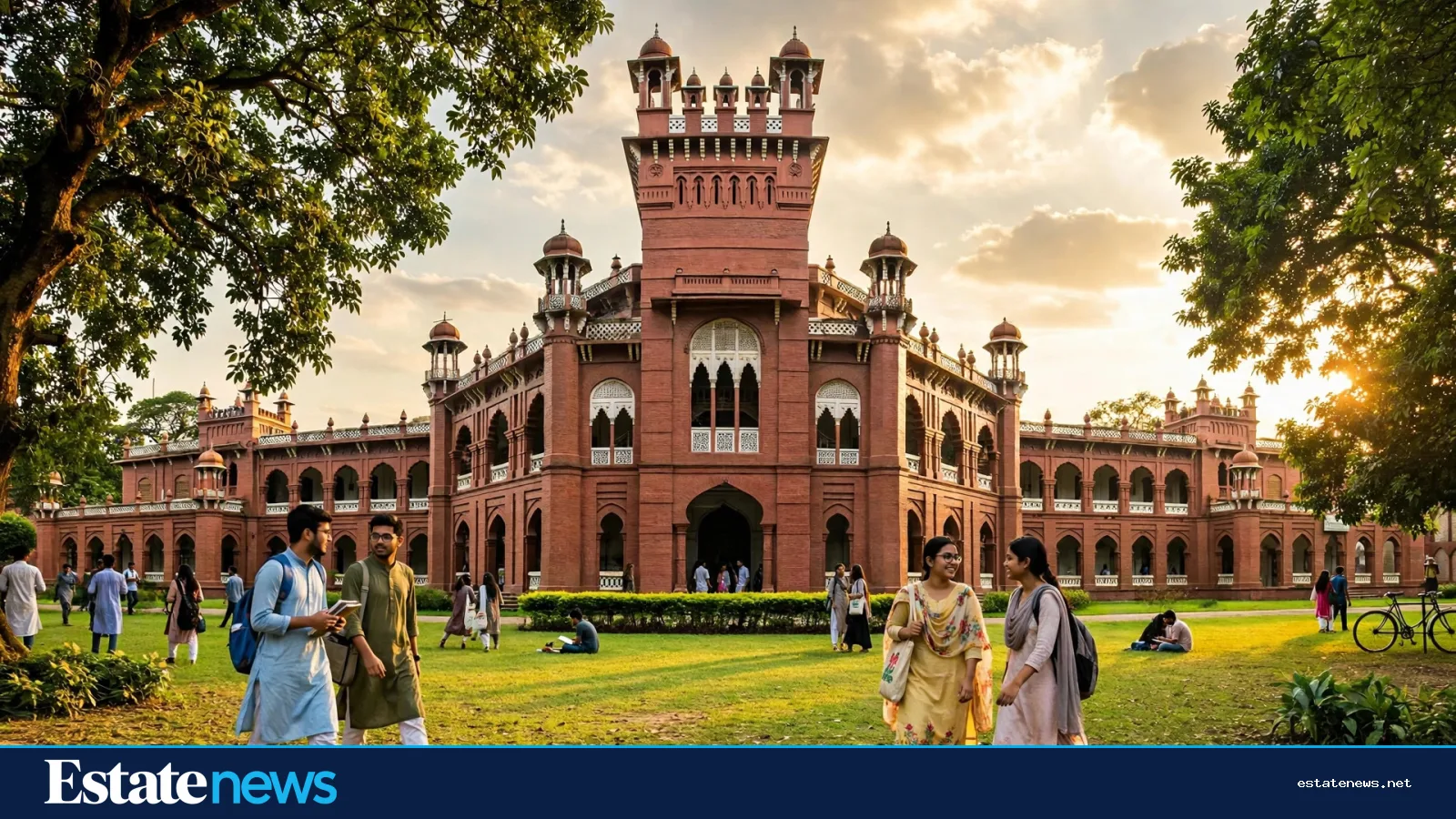
The lawn in front of Curzon Hall is one of the few places in Dhaka where the city slows down. Students sit under the trees with their books. A cricket game starts and stops. Behind them, the red-brick hall rises in a shape that belongs to no single tradition: arches and domes borrowed from Mughal building, set on a European plan, built with brick from Bengal. It is the most photographed building on the Dhaka University campus, and one of the least understood. Most people who walk past it know its colour. Few know how close it came to being something else entirely.
The foundation stone was laid on 19 February 1904 by Lord Curzon, the Viceroy of India, and the building was completed in 1908. It carries his name. The money came from the princes of the Bhawal Estate, who gave Tk 1.5 lakh, and the land came from Nawab Sir Salimullah. That much is settled. What the building was meant to be is not. The usual account says it was intended as a town hall. The historian Sharif Uddin Ahmed has argued instead that it was built as a library for Dhaka College. The records leave room for both readings, and the honest thing is to say so: a grand public building, paid for by the city's old money, raised for a purpose that was never quite fixed.
A college, then a university

History settled the question by using the building for something else. The Partition of Bengal in 1905, and its annulment in 1911, turned Dhaka's fortunes upside down, and Dhaka College found a home in the hall. Then, when the University of Dhaka was established in 1921, Curzon Hall became the base of its Faculty of Sciences. The town hall that never was became a classroom, and then a faculty, and the building has been a place of teaching ever since.
That is the thread that runs through its life. Curzon Hall was never a palace or a court or a museum. It was a working building from the start, and it stayed one. The students who passed through it in the 1920s were the first generation of Bengali science graduates. Their successors are still there, in the same rooms, under the same roof.
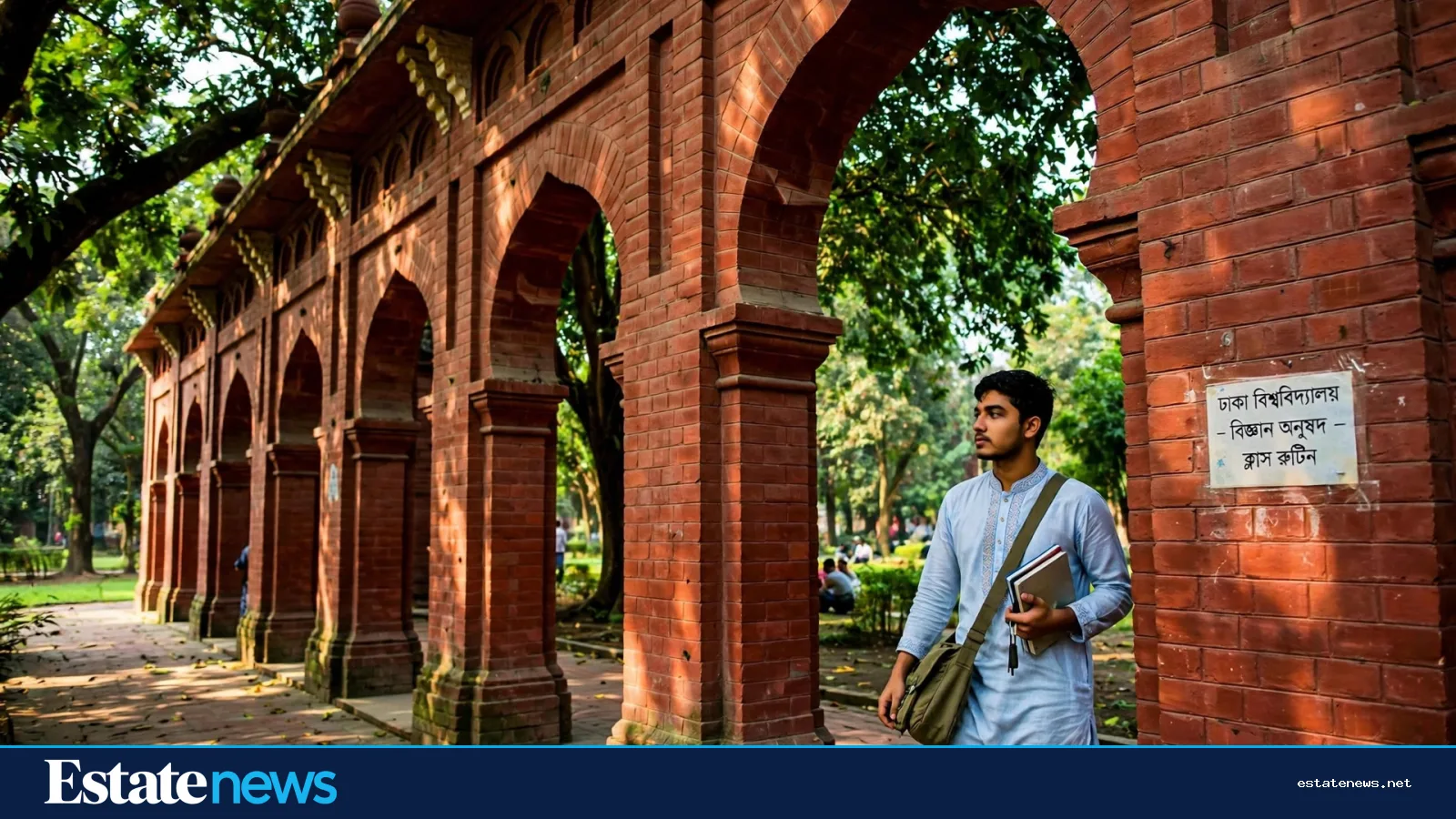
Stand under the veranda and the building shows its mixed parentage. The style is Indo-Saracenic, a blend of Mughal and European elements that the British used for their grandest Indian buildings. Red brick carries the walls. A central hall sits between east and west wings, and a continuous veranda runs around the building, shading the rooms behind it. The ornamentation was done by an artist from Rajputana, in what is now Rajasthan. The horseshoe arches, the small domed pavilions on the roof, the patterned brickwork: each piece comes from somewhere else, and the whole reads as Dhaka, not as a copy of anything.


The hall that spoke back
The hall's most famous hour had nothing to do with architecture. In 1948, when Muhammad Ali Jinnah declared that Urdu would be the only state language of Pakistan, students protested at Curzon Hall. The building became one of the stages of the Language Movement, the long campaign from 1948 to 1956 that ended with Bangla recognised as a state language. The lawn that now hosts cricket games once hosted the arguments that shaped the country.
That history is why the hall matters beyond its bricks. Dhaka has grander buildings and older ones. What it does not have is many buildings that were present at the moments people remember. Curzon Hall was there when the university began, and it was there when the language was defended. A building that has been in the room for both is not just old. It is part of the story.
Estate News has told the story of another campus landmark, Madhur Canteen, in "Madhur Canteen: A Century of Adda at Dhaka University", and the two buildings belong together in the mind. One is where students argued, the other is where they talked it over afterwards. Both are still in daily use, and that is what keeps them alive. A heritage building that nobody uses becomes a photograph. These two are still rooms people walk into every morning.
Walk past the hall on a weekday afternoon and it is still a working building. Classes end, and students spill out onto the lawn. The science faculty's departments, physics, chemistry, mathematics and the rest, still work from these rooms. The red brick has weathered, and the paint has been renewed more than once, but the shape is the one the builders left in 1908. In a city that pulls its old buildings down as fast as it puts new ones up, that is no small thing.
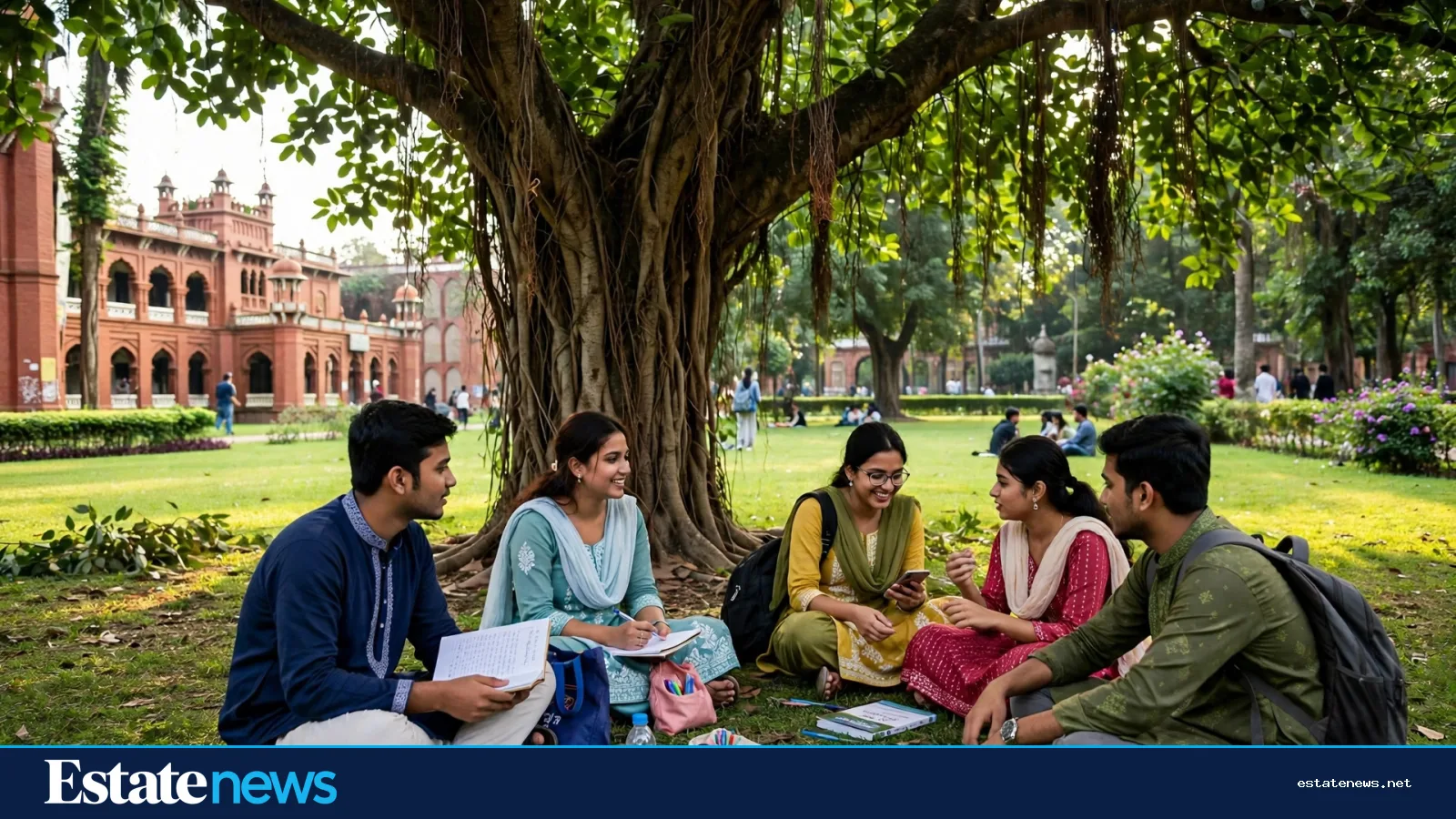
The hall sits in Shahbagh, near the High Court, at the centre of the city's institutional quarter. It appears in every survey of the country's great old buildings, including the map Estate News published in "The Crown Jewels of Bengal: A Map of the Country's Great Old Buildings". But the map is not the point. The point is the lawn, the veranda, and the students who use them. Curzon Hall was built for a purpose nobody can now agree on, and it found a better one: teaching Dhaka's young people, year after year, in a building that has watched the city become what it is.