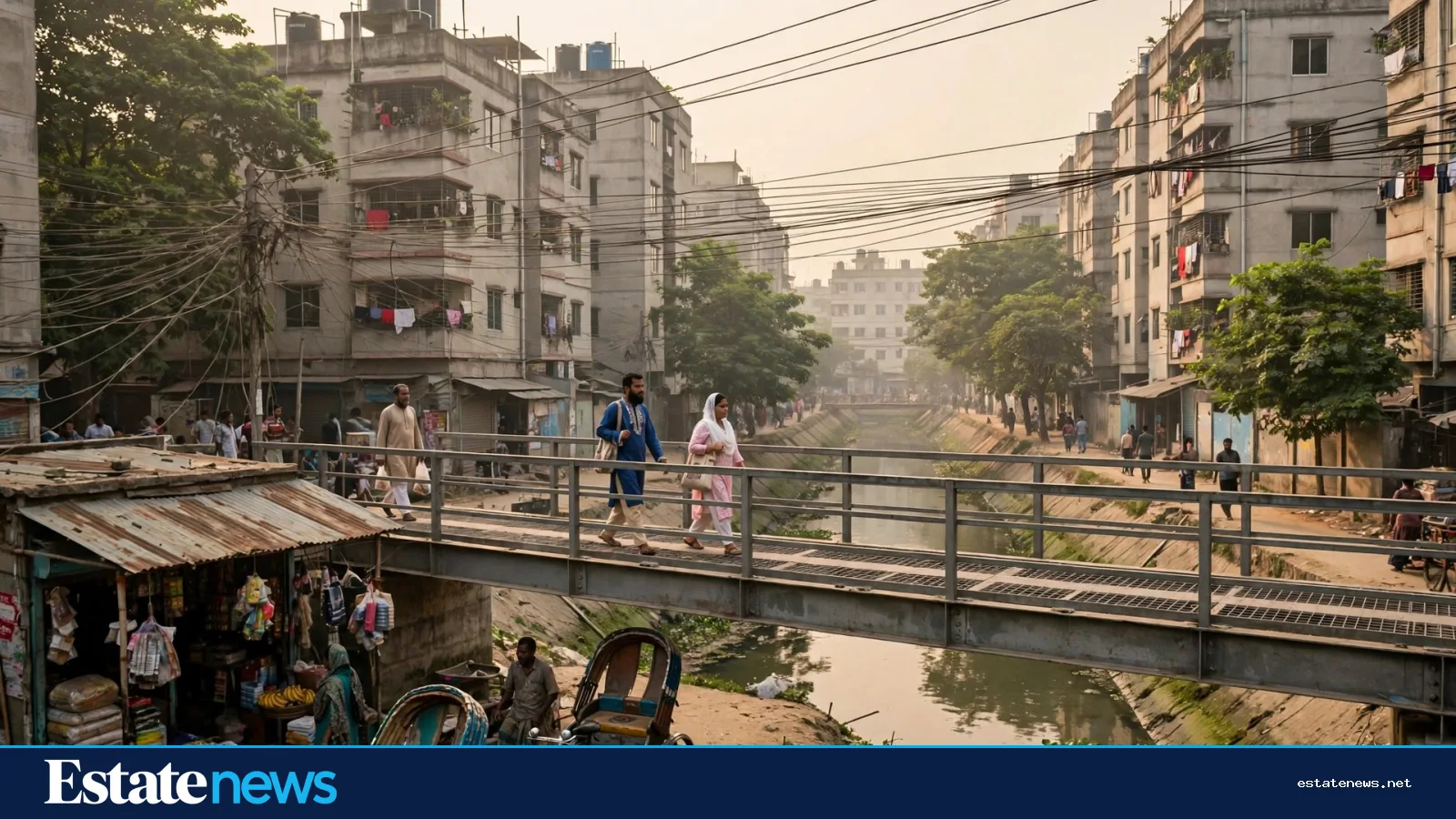
On a Wednesday evening in late September, a crowd gathered near Farazi Hospital in Banasree to watch a steel footbridge open. The bridge is 42 metres long and 3.8 metres wide, and it crosses the canal to Aftabnagar on the other side. Dhaka North City Corporation Administrator Shafiqul Islam Khan cut the ribbon, and residents walked across it for the first time. It was a small opening for a small structure. It joined two neighbourhoods that had lived side by side for years without a proper crossing between them.
The bridge is the second of three. All three are part of a Tk 89.54 crore project to build steel bridges connecting Banasree and Aftabnagar, according to the Daily Observer report of 23 September 2026. The other two, near Ideal School and Meradia Bazar, were still under construction when the second bridge opened. The administrator also told residents the city corporation plans to clean and renovate the canal, which runs between the two areas and sets the line most people in the neighbourhood cross every day.
That line matters more than it looks on a map. Banasree and Aftabnagar sit next to each other in eastern Dhaka, off the Rampura, Badda and Hatirjheel corridor, but the canal has always divided them. A school run, a hospital visit, a trip to the bazaar: each of these meant a long way round for families who could see the other side from their windows. Three short bridges change the daily maths of the place. A ten-minute walk replaces a rickshaw ride around the end of the canal, and a school or a clinic on one side becomes part of the other side too.

A neighbourhood that grew in blocks
Aftabnagar grew the way planned housing areas in Dhaka usually grow: block by block. The blocks carry letters, and the apartment projects inside them carry the names of their developers. Listings for ongoing projects in Block F and Block H show buildings rising floor by floor, and the streets between them are wide enough for a car and a rickshaw to pass without a stand-off. Banasree, the older of the two, is more settled, with schools, hospitals and bazaars already in place. The two areas now meet in the middle, and the families moving in treat them as one address rather than two.
Lenders have noticed the same thing. National Housing Finance PLC recently opened an Aftabnagar sales centre at Noor Tower in Aftabnagar, according to the Financial Express, with the company's managing director and the Aftabnagar Society president at the opening. A lender does not open a sales centre in a neighbourhood it expects to stay quiet. It opens one where people are already asking about loans, and where the questions are about which flat and which floor rather than whether to buy at all.
The buyers are easy to picture. They are families who want a flat inside Dhaka but cannot stretch to the prices of the older, central neighbourhoods. Our piece "The Tk 40 Lakh Question: What a Small Flat Really Costs Beyond Dhaka" worked through what a modest budget buys outside the centre, and the same calculation draws buyers east, to Banasree and Aftabnagar, where a flat costs less than a comparable one closer to the middle of the city. What they are buying is not only floor space. It is a shorter commute to Rampura and Badda, a school within walking distance, and a neighbourhood that is still adding its shops and clinics.
What to check before buying a share or a flat


A growing neighbourhood also attracts sellers who cut corners, and Aftabnagar has seen the sharp end of that. A company called Share Land Build Home has been accused of collecting around Tk 30 crore from more than 100 customers in Aftabnagar, according to The Business Standard on 25 October 2026, and the company is not a member of the Real Estate and Housing Association of Bangladesh. The same report says 9,823 cases of alleged land-share housing fraud were pending in courts across the country as of 30 September, involving nearly 40,000 buyers and around Tk 12,000 crore.
The lesson is not to stay away. It is to check the papers before paying. REHAB President Dr Md Ali Afzal told the same newspaper that buyers should verify a developer's REHAB membership, the RAJUK approval for the project and the ownership documents of the land. That advice fits Aftabnagar exactly, because so much of the buying here happens through land-share arrangements, where a group of buyers takes a share in a plot and builds together. In a land-share deal, the papers matter more than the brochure, and a developer with a record of finished buildings is worth more than a developer with a good sales pitch.
The checks are the familiar ones. The deed and the khatian should agree on the owner and the plot. The mutation record should show the name it ought to show. The RAJUK approval should cover the building being sold, not a different plot or an earlier plan. Our guide "Buying Land in Purbachal: The Checks Before You Pay" runs through these documents step by step, and today's guide "How to Verify a Land Title in Bangladesh: The Documents That Matter" lists the five papers that decide whether a title is clean. A buyer who walks through those checks before paying booking money keeps control of the deal. A buyer who skips them hands it away.
The canal, and what comes next
The canal itself is the next test for the area. A bridge is only as pleasant as the water it crosses, and the DNCC plan to clean and renovate the canal will decide whether the crossings feel like a proper part of the neighbourhood or a shortcut people use in a hurry. Residents were asked to help keep the area and the canal clean, and that request is worth taking seriously. A clean canal, with the three bridges open, would give Banasree and Aftabnagar something few Dhaka neighbourhoods have: a shared walkway between two housing areas, used by schoolchildren in the morning and families in the evening.
Other parts of Dhaka have grown the same way, one crossing at a time. Our piece "Gazipur's Factory Belt Is Slowly Becoming a Family Housing Market" describes a different edge of the city finding its feet as a place to live rather than only a place to work. The pattern is the same in the east. First the plots, then the flats, then the schools and clinics, then the roads and bridges that tie them together. The bridges do not finish that story. They mark the point where it starts to join up.
For a family looking at a flat in Block F or Block H, the advice is simple and practical. Walk the crossing before signing anything. Cross from Banasree to Aftabnagar on foot, at the hour you would actually travel, and see how long it takes and what it feels like. Look at the canal, the road, and the building itself. Then check the papers the way the guides on this site describe. The bridges are new, and the neighbourhood is still taking shape. The buyers who do their homework now will be the ones living comfortably in it when the third bridge opens and the canal is cleaned.