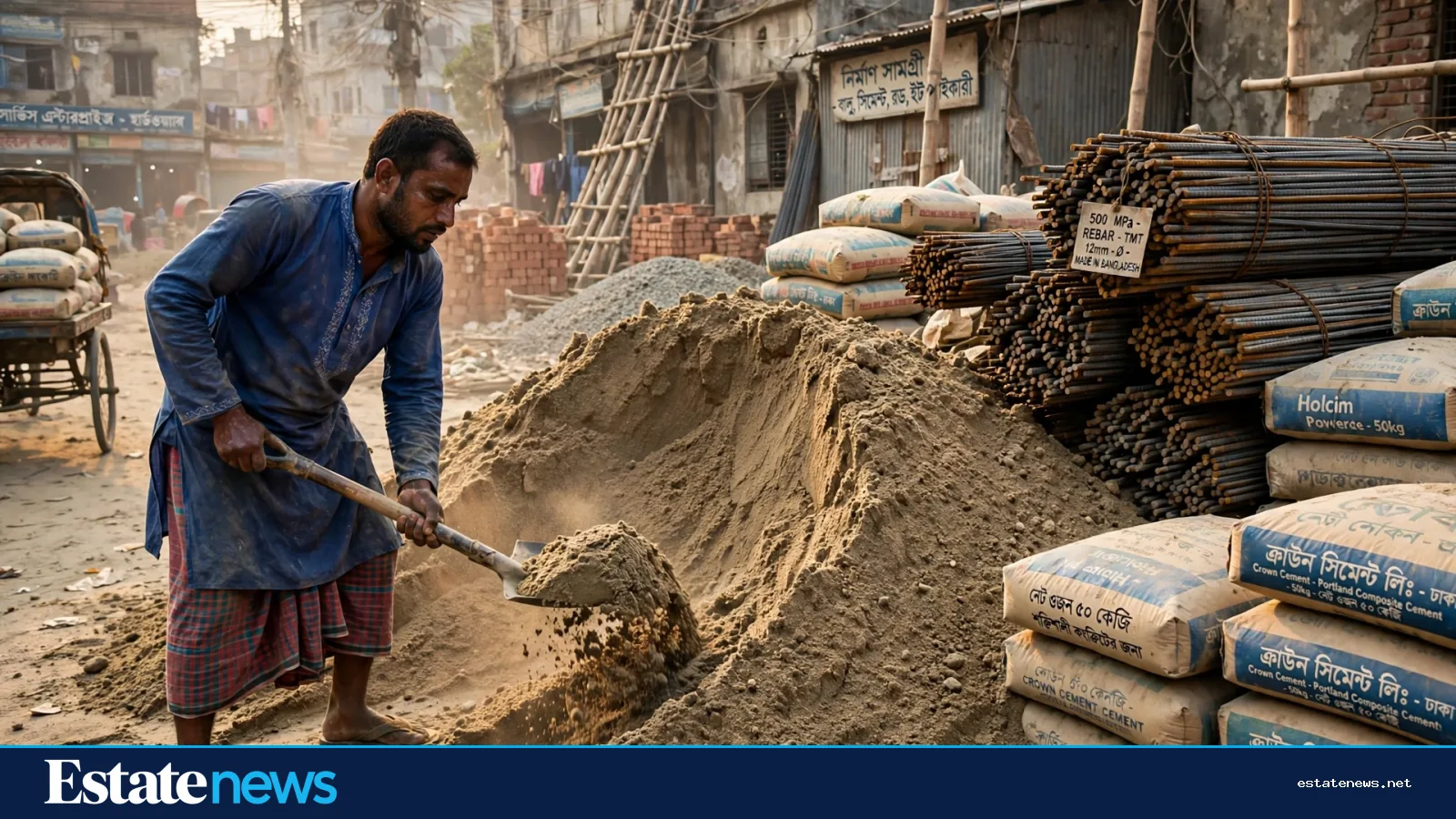
One number from Tuesday's ECNEC meeting stands out from the rest. Coarse sand, the material every concrete mix and every brick wall depends on, is up nearly 86 percent in the official schedule of rates. The rate rises from Tk 1,900 to Tk 3,530 per cubic metre, a jump of 85.79 percent. For anyone building a house, a factory or a road, that is the figure that changes the estimate first.
This is a follow-up, not a repeat. Estate News reported the project approvals from the same 18 November meeting in "ECNEC Clears 16 Projects Worth Tk 33,298 Crore", sixteen projects worth Tk 33,298.48 crore, from rural bridges to the Dasherkandi sewerage lines. The meeting also revised the 2022 schedule of rates for government construction work, and that decision is what this piece tracks.
What the schedule changed

The Executive Committee of the National Economic Council approved the revision at a meeting chaired by Prime Minister Tarique Rahman at the Secretariat on 18 November, according to The Business Standard. Portland Pozzolana Cement moves from Tk 10,000 to Tk 10,400 per tonne. Steel rods of 500 MPa grade move from Tk 87,000 to Tk 89,000 per tonne, while 420 MPa rods come down from Tk 90,000 to Tk 89,000. Imported stone falls from Tk 8,400 to Tk 7,949 per cubic metre, and Madhyapara granite stone is set at Tk 5,696 at source level. Diesel rises 23.85 percent.
Two points need care. These are schedule rates for government projects, not shop prices. A schedule rate is the price the government uses to estimate and pay for its own work. The price a builder pays at a dealer's yard is a different number, set by the market that week. Second, not everything rose. Stone and the lower-grade rod came down, which tells its own story about which materials are scarce and which are not.
What the market charges alongside


In the market, rods are already above the new schedule rate. A Bangladesh Post market review found MS rod selling at Tk 90,000 to Tk 92,300 a tonne, with BSRM at Tk 92,300, KSRM at Tk 90,500, AKS at Tk 91,500 and GPH at Tk 91,000. Cement was selling at Tk 500 to Tk 530 per 50-kg bag, and the review noted there was no cement below Tk 500 in the market. Cement, traders told the paper, had risen Tk 100 to Tk 120 a bag within a month, and rods were Tk 85,000 to Tk 86,000 a tonne a month earlier.
The Trading Corporation of Bangladesh midpoint for 60-grade MS rod in Dhaka was Tk 91,250 a tonne on 12 November, up 9.3 percent on a year earlier, according to AnalystBro's commodity monitor. The 40-grade midpoint was Tk 87,000, up 13 percent. Cement, by press reports, was Tk 540 to Tk 580 a bag on 10 October, a midpoint of Tk 560.
Read together, the two sets of numbers say something simple. The official schedule is catching up with a market that had already moved. Sand, though, is the sharpest move of all, and it is the one with no easy substitute: every cubic metre of concrete needs it.
What it means for a builder
For a government project, the new schedule changes the estimate on paper from the day it applies. For a private builder, the effect is indirect but real. Contractors watch the schedule because it signals where official costs are heading, and suppliers watch it because it tells them what the biggest buyer in the country is willing to pay. A house under construction in Dhaka this winter will feel the sand price in the foundation and the rod price in the frame.
Estate News tracks these figures as a range, not a single price, and labels them as such. "Building Costs This Winter: Rod, Cement and the Sq Ft Maths" set out the winter picture, and the Bangla guide "বাংলাদেশে প্রতি বর্গফুট নির্মাণ খরচ ২০২৬: রড, সিমেন্ট আর হিসাব" carries the same figures for Bangla readers. This tracker will keep updating as new schedule revisions and market reviews come in, and it will keep the two kinds of price apart: what the government schedules, and what the market charges.