Walk into a new flat in Mirpur or Uttara and you will often find the same thing: a wall of open wooden shelves, installed with hope, filled with everything the family owns. The idea was airiness. The result is a wall that looks like a shop. Open shelves are unforgiving that way. A closed cabinet hides a mess. An open shelf displays it.
The shelves themselves are not the problem. In Dhaka's small flats, where a living room of 12 feet by 14 feet does the work of a drawing room, a dining space and a children's study corner, open shelves make sense. They cost less than a full cabinet, they let light through, and they turn storage into decoration. The trick is treating them as display first and storage second.
Start with the empty space

The most common mistake is filling every inch. A shelf that is 70 per cent full looks styled. A shelf that is 100 per cent full looks like a godown. Leave a gap at one end of each shelf, and leave one shelf in three mostly empty. That empty space is what makes the full shelves readable. It also gives you somewhere to put the things that arrive later, the gift, the school project, the new plant, without the whole wall collapsing into clutter.
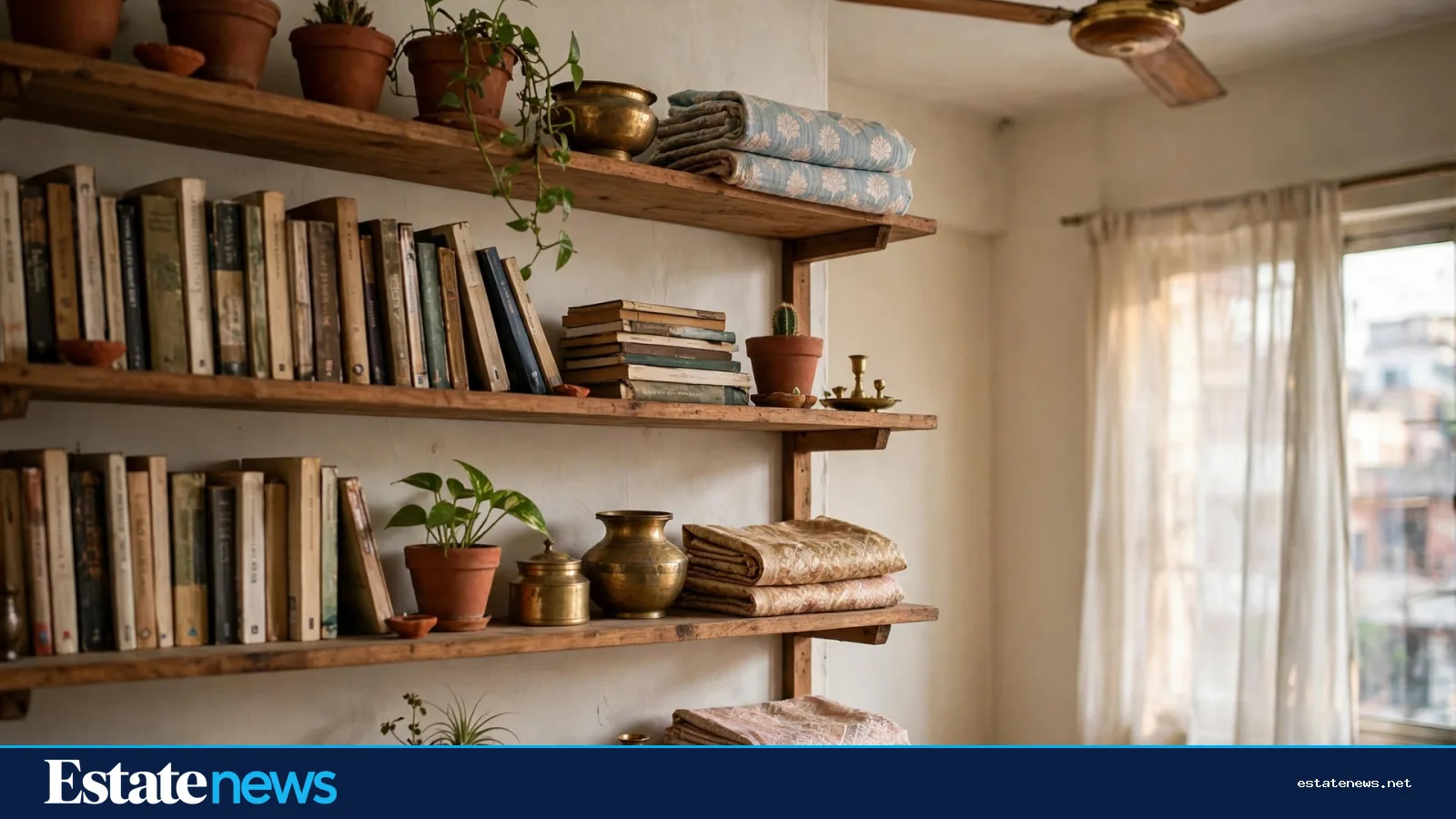
Grouping matters more than the objects themselves. Put books together in one run, upright, with a small stack lying flat at the end to break the line. Put plants together on another shelf. Keep the brass and terracotta pieces in one cluster rather than scattered across all four shelves. The eye reads a shelf in groups. When every shelf holds a bit of everything, the eye reads nothing.
What belongs on a Dhaka shelf
The best open shelves in Dhaka flats look like the family that lives there, not like a showroom. A row of well-read books, spines facing out, does more than any ornament. A folded jamdani or a handloom throw, stacked in twos, adds colour that no imported cushion can match. Terracotta pots from a local maker, a brass bowl from the old house, a small potted money plant trailing down from the top shelf: these are the things that make a shelf Bangladeshi rather than generic.
Plants earn their place twice over. A money plant or a small fern softens the hard lines of wood and books, and it survives the Dhaka flat's particular climate of dust and low winter light. Keep the pots small. A shelf with three large pots looks like a nursery. One trailing plant at the end and one small pot in the middle is enough.


What does not belong: the stack of old newspapers, the phone chargers, the medicine boxes, the plastic bags folded into a ball. Those need a closed box, a basket or a drawer. Woven baskets are the open shelf's best friend. One basket on the bottom shelf can swallow the clutter that would otherwise ruin the whole wall.
Light, dust and the Dhaka reality
Two practical facts decide whether open shelves work in a Dhaka flat. The first is dust. The city is dusty, and an open shelf collects it. If nobody in the house will wipe the shelves once a week, open shelves are a bad idea, and a closed cabinet is the honest choice. The second is light. A shelf on the wall opposite the window looks bright and open. A shelf on a dark wall looks like a cave, and no amount of styling fixes that. If the only free wall is dark, paint it a pale colour first, or fit a small warm light above the top shelf.
Depth matters too. Most carpenters in Dhaka will build shelves 12 inches deep by default. For a display shelf, 10 inches is better. Shallower shelves force you to keep one row of things instead of two, and the second row is where clutter hides. Ask the carpenter for 10 inches, and for brackets that sit flush, so the shelf looks like it floats rather than hangs.
A shelf that changes with the house
The nicest thing about open shelves is that they are never finished. A child's drawing goes up for a month and comes down. A new book joins the row. A plant outgrows its pot and moves to the balcony. That is the point. A closed cabinet is bought once and forgotten. An open shelf is a small, ongoing conversation between a family and its living room.
So start small. One wall, three shelves, and fewer things than you think you need. Live with it for a month. The shelf will tell you what is missing, and it will tell you more honestly than any catalogue.
Read more: [Our guide to small-apartment living in Dhaka](https://estatenews.net/markets/small-apartment-living-in-dhaka-space-design-that-actually-works-in-800-to-1200-square-feet) | [Our piece on bringing light into north-facing flats](https://estatenews.net/markets/north-facing-flats-in-dhaka-how-to-bring-light-and-colour-into-a-cooler-room) | [For the kitchen, our small-kitchen guide](https://estatenews.net/markets/chot-rannaghr-bd-subidha-dhakar-chot-flzate-rannaghr-sajanor-bastb-dharna)