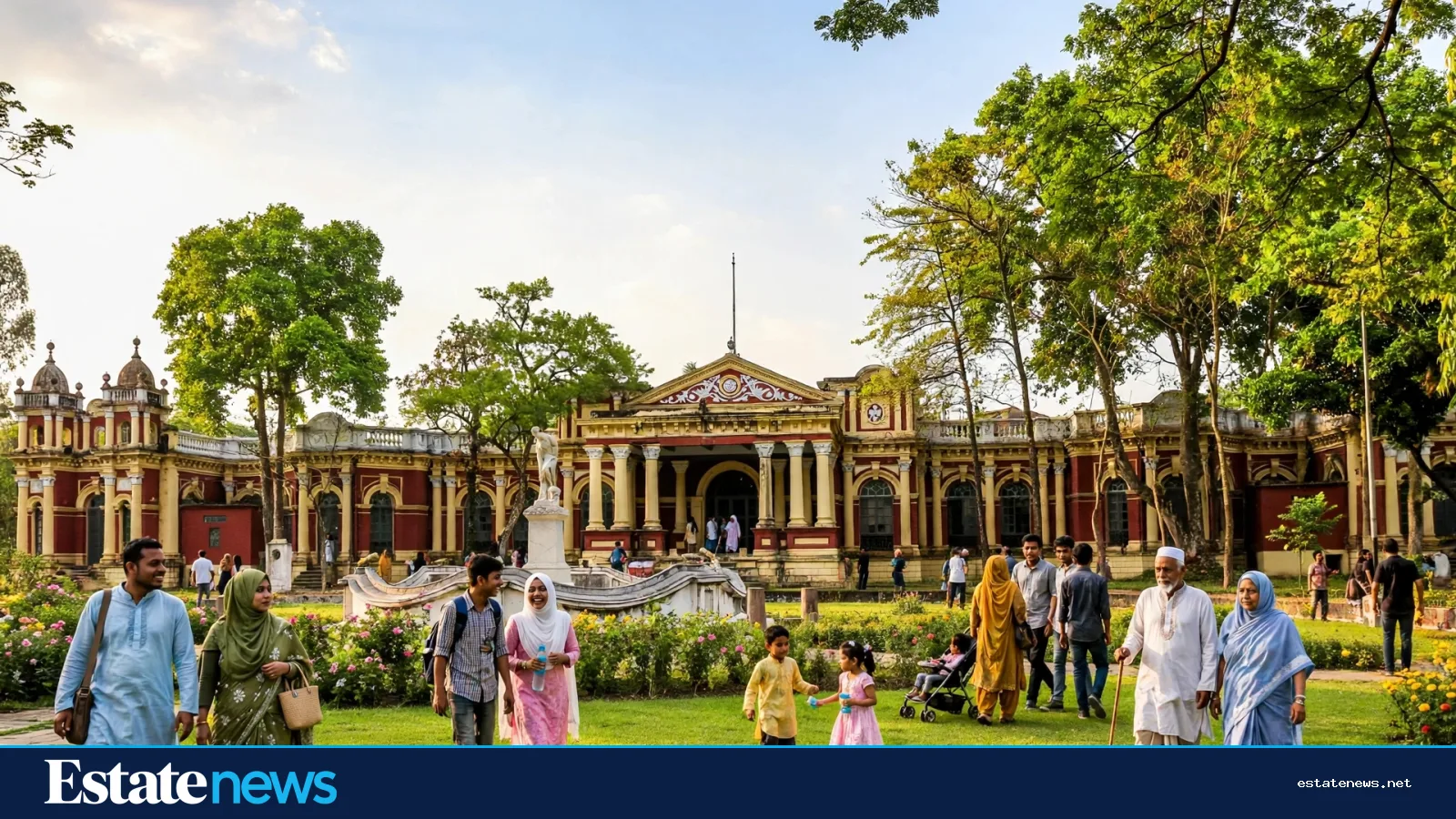
The lawn in front of Shashi Lodge fills up on a winter afternoon. Families walk the paths between the flower beds, students sit on the grass with their books, and an old couple stops to look up at the red and cream facade with its arches and columns. The palace stands in the middle of Mymensingh city on nine acres of ground, and it looks the way a zamindar's house is supposed to look: grand, a little worn at the edges, and impossible to walk past without stopping.
The building that stands there today is not the first palace on the spot. It is the second, built after an earthquake took the first one down, and its story runs through two maharajas, a family with no direct heir, and a city that refused to let the house fall apart. Shashi Lodge is now the home of the Mymensingh Museum, and the palace has become the reason many visitors come to the city at all.
Mymensingh grew up on the bank of the Brahmaputra, and the Muktagacha zamindar family grew with it. The estate was founded in the eighteenth century, and by the late nineteenth century its head was Maharaja Suryakanta Acharya Chowdhury, a man who spent four decades building schools, roads and public works across the district. He had no son of his own, so he adopted his nephew Shashikanta, and in 1877 he built a two-storey palace in the heart of the city and named it Shashi Lodge after the boy.

An earthquake, then a rebuilding
The first palace lasted twenty years. On 12 June 1897, the Great Indian Earthquake shook the whole of the region, and the two-storey building came down. Suryakanta was still alive then, and he began to rebuild on the same ground, but he died before the work was finished. His adopted son Shashikanta took up the task, and between 1905 and 1911 the lodge rose again, this time as a single-storey palace, longer and lower than the first, with European marble, glass and furniture brought in for the rooms.
The result is the building visitors see now: a long red-brick palace with cream trim, arched verandas, a central hall and gardens that run down to the road. The style is European, the way the zamindars of the time liked it, but the house sits on Bangladeshi ground and answers to a Bangladeshi climate, with deep verandas against the sun and tall windows to catch the air off the river. Close by stands Alexander Castle, another of Suryakanta's buildings, raised in 1879, which shows the same taste in a smaller frame.
From a teacher's college to a museum
When the zamindari system ended in 1950, the palace passed out of the family's hands. From 1952 it served as a women's teachers' training college, and for more than sixty years its rooms held classes and offices rather than durbars. The museum that now fills it has its own history: the Mymensingh Museum was set up by the district administration in 1969 to keep the relics of the old zamindar houses, and it came under the Department of Archaeology in 1989.
The two histories joined in 2015. On 4 April that year, the Department of Archaeology took over Shashi Lodge to turn it into a museum, and in 2019 the museum's collection moved into the palace and opened to the public. The relics inside come from the zamindar houses of Muktagacha, Gouripur and Atharabari, and from Kendua in Netrokona and Kaliakoir in Gazipur: sculpture, metalwork, wooden furniture, old photographs, hookahs and clay pipes, the everyday objects of a world that ended with the zamindars.


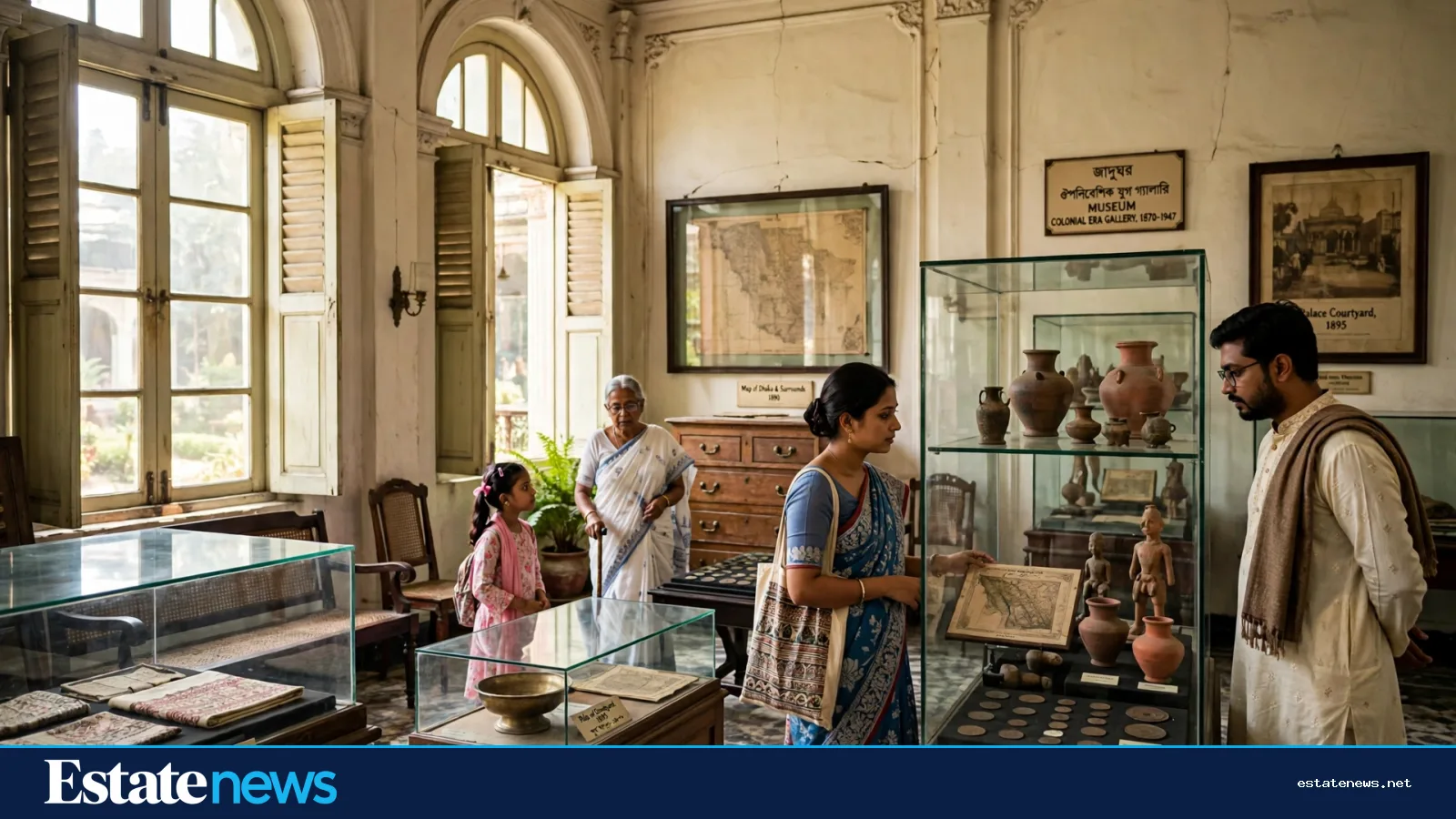
Step inside now and the palace works the way a museum should. The rooms are cool and dim, the display cases hold pots and coins and carved figures, and the labels give each object a place and a date. Some of the pieces are grand, like the old furniture of the durbar rooms. Others are small and ordinary, a drinking vessel, a pipe, a piece of cloth, and those are the ones that tell a visitor how the family actually lived. The museum has room for about two hundred relics on display, and more sit in storage waiting for showcases and staff.
The river city around it
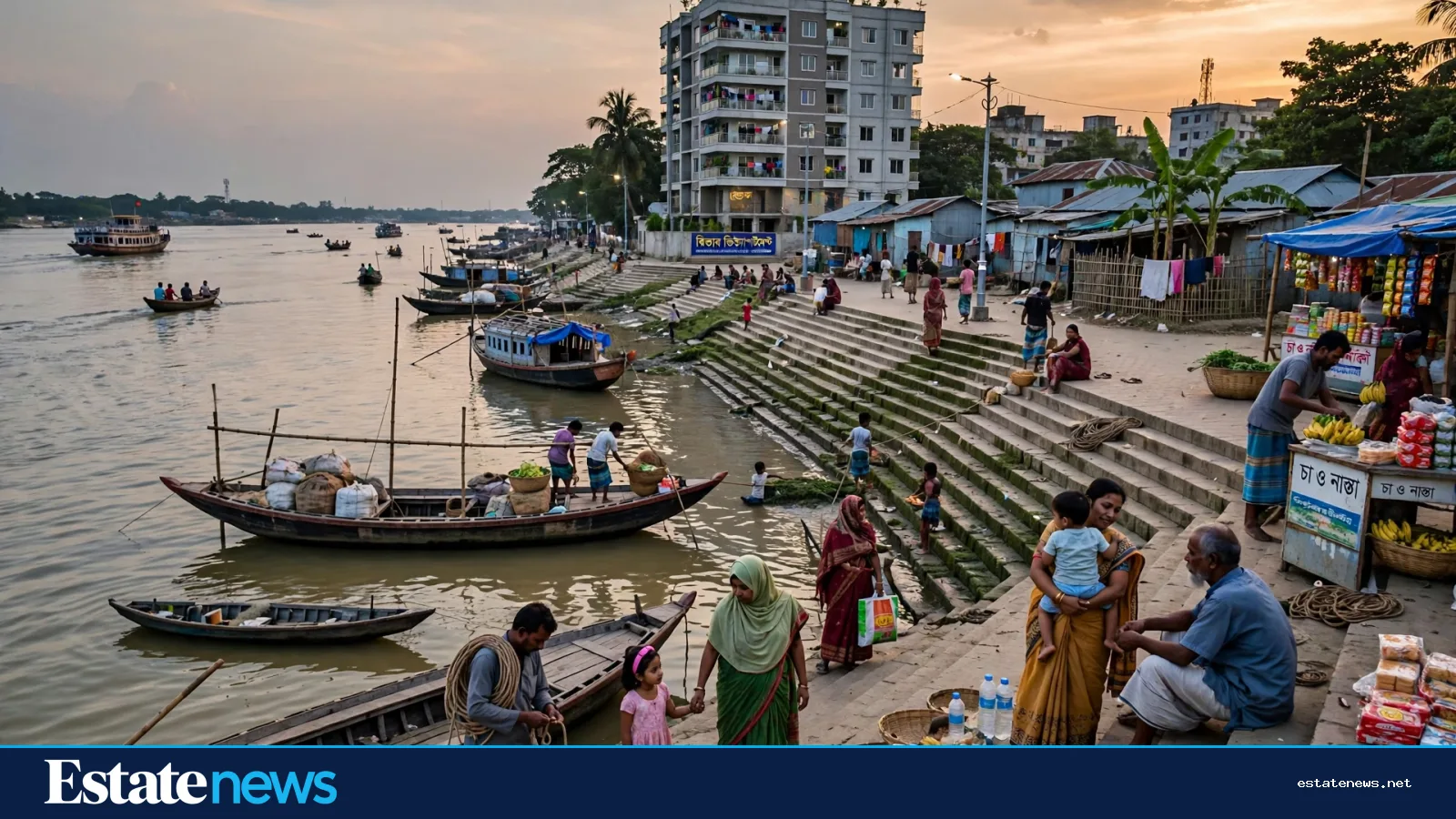
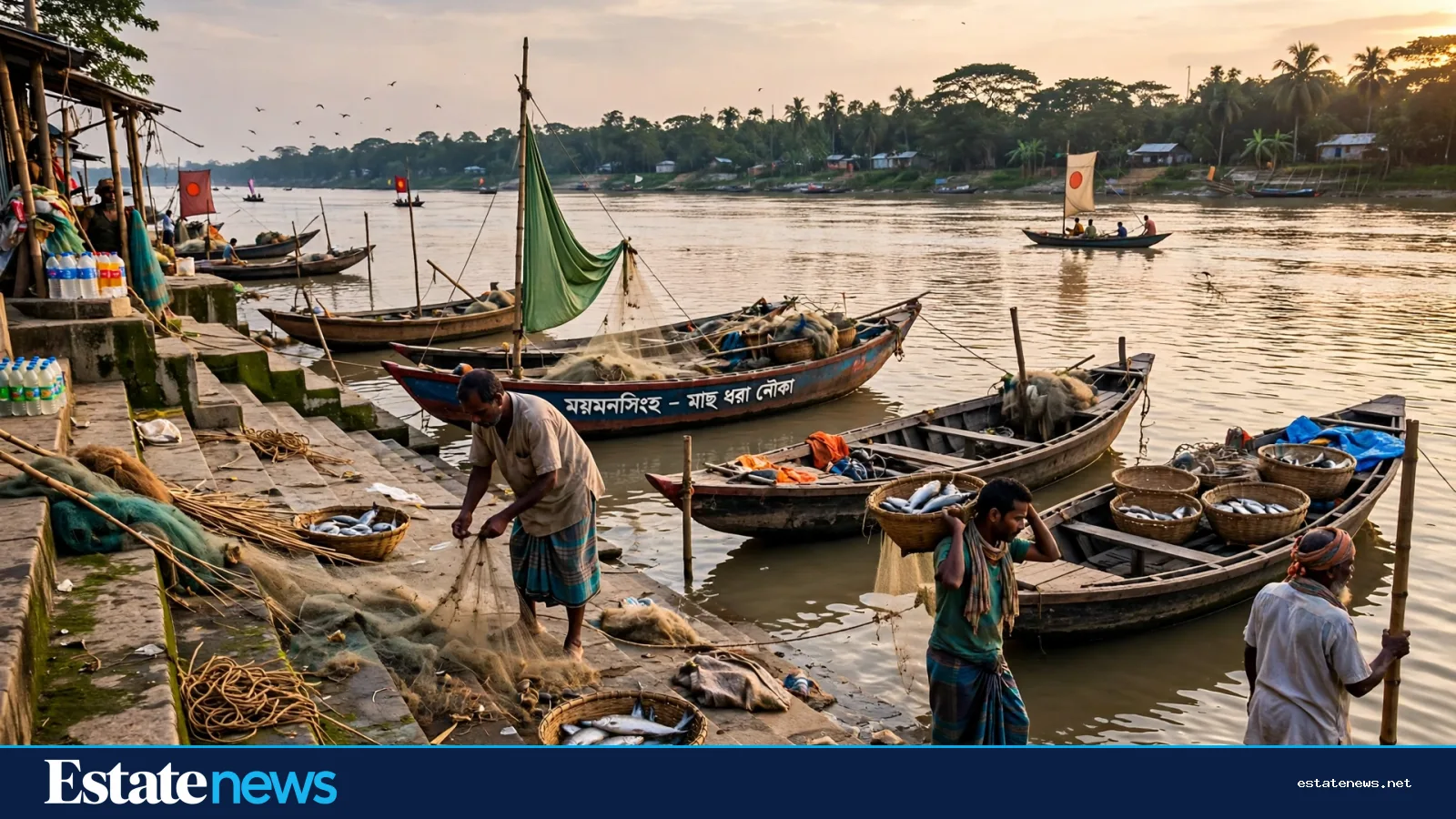
The Brahmaputra runs past the city the way it always has. The old river, as the people of Mymensingh call this stretch, bends around the town, and its ghats still fill in the morning with fishermen and their boats. The palace stands a short walk from the water, and the two belong together in the city's story: the river made the land rich, the land made the zamindars rich, and the zamindars built the palace that now teaches the city about itself.
Mymensingh has other reasons for a visitor to stop. The twin temples of Muktagacha, which Estate News covered in "মুক্তাগাছার জোড়া মন্দির: দুই শতাব্দীর স্মৃতি, সংরক্ষণের অপেক্ষায়", stand a short drive away, and the Trishal of Kazi Nazrul Islam's youth is the subject of "ত্রিশালে নজরুলের স্মৃতি: কাজীর শিমলা আর বটগাছের গল্প". In Rangpur, the Tajhat Palace keeps a similar story, told in "তাজহাট প্রাসাদ: রংপুরের জমিদার বাড়ির গল্প". Each of these houses came out of the same century, and each of them now survives because someone decided it was worth keeping.
Shashi Lodge has one more claim on the country's memory. The television drama Ayomoy, written by Humayun Ahmed, was filmed in the palace, and for a generation of viewers the lodge is the house they saw on screen before they ever visited Mymensingh. That is the way old buildings stay alive here: not only as museums, but as places people have already met in a story.
The palace needs care, and the museum needs more of it. Showcases are short, staff are few, and some of the collection stays packed away. What the lodge has on its side is the city around it. Families come on Fridays, students come with their teachers, and the lawn stays full. A palace that was built for one adopted son now belongs to a whole city, and the city seems in no hurry to give it back.