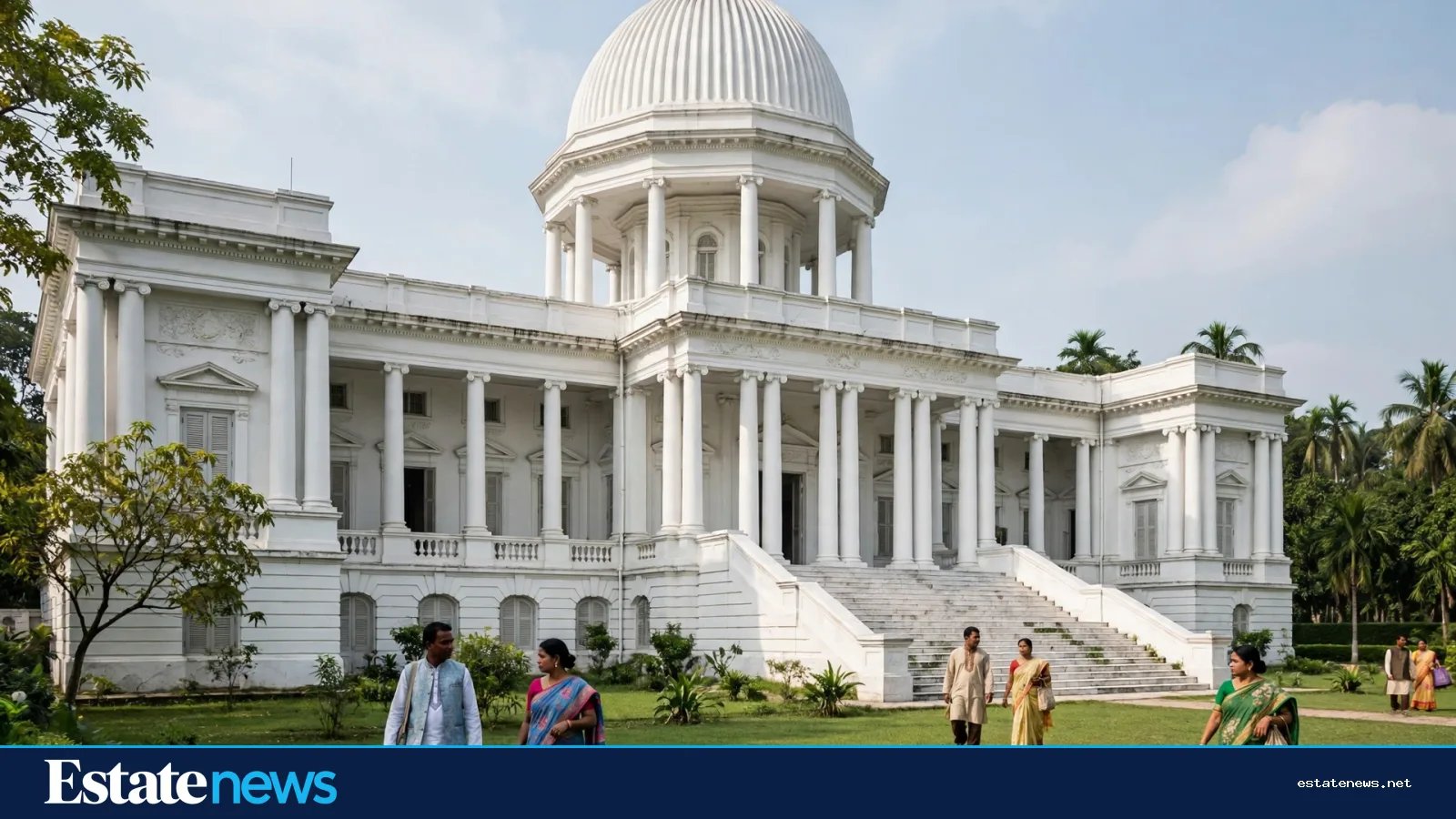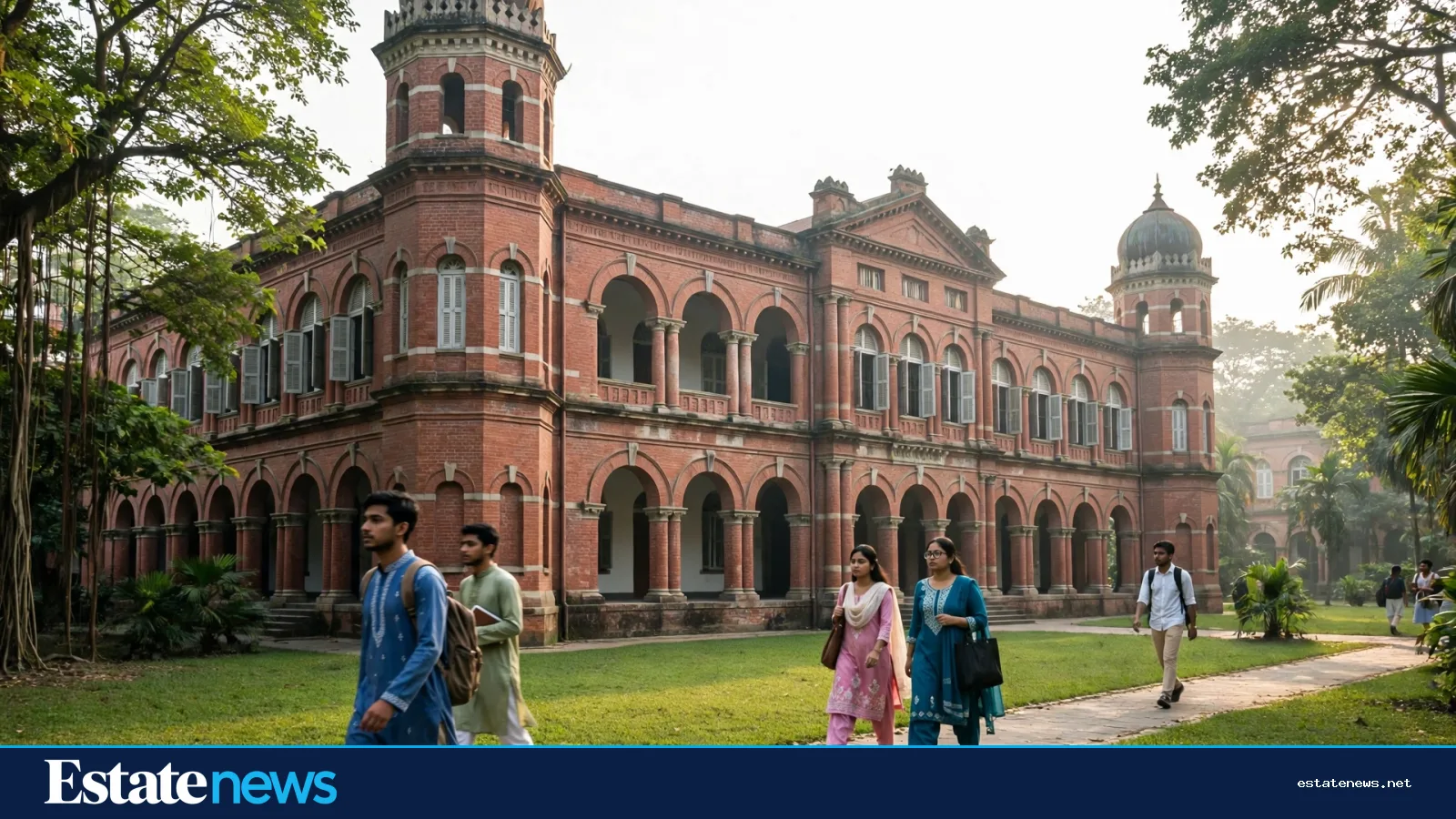
Stand on the lawn in front of Curzon Hall on a teaching morning and the building does something few Dhaka buildings manage: it slows people down. Students cross the grass with books under their arms, a teacher pauses under an arch, and the red brick catches the light in a way that makes the whole campus feel older, and steadier, than the traffic on the road outside. Curzon Hall is not a ruin, a museum piece or a backdrop. It is a working university building, and it has been working, in one form or another, for more than a century.
The dates are well recorded, with one small wrinkle worth stating plainly. Lord Curzon, the Viceroy of India, laid the foundation stone in February 1904. Accounts differ on the exact day in that month, with 14 and 19 February both appearing in published histories, so this article gives the month rather than a single day. Construction was completed in 1908. The princes of the Bhawal estate contributed Tk 1,50,000 toward the building, according to The Daily Star's historical account, and the ornamentation was done by an artist from Rajputana, in present-day Rajasthan. When the University of Dhaka was established in 1921, Curzon Hall passed to the university and became the home of its science faculty, a role it still holds.
A building with a disputed first purpose

Curzon Hall's first purpose is, unusually, a matter of historical argument rather than settled fact. Ahmad Hasan Dani, author of Dacca: A Record of Its Changing Fortunes (1956), claimed it was originally built as a town hall for the colonial administration. Historian Sharif Uddin Ahmed, cited by The Daily Star, held that it was constructed as a library for Dhaka College. Banglapedia's entry, by Perween Hasan, notes the building was originally intended to be a town hall, while other histories record its use by Dhaka College. The safest statement, and the honest one, is that the building began in the orbit of Dhaka College, served that college, and became a university science building in 1921, whatever its first intended label.
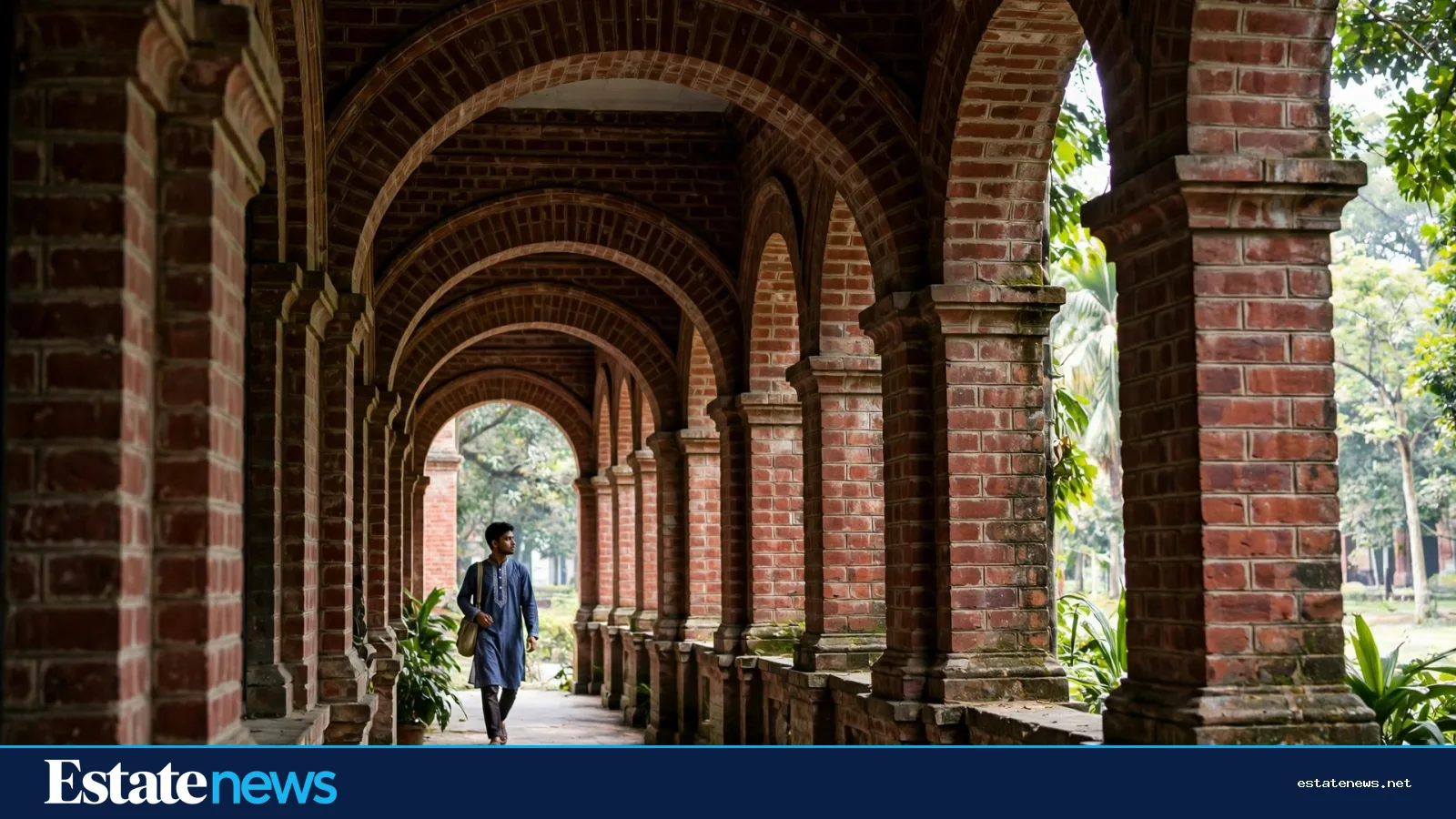
That dispute is part of the building's interest, not a flaw in the story. Buildings that change hands tend to collect competing origin stories, and Curzon Hall changed hands at exactly the moment Dhaka was changing from a provincial town into a university city. The building's architecture tells the same story of mixing. Banglapedia and later descriptions call it one of the best examples of Dhaka's architecture, a blend of European and Mughal elements, most visible in the projecting northern facade with its horseshoe and cusped arches. Red brick, continuous loggias, brackets, lattices, corner turrets and small kiosks give it a rhythm that reads, at a glance, as both colonial and local. It was built by a colonial administration, paid for in part by local princes, decorated by an Indian artist, and then taken over by a Bangladeshi university. Its walls hold all of those hands at once.
The hall where a language was defended
Curzon Hall's place in national history rests on a single morning in 1948. On 24 March that year, Mohammad Ali Jinnah spoke at the university convocation held at Curzon Hall and declared that Urdu alone would be the state language of Pakistan. Dhaka University students protested at the hall, refusing to accept that declaration. The protest belongs to the longer Bengali Language Movement of 1948 to 1956, and Curzon Hall is remembered as one of its stages. A building that began as a colonial project became, within a generation, a place where students argued, in public, for the language they spoke at home.


The science story runs alongside the political one, quieter but just as long. Physics classes were held at Curzon Hall in the university's early years, and the hall housed the science departments that trained generations of Bangladeshi scientists, teachers and doctors. Students still pass through its arches to lectures, examinations and departmental offices. A landmark that is also a timetable is a rarer thing than a landmark that is only photographed. Curzon Hall earns its visitors because it is used, not because it is fenced off.
What stands there today, and what care means
Today Curzon Hall stands in the University of Dhaka campus area near Shahbagh, in use as the Faculty of Sciences, with its lawn, trees and walkways forming one of the most photographed corners of the campus. Older accounts note that parts of the building were extended and some parts demolished over time, altering the original structure. That is normal for a working building, and it is also a warning: each alteration that is done carelessly makes the next restoration harder, and each decade of deferred maintenance shows first in brick, plaster and drainage, long before it shows in a report.
The positive case for Curzon Hall is therefore a practical one. Keep the building in daily academic use, because use is what justifies maintenance. Keep its arches, loggias and brickwork legible, because they are the reason students and visitors recognise it. Keep its lawn as a public, green breathing space in a campus that is under constant pressure for new construction. And keep teaching its disputed origin honestly, because a hall that once hosted an argument about language should not be given a smoothed-over history of its own.
Visitors who come for a photograph will leave with one. Visitors who stay a little longer, who sit on the lawn and watch a class change over, will understand something more useful: Dhaka's university did not arrive fully formed, and its most famous building did not arrive with a single purpose. Both were argued into being, in a hall of red brick and arches, and both are still being argued over, in the best sense, every teaching day.