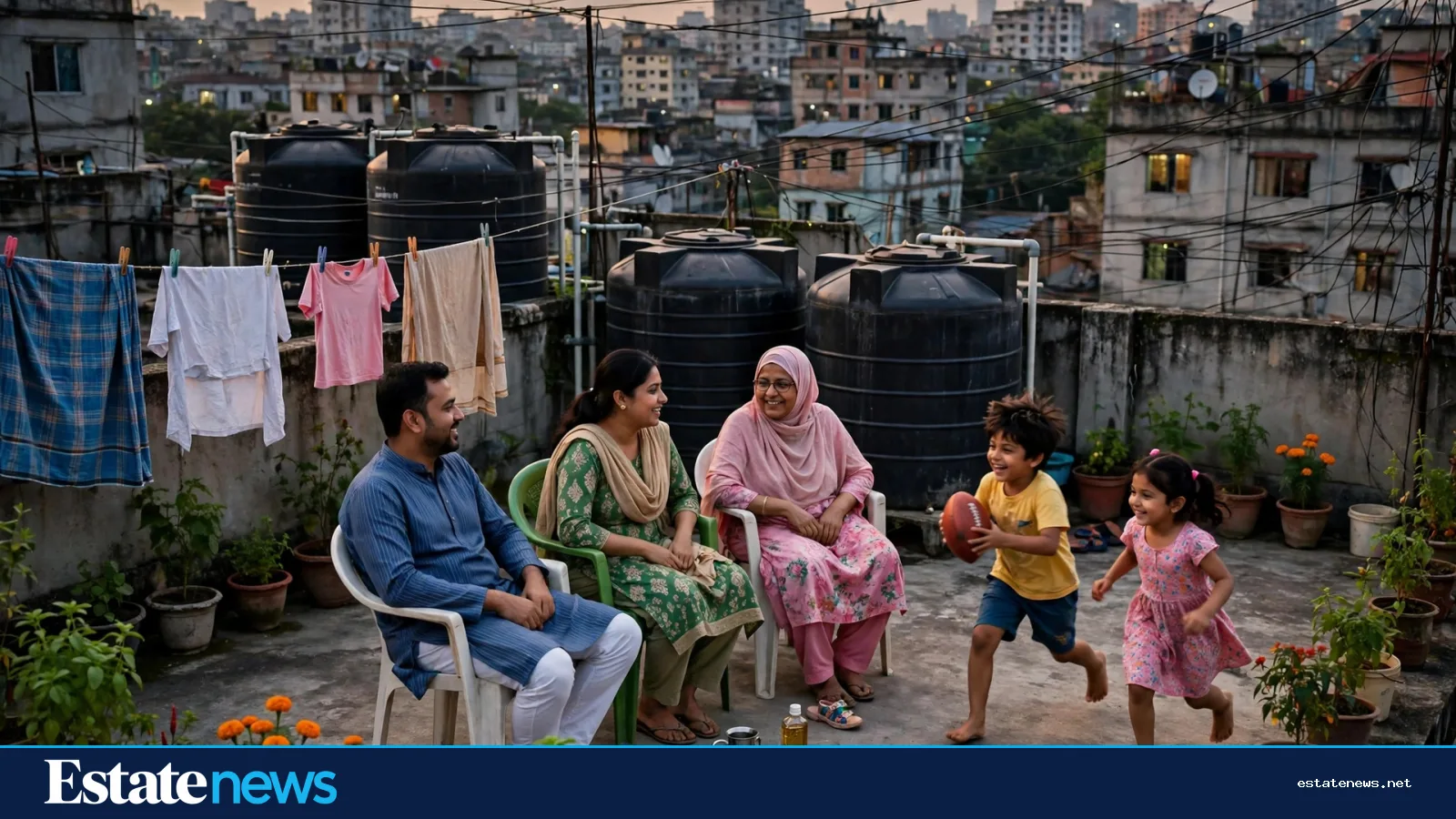
At half past five, the roof of a six-storey building in Dhanmondi changes hands. The water tanks hum. The clothes lines empty as shirts and lungis come down. A man carries up two plastic chairs, then a third. His mother follows with a steel jug of water. Children race up the stairs ahead of everyone, a ball under one arm. By six, the roof has become the building's largest room, and the evening belongs to whoever climbs up to claim it.
Dhaka's flats are getting smaller, and its streets are getting busier. The rooftop is the answer many families have quietly found. It is the one place in a building where a child can run, a grandmother can sit in the open air, and neighbours can talk without a wall between them. No one planned it as a living room. It became one because the city left little choice.
What the roof is used for

The uses change with the hour. In the early morning, the roof belongs to whoever walks there for exercise, and to the plants. By midday, it is the drying ground, and the lines fill with clothes that would never dry inside a flat. In the late afternoon, it turns social. The evening adda, the low plastic chairs in a circle, the tea carried up in a flask, these are the scenes that make a rooftop feel like a neighbourhood square.
Children use it hardest. A roof is the only open ground many Dhaka children have. A ball, a skipping rope, a game of cricket with a soft ball and a plastic bat, all of it fits. Small gardens grow here too: marigolds in earthen pots, chilli plants, a lemon tree in a drum, pudina in a broken bucket. The plants do more than look good. They mark the roof as cared for, and a cared-for roof gets used more.
Buildings use the roof together in other ways. Some hold small gatherings there at Eid or Pohela Boishakh, with chairs borrowed from every flat. Some run a shared vegetable patch, with each family tending a row. A few have turned a corner of the roof into a prayer space in Ramadan, with mats laid out at iftar. The roof takes whatever the building needs, as long as someone looks after it.
The practical side no one can skip


A roof that works as a room needs care, and the care has a price. Safety comes first. The parapet wall must be high enough, and the edge must be clear of loose bricks and broken tiles. A child chasing a ball should never reach an unguarded edge. Staircase doors should shut properly, and the roof should be lit at night, so no one climbs up to a dark floor.
Water is the second question. The black tanks that sit on every Dhaka roof feed every flat, and they need cleaning and covers that fit. A tank left open breeds mosquitoes. A tank that leaks stains the ceiling of the top-floor flat, and the repair bill lands on everyone. Heat is the third. A bare concrete roof soaks up the sun all day and gives it back to the top floor all night. Pots, a shade, a light-coloured coating, any of these helps, but someone has to arrange it and someone has to pay.
Then there are the rules. A rooftop belongs to the building, not to one flat, and its use is decided by the residents together. Some buildings write the rules down: hours for play, a ban on loudspeakers after ten, a rota for watering the plants, a monthly contribution for cleaning and repairs. Others run on habit and goodwill. Both can work. What fails is a roof with no rules at all, where one family's chairs become another family's complaint, and where the first broken tile stays broken because no one owns the job.
A small room with a large return
The cost of a rooftop that works is modest: a few chairs, some pots, a swept floor, a locked gate, a shared cleaning rota. The return is larger than the spend. A building where neighbours know each other is a building where the lift gets fixed faster, where a parcel left downstairs is safe, where an older resident is noticed when she does not come down for a week. The roof is where that knowing starts.
Look up from any Dhaka street in the evening and the roofs tell the story. Lines of washing, a row of pots, a circle of chairs, children running between the tanks. The city built upward because it had no land left. Its families went one floor higher and found the room the flat could not give them.
[Read more: ছোট বারান্দা, বড় স্বস্তি: ঢাকার ফ্ল্যাটে বারান্দা ও ছাদ বাগানের সঠিক পরিকল্পনা](https://estatenews.net/markets/chot-baranda-bd-swsti-dhakar-flzate-baranda-oo-chad-baganer-sthik-priklpna) | [Small-Apartment Living in Dhaka: Space Design That Actually Works in 800 to 1,200 Square Feet](https://estatenews.net/markets/small-apartment-living-in-dhaka-space-design-that-actually-works-in-800-to-1200-square-feet) | [North-Facing Flats in Dhaka: How to Bring Light and Colour Into a Cooler Room](https://estatenews.net/markets/north-facing-flats-in-dhaka-how-to-bring-light-and-colour-into-a-cooler-room)