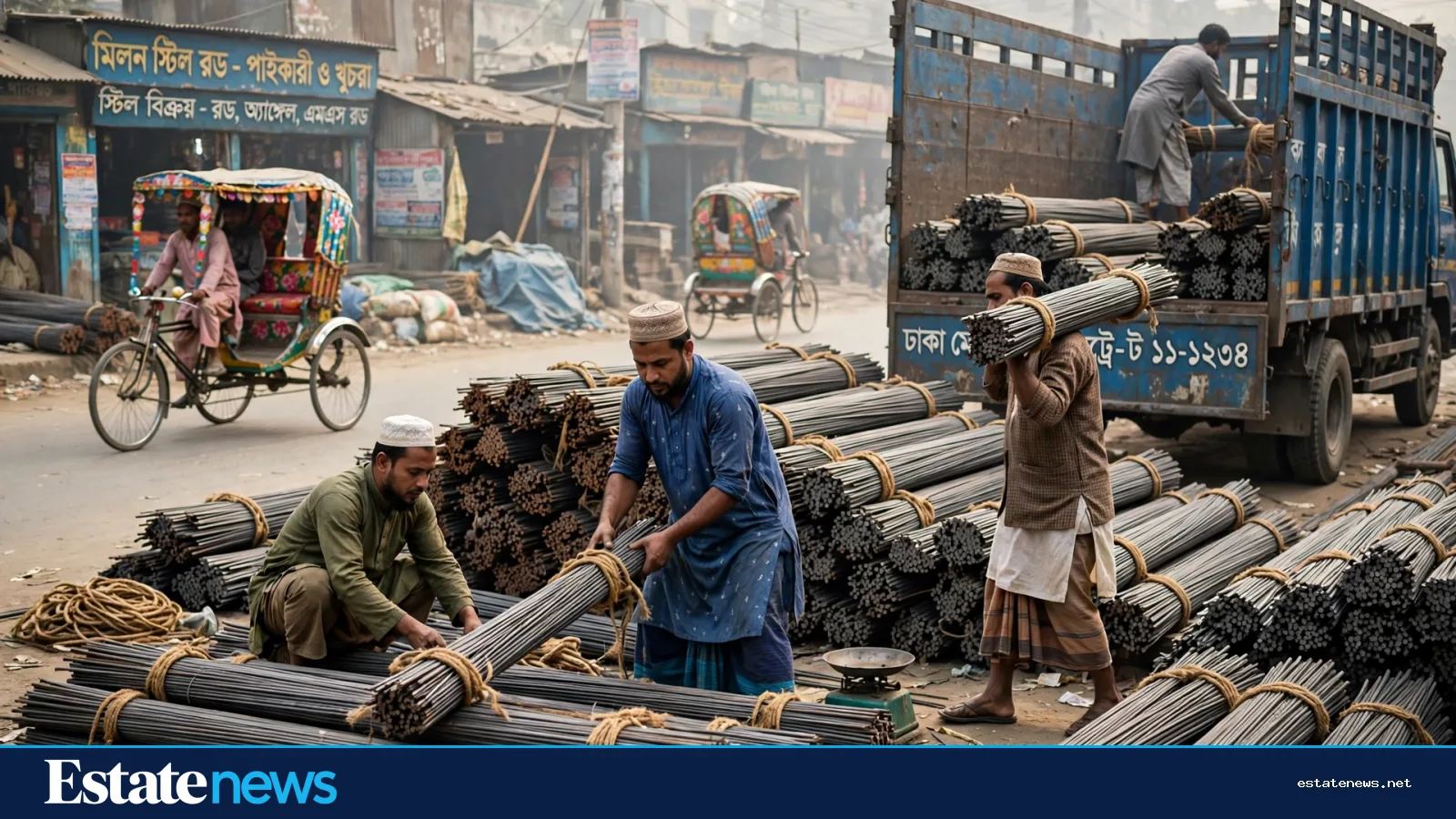
Anyone building a house in Bangladesh this month is paying about the same for steel as last month. Sixty-grade mild steel rod, the grade most construction sites use, sells near Tk 91,250 a tonne at retail, according to Trading Corporation of Bangladesh figures published on 12 November. The range across the market runs from Tk 89,500 to Tk 93,000 a tonne. Forty-grade rod sells at Tk 87,000 a tonne.
Those are shop prices, the prices a builder actually pays at a depot. They are not the same as the government's schedule rates, and the gap between the two is the first thing to understand about steel in Bangladesh.
What the brands charge

The brand makes a difference of a few thousand taka a tonne. According to a Bangladesh Post market review of indicative retail prices, BSRM rod sells at Tk 92,300 a tonne, AKS at Tk 91,500, GPH Ispat at Tk 91,000 and KSRM at Tk 90,500. Those are indicative retail figures from a market review, not mill price lists, and they move with the depot and the day. A builder buying in bulk, or buying from a mill directly, will pay less than the shop price. A builder buying a few bundles at a time from a neighbourhood depot will pay the shop price, and sometimes more.
The spread between the cheapest and the dearest brand is Tk 1,800 a tonne. On a small house that needs a few tonnes of rod, the brand choice is worth a few thousand taka. On a larger building it is worth much more, and it is one of the few costs a builder can actually control by shopping around.
The schedule rate is a different number


On 18 November, the Executive Committee of the National Economic Council approved revised rates for materials used in government construction projects. Under the revised schedule, 500 MPa steel rods are rated at Tk 89,000 a tonne, up from Tk 87,000, while 420 MPa rods are rated at Tk 89,000, down from Tk 90,000, according to The Business Standard.
That Tk 89,000 is a schedule rate for government projects. It is the rate the government uses to price its own construction work. It is not the price at a shop in Dhaka, and it should never be quoted as one. The shop price for 60-grade rod sits about Tk 2,250 a tonne above the schedule rate, and the gap is what a builder pays for buying retail, in small lots, with transport and the dealer's margin included.
The same ECNEC revision moved other materials too. Coarse sand rose from Tk 1,900 to Tk 3,530 per cubic metre, a rise of nearly 86 percent, and Portland Pozzolana Cement rose from Tk 10,000 to Tk 10,400 a tonne in the schedule. Those are schedule rates as well, and the same warning applies to them.
What it means for a house
Cement at retail sells at Tk 540 to Tk 580 per 50-kg bag, a midpoint of Tk 560, according to press figures from 10 October. Put the two together and the picture is steady rather than cheap. Rod has held near Tk 91,250 and cement near Tk 560, which means a builder starting now faces much the same material bill as a builder who started last month. That steadiness is itself useful. A house budget drawn up in October still holds in November, and a family planning a build can price the steel and the cement with some confidence.
Estate News set out the full November picture in "Rod at Tk 91,250 a Tonne, Cement at Tk 560 a Bag: November's Building Costs", and the wider question of what a house costs to build, square foot by square foot, in "Construction Cost Per Square Foot in Bangladesh: What a House Really Costs in 2026". The step-by-step build, from land to roof, is in "How Much Does It Cost to Build a House in Bangladesh in 2026?". The rule for any builder is simple. Ask the depot price, not the schedule rate, and ask it on the day you buy. The two numbers answer different questions, and only one of them is what you will pay.