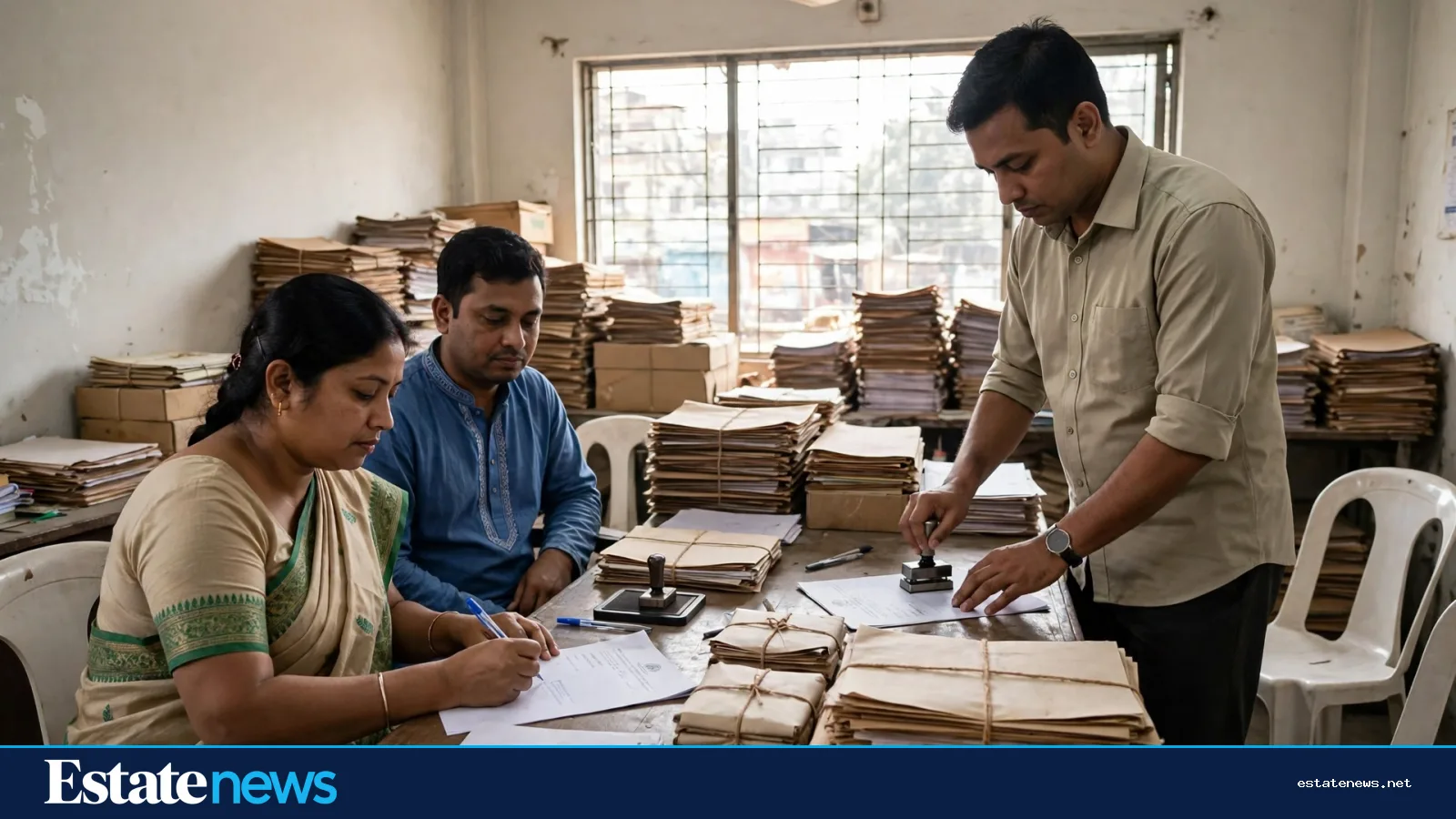
The morning of a registration is a particular kind of Dhaka morning. The buyer arrives early, papers in a file, a lawyer or deed writer nearby, and a seller who is, for once, as nervous as the buyer. Money has already moved, or is about to. What happens in the next few hours decides whether the flat the buyer has paid for becomes, in law, the flat the buyer owns. Registration is not a formality at the end of a purchase. It is the purchase, in the eyes of the state.
Under the Registration Act, 1908, a sale deed for immovable property must be registered with the sub-registrar for the area where the property lies. Until that happens, the buyer's claim rests on private papers and promises. After it happens, the transfer is on the public record, and the buyer can take the next step, mutation of the holding in their own name at the land office, with a registered deed in hand. Buyers who postpone registration to save a fee, or who accept an unregistered arrangement, carry a risk that no later apology fixes.
The stack of charges, in plain terms

Registration costs are not one fee. They are a stack, and each layer has its own rule. The commonly cited layers for a flat in Dhaka are stamp duty at 1.5 percent of the deed value, a registration fee of 1 percent, and local government tax of 2 percent in city corporation and municipality areas, or 3 percent outside them. New flats from a developer add VAT: 2 percent for flats up to 1,600 square feet and 4.5 percent above that size. Source tax under section 125 of the Income Tax Act 2023 is charged on top and varies by area and value, so no honest guide can quote a single all-in total for every flat.
A worked example from Estate News' own registration-cost guide shows the shape of it. For a Tk 1 crore resale flat in Dhaka, stamp duty of Tk 1,50,000, registration fee of Tk 1,00,000, local government tax of Tk 2,00,000 and a mutation fee of Tk 1,170 come to Tk 4,51,170 before source tax, which varies and is not totalled in that guide. A new flat would add VAT on top. Rates change with budgets, and a government-appointed committee has proposed halving stamp duty and cutting other charges, while REHAB, in pre-budget proposals reported by The Financial Express, sought stamp duty of 1 percent, local government fees of 1 percent, and a uniform 2 percent registration rate. Those are proposals, not law. The only safe figure on the day is the one the sub-registry confirms for that deed, in that mouza, at that value.
The papers to carry, and the order of the day
A registration day runs more smoothly when the file is complete before anyone leaves home. The deed itself, drafted and checked, comes first, with the seller's title papers behind it: the deed chain, the mutation record, and, for a developer flat, the approval and handover papers. Both parties carry national identity cards, and the buyer carries proof of every payment: stamp duty, registration fee, local government tax, VAT where it applies, and source tax, each with its challan or receipt. The sub-registrar will not accept a deed until each charge is paid and proved, so the payment queue comes before the signature, not after.


At the office, the deed is presented, the parties are identified, and the deed is signed and admitted in front of the sub-registrar. Keep the receipt for the presented deed with care: it is the proof that registration is in process, and the original registered deed is collected later against it. Photograph nothing that the office forbids, but note the deed number, the date, and the book and volume details when they are given, and keep them with the file at home.
Three mistakes that cost buyers real money
Declaring a deed value far below the real price to cut the fee bill is one such mistake. Deed values are checked against the mouza's minimum values, and an under-declared deed invites enquiry, penalty, and a title that later buyers distrust. The saving is small beside the trouble.
Paying the seller in full before registration is another. If the seller fails to appear, or a last-minute paper problem emerges, a buyer who has already paid everything has lost their bargaining power. A lawyer can structure the payment so the final portion moves on the registration day, against the admitted deed.
Walking out of the sub-registry and forgetting mutation is the quietest mistake of all. Registration transfers the title. Mutation updates the government's own record of who holds the land and flat, and it is mutation that makes future sales, loans, and tax records run smoothly. Budget the Tk 1,170 mutation fee, file promptly at the land office with the registered deed, and keep the mutated khatian with the deed file.
A day worth preparing for
Registration day rewards preparation the way few other days in a purchase do. Confirm the current rates at the sub-registry a few days ahead, because budget changes and area rules move the total. Reconcile the deed value with the real price. Carry every receipt. Keep a portion of payment for the day itself. A flat buyer who treats registration as the main event, rather than the paperwork after it, walks out with something no brochure gives: a home that the public record says is theirs.