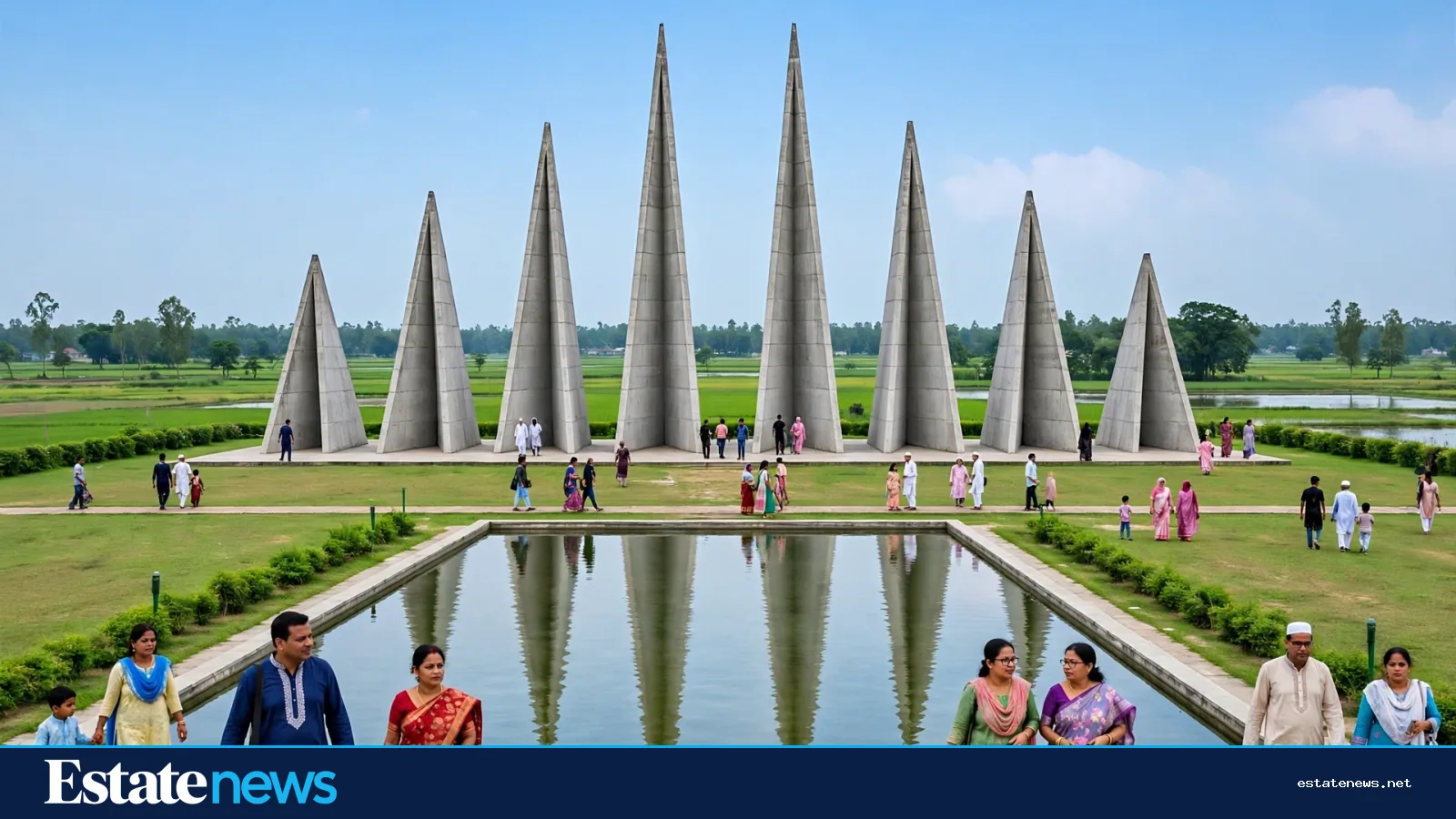
The road out of Dhaka to the north-west runs past factories and fields, and then the walls appear. Seven pairs of triangular concrete walls rise from the flat green of Savar, the tallest reaching 150 feet, sharp against the sky like folded paper. There is no mistaking what they are. This is the National Martyrs' Memorial, Jatiya Smriti Soudha, the monument Bangladesh built for those who died in the Liberation War of 1971. It stands about 35 kilometres from the capital, on the Dhaka-Aricha highway, and it has become one of the most recognised shapes in the country.
The monument does not tell its story in words. It tells it in geometry. Each pair of walls stands for a chapter in the road to independence: the Language Movement of 1952, the United Front election victory of 1954, the Constitution Movement of 1956, the Education Movement of 1962, the Six-Point Movement of 1966, the mass uprising of 1969, and the Liberation War of 1971. The outermost pair is the shortest in height and the widest in span. Each pair after it rises higher, until the innermost pair forms the peak. The shape is a story of a movement gathering force, told in concrete.
A competition, and a 26-year-old winner

Plans for the memorial began in 1976. In June 1978 the government held a nationwide design competition, and 57 designs were submitted. The winner was Syed Mainul Hossain, an architect aged 26. His design was chosen over the work of far older hands, and the choice has shaped how the monument is remembered: a young man's drawing of a nation's hardest history, built at full size.
The main structure and the artificial lake were completed in 1982, and the memorial was inaugurated on 16 December 1982, Victory Day. Concord Group built the monument, and the Public Works Department supervised the work. The building was done in stages. Work in 1972 covered land and roads at a cost of Tk 26 lakh. From 1974 to 1982 came mass graves, a helipad, parking and pavements at Tk 3.77 crore. From August 1982, the main structure, the lake, the green belt, a cafeteria and housing at Tk 848.65 lakh. The figures come from Banglapedia, and they show a project built in stages over a decade, not in a single rush.
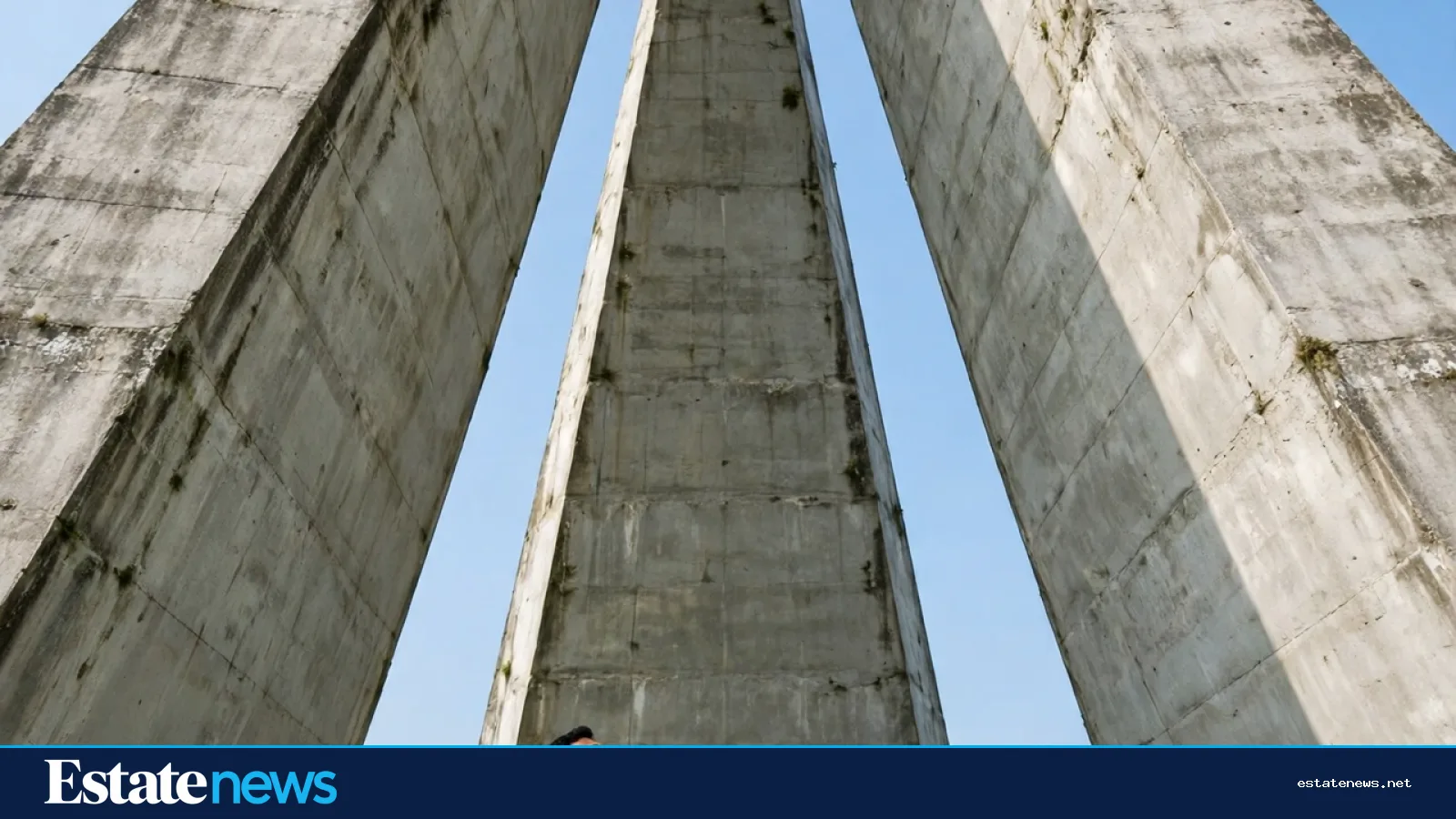
Stand at the base of the walls and the design reads differently. From a distance the seven pairs look like a single peak. Up close they separate into walls you can walk between, and the concrete is plain and unadorned. There is nothing to distract from the shape itself. The architect gave the monument no statues and no carved scenes. The walls are the whole statement, and they hold it without decoration.
What stands there today


The complex spreads over 34 hectares, about 84 acres, wrapped by a green belt of 10 hectares. In front of the monument lies a pool, and within the grounds are mass graves from the war. The scale is part of the design. The memorial is not a statue in a square. It is a piece of ground set aside, with room for crowds to gather and for a visitor to walk and think.
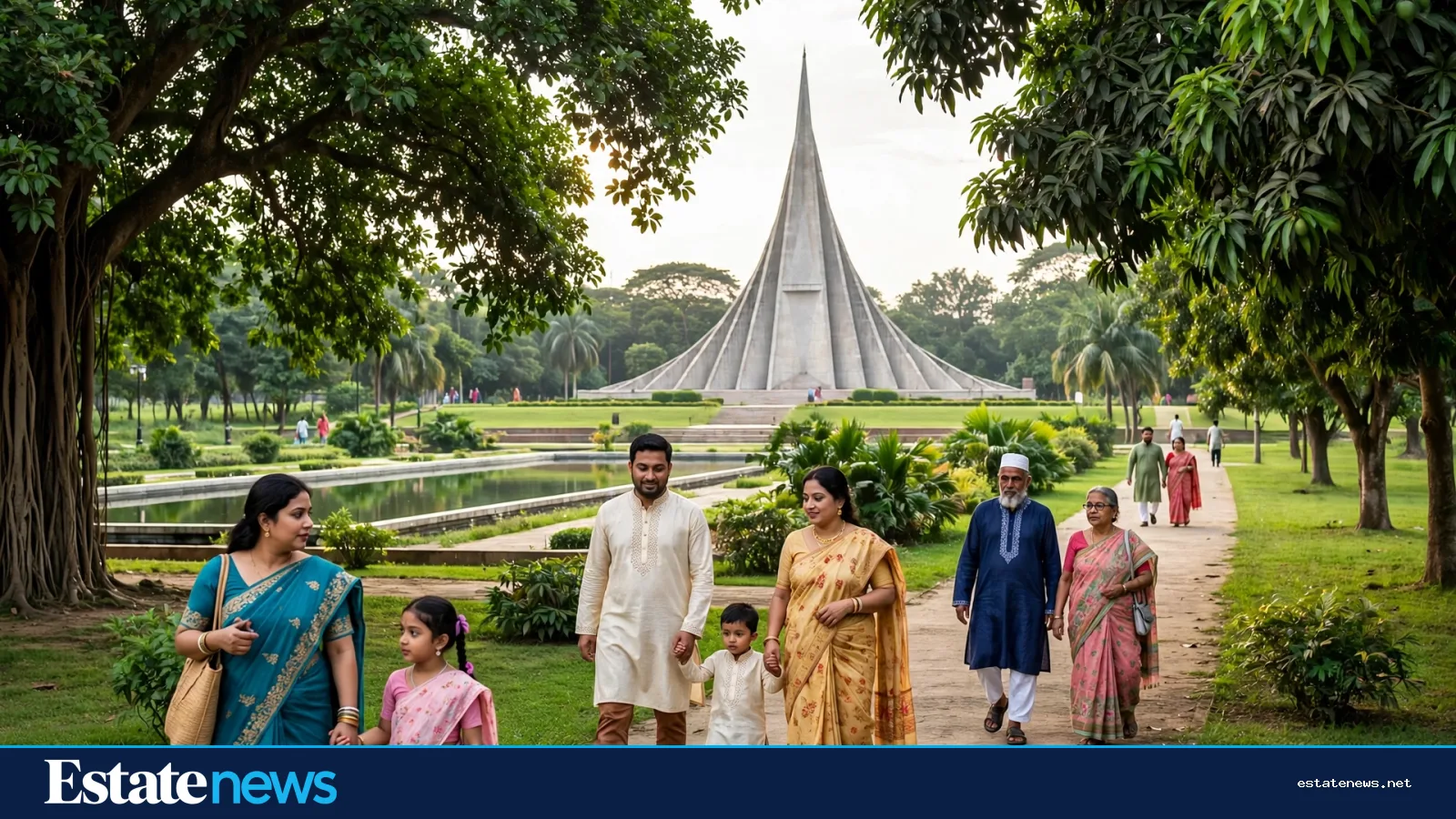
That is how it is used. On 16 December and 26 March, thousands come to lay wreaths. On ordinary weekends, families come with children, and school groups walk the lawns with teachers explaining the seven chapters.
The gardens do the quiet work of the complex. Lawns, trees and water soften the concrete, and the green belt holds the site apart from the highway and the factories beyond it. Without the planting, the walls would stand bare in the fields. With it, the monument reads as a garden with a sharp stone heart, a place to sit as well as a place to remember.
Why the design still works
Other memorials from the same era have dated. This one has not, and the reason is in the drawing. Mainul Hossain did not try to carve the war into stone. He drew a shape that anyone can read: seven steps, each higher than the last, ending in a single point. A child can count the walls and learn the seven dates. An architect can study the way the proportions change from pair to pair. A visitor who knows nothing of the history can still feel the rise.
The monument also carries a second story, about building in Bangladesh. It was designed by a young Bangladeshi architect, built by a Bangladeshi company, and finished in time for the eleventh Victory Day after independence. The country was still poor and still rebuilding, and it chose to spend a decade and crores of taka on a monument with no practical use. That choice says as much about the nation as the walls do.
Savar has changed around the memorial. Factories and housing have filled the highway, and the town is no longer the quiet place it was in 1982. The complex holds its ground. Its green belt keeps the fields in view, and the walls still rise over them. Estate News told the story of another Old Dhaka landmark that gave travellers free rooms in "Bara Katra: The Mughal Inn That Gave Old Dhaka Free Rooms for Travellers", and of the city's oldest church in "The Armenian Church: Dhaka's Oldest Church Still Keeps Its Quiet Corner". The memorial at Savar is different from both. It is not a building to enter or a ruin to restore. It is a shape on the horizon, and a history a visitor can walk through. Retirement living is changing Purbachal in a different way, as Estate News reported in "Retirement Living Comes to Purbachal: Inside the JBFRH Story". At Savar, the change is slower and simpler. The walls stand, the lawns grow, and each December the crowds return to the place where seven chapters of a nation's history rise to a single point.