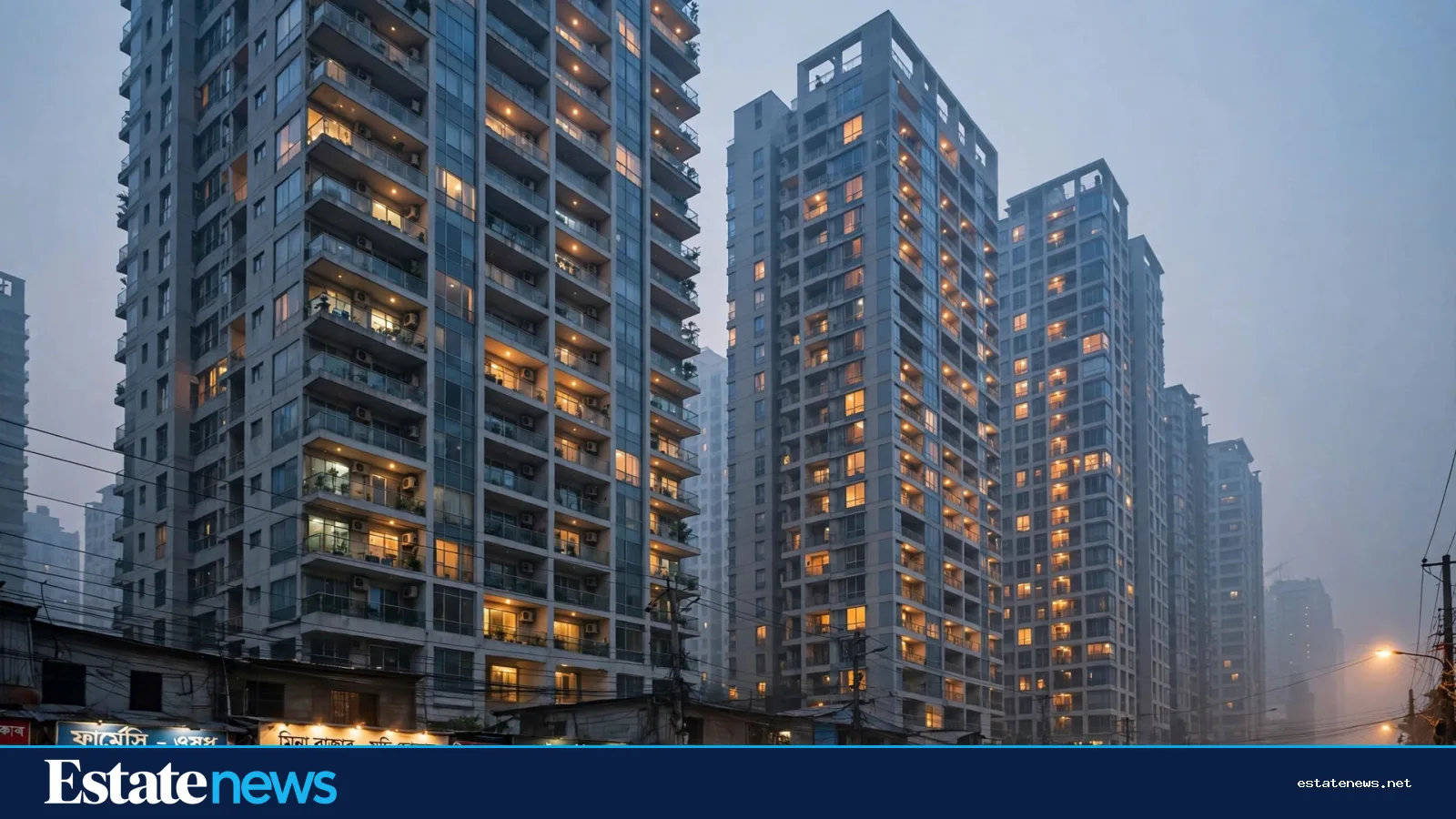
Dhaka is growing upwards because it has little choice. Land is scarce, plots are small, and demand for homes near jobs, schools and hospitals keeps rising. High-rise living is the city's answer. But it comes with a cost structure that surprises many buyers, who compare a high-rise flat's price per square foot with a low-rise flat nearby and wonder why the taller building charges more.
The answer is not fashion or marketing. It is physics, engineering and services. Height changes what a building must be.
Structure gets heavier as buildings get taller

A low-rise building carries its own weight and a modest wind load. A tall building must resist much stronger wind forces, and in Bangladesh, seismic forces as well. That means larger columns, stronger concrete, more reinforcement steel and, often, deeper foundations or piling.
The structural share of cost therefore rises with height, not in a straight line but in steps. Each additional band of storeys can require a step-change in design — thicker shear walls, a stronger core, or a different foundation system. A developer cannot simply stack more identical floors on top of a low-rise design and call it a tower.
There is also an efficiency cost. In a tall building, more floor area is consumed by the core — lifts, staircases, lobbies and service shafts. The saleable area per floor falls as a share of the total built area, so the cost of the whole building is spread over fewer saleable square feet. That alone pushes the per-square-foot figure up, even before services are counted.
Lifts, water and power: the hidden infrastructure
Low-rise residents may take a staircase for granted. High-rise residents cannot. Lifts are not an amenity in a tall building; they are essential infrastructure, and they must be plural. A single lift serving twenty floors is a failure waiting for a breakdown. Reputable towers provide multiple lifts, with backup power so that residents are not stranded during an outage.
Water is a similar story. Gravity alone will not carry water reliably to the upper floors. Tall buildings need underground reservoirs, overhead tanks, booster pumps and pressure management, with standby systems for outages. Power needs its own planning: substations, generators, load distribution and fire-rated cabling.
None of this is visible in a show flat. All of it is priced into construction, and much of it recurs as service charges for the life of the building.
- Lifts: multiple lifts, backup power, annual maintenance contracts and eventual replacement reserves.
- Water: reservoirs, pumps, tanks and pressure systems that must run every day.
- Power: substations, generators and common-area loads that low-rise buildings largely avoid.
- Security and common areas: lobbies, guards, CCTV and access systems scaled to many households.


Fire safety is not optional, and it is not cheap
Fire safety is where the difference between a low-rise and a high-rise building becomes most serious. Escape from an upper floor cannot rely on a single staircase and a hope. Tall buildings require fire-rated staircases, pressurised lobbies in many designs, smoke detection and alarm systems, hydrants, extinguishers, refuge provisions where required, and clear, practised evacuation routes.
These systems must be installed, tested and maintained. A fire pump that has never been tested, a staircase blocked by storage, or an alarm system with dead batteries is not a minor housekeeping failure in a tall building. It is a safety failure. Buyers should treat a building's fire-safety maintenance record as seriously as its finishes, because the cost of doing it properly is real — and the cost of not doing it is unacceptable.
What this means for service charges
The high-rise premium does not end at purchase. Monthly service charges in tall buildings are typically higher because the building has more to run: lifts, pumps, generators, common lighting, security and cleaning across large common areas. A buyer comparing two flats should compare not just the purchase price per square foot but the expected monthly charge, and what it covers.
A useful question to ask before buying is what the service charge includes, how it is calculated, whether a sinking fund exists for lift replacement and major repairs, and who manages the building after handover. A tower with a low advertised service charge and no reserve fund may simply be deferring costs that will arrive later as a special levy.
When height is worth paying for
None of this means high-rise living is poor value. For many Dhaka families, it is the only way to live near work, schools and hospitals without an impossible commute. Views, light, air and security can be genuine benefits, and well-managed towers offer amenities — gyms, community rooms, rooftop spaces — that small plots cannot.
The point is to price height honestly. A high-rise flat costs more per square foot because it is a more complex machine for living: stronger, taller, more serviced and more safety-critical than a low-rise home. Buyers who understand that can judge whether the premium buys real engineering and reliable services, or merely a floor number.
Height is not a luxury added to an ordinary flat. It is a different kind of building, with different costs, different risks and different responsibilities — and it should be bought with that understanding.
Follow Estate News on Facebook for daily property, market and money updates: https://www.facebook.com/profile.php?id=61593817347872