Ask a builder in Dhaka what it costs to build a house, and the answer will usually be a single number per square foot. Ask a family that has actually finished one, and the answer will be longer, messier and more useful. The per-square-foot figure covers the building. It rarely covers everything else — and it is everything else that most often breaks a budget.
A house budget is better understood as four buckets, not one. Land comes first. Structure comes second. Finishes come third. And a fourth bucket — fees, connections, professional charges and contingency — is the one people forget until it arrives as a demand.
Land is not just the purchase price

Land is usually the largest single cost in Dhaka and its surrounding districts, and it is also the most variable. Two plots of the same size, a few streets apart, can differ sharply in price because of road width, drainage, flood history, proximity to a main road and whether the title is clean and mutation is complete.
The purchase price, however, is not the full land cost. Registration, stamp duty, legal verification and mutation all add to it, as do boundary demarcation, soil testing and, on low or filled land, earth filling and piling. A plot that looks cheap because it needs extensive filling or deep foundations may not be cheap at all once those works are priced in.
Buyers should also budget time. Title checks, deed verification and approval processes can take months, and delay itself has a cost — in rent paid elsewhere, in material prices moving, and in loan interest if borrowing has begun.
Structure: where the money is most visible
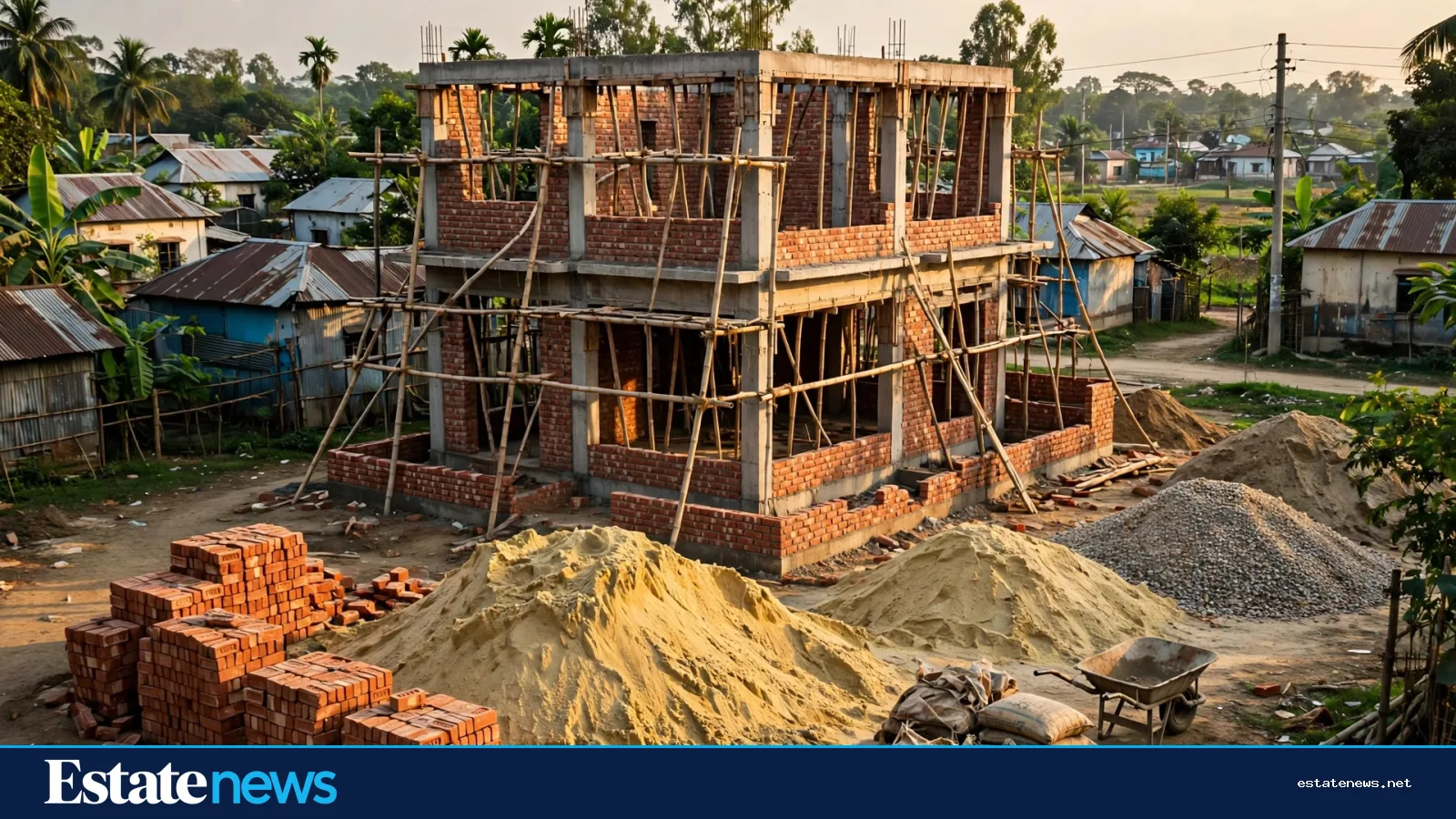
The structure — foundation, columns, beams, slabs, brickwork and roof — is the part of the budget most people picture when they think of construction. Its cost depends heavily on soil condition, the number of storeys, and the structural system chosen.
A single-storey house on firm ground is a different engineering proposition from a four-storey house on soft, filled soil that needs piling. Staircases, water tanks, boundary walls and septic or sewerage arrangements are structural-adjacent works that are sometimes left out of a headline quotation and then appear later as extras.
Indicatively, and only as a planning range rather than a quotation, many mid-range houses in and around Dhaka see structure account for roughly 40 to 50 per cent of the pure building cost, before land and finishes. The share rises where foundations are difficult and falls where finishes are lavish. The point of the range is not precision; it is discipline. If a quotation shows structure as a suspiciously small share of the total, something has probably been left out.
Finishes: the budget that expands quietly
Finishes — flooring, doors and windows, kitchen and bathroom fittings, painting, electrical fittings and joinery — are where budgets expand quietly, room by room. No single finish decision is dramatic. Together, they are decisive.
A family choosing local tiles over imported ones, standard sanitary ware over premium brands, and aluminium windows over a costlier system can move the total by a wide margin without changing the size or structure of the house at all. The reverse is also true: a modest structure dressed in premium finishes can end up costing as much as a larger, plainer house.


The practical safeguard is to fix a finishes schedule early, in writing, with brands or at least quality grades named. Vague phrases such as "good quality fittings" invite dispute later, when one side's idea of good quality turns out to be considerably more expensive than the other's.
- Fix the finishes schedule before construction starts, with grades and brands named where possible.
- Price the kitchen and bathrooms separately — they concentrate fittings, plumbing and tiling in small areas.
- Decide on air-conditioning, water heating and solar provisions early, so conduits and loads are planned rather than retrofitted.
- Keep a written record of every variation, with its price agreed before the work is done.
The costs people forget
Beyond land, structure and finishes sits a list that rarely appears in casual conversation about building costs. It includes architect and engineer fees, approval charges, utility connection fees for electricity, water and gas where applicable, and the cost of a site supervisor or project manager if the owner cannot be present daily.
Then there is contingency. Material prices move. A monsoon season can slow work. A design change mid-way — moving a wall, adding a room, upgrading a staircase — ripples into structure, finishes and labour. Experienced builders advise holding back a contingency of roughly 10 per cent of the building budget for exactly these reasons. It is not pessimism; it is the difference between a project that absorbs a surprise and one that stalls halfway.
Financing costs belong here too. A construction loan drawn in stages still accrues interest, and a project that runs six months longer than planned costs more in interest and in rent for temporary accommodation.
What moves the total most
Five factors move a house budget more than any others: location and land condition, number of storeys and foundation type, the finishes standard, the quality of supervision, and time. Of these, time is the least discussed and often the most expensive, because delay compounds every other cost.
The most reliable way to control cost is not to chase the cheapest quotation. It is to compare quotations on the same scope — same structure, same finishes schedule, same inclusions — and to ask, in writing, what is excluded. A quotation that excludes piling, boundary walls, water and electricity connections and approval fees is not cheaper. It is incomplete.
Building a house is not buying a product off a shelf. It is commissioning a long, weather-exposed project, and the budget that survives contact with reality is the one that planned for the parts nobody photographs.
A house built within budget is rarely the cheapest house imagined at the start. It is the house whose owner understood, before the first brick was laid, that land, structure, finishes and the forgotten costs are four budgets, not one — and planned for all four.
Follow Estate News on Facebook for daily property, market and money updates: https://www.facebook.com/profile.php?id=61593817347872