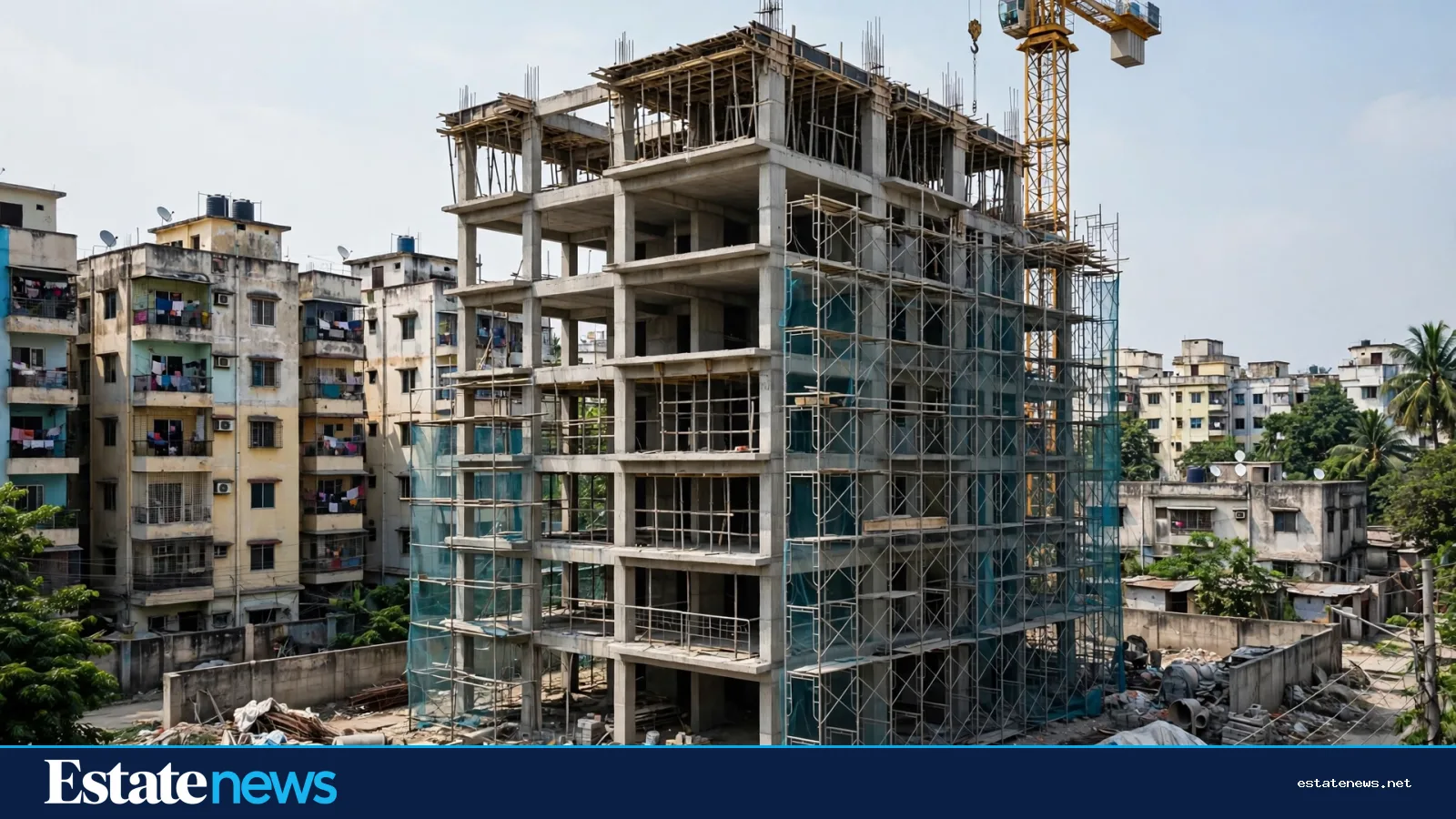
A buyer walking past a half-built apartment block in Dhaka usually asks two questions: when will it be finished, and what will the flat look like? A third question matters just as much, though it is rarely asked on a site visit: how is this project being paid for?
Apartment development is capital-intensive long before the first flat is sold. Land must be secured, approvals obtained, materials bought in stages, and workers and contractors paid month after month. The money rarely comes from one place. Most projects combine several sources, and the balance between them helps explain why some buildings rise steadily while others stall, restart, and stall again.
Understanding the main funding models does not require a finance degree. It requires knowing what each source of money expects in return, and what happens when that money is slow, expensive or withdrawn.

Presales: selling the future to build the present
The most familiar model in Dhaka is presale funding. A developer sells flats before or during construction, and the instalments buyers pay — a booking amount, followed by stage-linked payments — help fund the work itself.
For a developer, presales reduce borrowing and test demand early. If buyers commit, the project has both cash and a visible vote of confidence. For buyers, the trade-off is clear: a lower entry price than a ready flat often comes with waiting, uncertainty and exposure to delay.
That is why the payment schedule deserves as much attention as the floor plan. Payments tied to visible construction stages — foundation, structure, brickwork, finishing — align the buyer's money with progress on the ground. A schedule that demands most of the price before the structure is complete asks the buyer to carry more of the project's risk.
Buyers can also ask a simple, fair question: what happens to instalments if construction pauses? The answer, and whether it is written clearly in the agreement, tells you a great deal about how the project is governed.
Bank finance: borrowed money, disciplined timelines
A developer may borrow against the land, the project or its own balance sheet, repaying from sales proceeds as flats are handed over.
Bank finance brings discipline. Lenders usually ask for approvals, valuations, progress reports and a repayment plan, and they disburse in stages rather than in one lump sum. That oversight can protect buyers indirectly, because a project that cannot satisfy a lender's checks may struggle to proceed at all.
But borrowed money also has a cost. Interest accumulates whether flats sell quickly or slowly, and a high policy-rate environment — Bangladesh's policy rate stands at 9.5 per cent — raises the price of carrying a project over time. When borrowing is expensive, developers have less room to absorb slow sales, rising material costs or approval delays. That pressure can show up as slower work, renegotiated terms or, in difficult cases, a search for fresh capital mid-project.
For buyers, the lesson is not to fear bank-funded projects. It is to understand that a project's timeline is partly a function of its interest bill, and that a developer with a credible repayment plan is in a stronger position than one relying on hope that sales will accelerate.
Landowner joint ventures: land in, flats out
A third model is the joint venture between a landowner and a developer. The landowner contributes the plot; the developer contributes capital, expertise and construction capacity. In return, they share the completed building, usually by an agreed ratio of flats or floor area.
This model has built a large share of Dhaka's housing. It lets landowners unlock the value of a plot without selling it outright, and lets developers build without buying land at full market price upfront. The sharing ratio, the party responsible for approvals and costs, and the treatment of delays are all set in the joint-venture agreement.


Where these projects run into trouble, it is often not the construction itself but the partnership: a dispute over costs, a change in the agreed design, or uncertainty over who signs what at handover. Buyers should therefore ask who the developer is, who the landowner is, and whether both stand behind the sale agreement. A clear, single point of accountability matters more than a glossy brochure.
Equity and internal funds: the developer's own stake
Finally, there is equity — the developer's own money, retained profits from earlier projects, or investment from partners. Equity is the most patient form of funding because it does not carry a fixed repayment date in the way a loan does. A developer with substantial equity in a project has more room to ride out a slow market.
No buyer can see a developer's balance sheet from the street. But indirect signals help: a record of completed projects, a history of handing over on or near schedule, and a willingness to answer questions about funding in plain language. Evasiveness about money is itself information.
Why the mix matters more than any single source
In practice, most projects blend these models. A typical structure might combine presale instalments, a bank facility and the developer's equity, built on a joint-venture plot. The mix matters because each source behaves differently under stress. Presales dry up when buyer confidence falls. Bank money tightens when rates rise or approvals lag. Joint ventures strain when partners disagree. Equity cushions shocks but is finite.
Delivery risk, then, is not a single number. It is the interaction of funding, approvals, sales pace and construction management. A well-funded project can still be delayed by an approval bottleneck. A thinly funded project can still finish if sales are strong and costs are controlled. Buyers who understand the mix can ask better questions and weigh the answers.
What buyers can ask before they sign
How is this project funded, in broad terms — presales, bank finance, joint venture, equity, or a mix?
Are my instalments linked to visible construction stages?
Who is the contracting party, and what does the agreement say about delay?
Has the developer completed comparable projects, and were they handed over?
What approvals are already in place, and which are still pending?
None of these questions requires the developer to disclose commercially sensitive detail. A reputable developer can answer them in general terms without hesitation. A project team that cannot explain its own funding model in plain language is asking buyers to trust what they cannot see.
Buying a flat is, in part, buying into a funding plan. The building you will live in is the visible result of invisible financial choices made years earlier. Asking how the project is paid for does not make a buyer difficult. It makes a buyer informed — and informed buyers are, in the end, the best protection a housing market has.
Follow Estate News on Facebook for daily property, market and money updates: https://www.facebook.com/profile.php?id=61593817347872