Bangladesh earns about $16 million a year from selling carbon credits. The country could earn up to $1 billion a year. That is the gap the government is now trying to close, and the framework for doing it has just been finalised.
The figures come from Md Saimum Parvez, special assistant to the prime minister for environment, forest and climate change affairs, speaking at a Dhaka event organised by the Power Division and the Infrastructure Development Company Limited (IDCOL). The Daily Star reported his remarks on 5 November.
Where the $16 million comes from

The money earned so far is small, and it comes from small things. Since 2006, Bangladesh has sold about 2.53 million carbon credits, earning roughly $16.25 million, largely from solar home systems and improved cookstoves, according to reporting by The Business Standard cited in The Prestige magazine. A carbon credit is, in plain terms, a certificate for one tonne of emissions avoided, sold to a buyer elsewhere who needs it to meet a climate commitment.
The early projects were the right ones for their time. Solar home systems put light in village homes that the grid had not reached. Improved cookstoves cut smoke in kitchens and used less firewood. Both cut emissions, and both could be measured. What they could not do was scale. IDCOL's credits sold for $1 to $7 each, and less than 15 percent of the more than 50 million credits the country has issued has actually been turned into money.
The framework, the registry, the cell
The government has finalised a national carbon credit framework, which will go to the cabinet within a month, according to the Daily Star report. It also plans a national registry and a dedicated cell under the Department of Environment, to keep track of what is sold and to stop the same tonne of avoided emissions being counted twice.
That plumbing matters more than it sounds. International buyers will not pay for credits they cannot trust, and the rules of the Paris Agreement require a project to prove it would not have gone ahead without carbon money. Developers must now think about carbon finance from the planning stage, Saimum said at the Dhaka event, because the standards demand that proof from the start.


The barriers are familiar ones. Stakeholders at the event named low awareness, investment risk and limited access to affordable finance as the main blocks. Fazlul Hoque of the Federation of Bangladesh Chambers of Commerce and Industry said the problem was not a shortage of funds but weak demand at the grassroots and limited awareness among businesses. Habibur Rahman, deputy governor of Bangladesh Bank, called for cheaper loans, longer repayment periods and clear guidelines, and pointed to the central bank's $200 million Green Transformation Fund, which lends to banks at 1 to 2 percent while borrowers pay 5 percent.
The pumps, the trees, the roofs
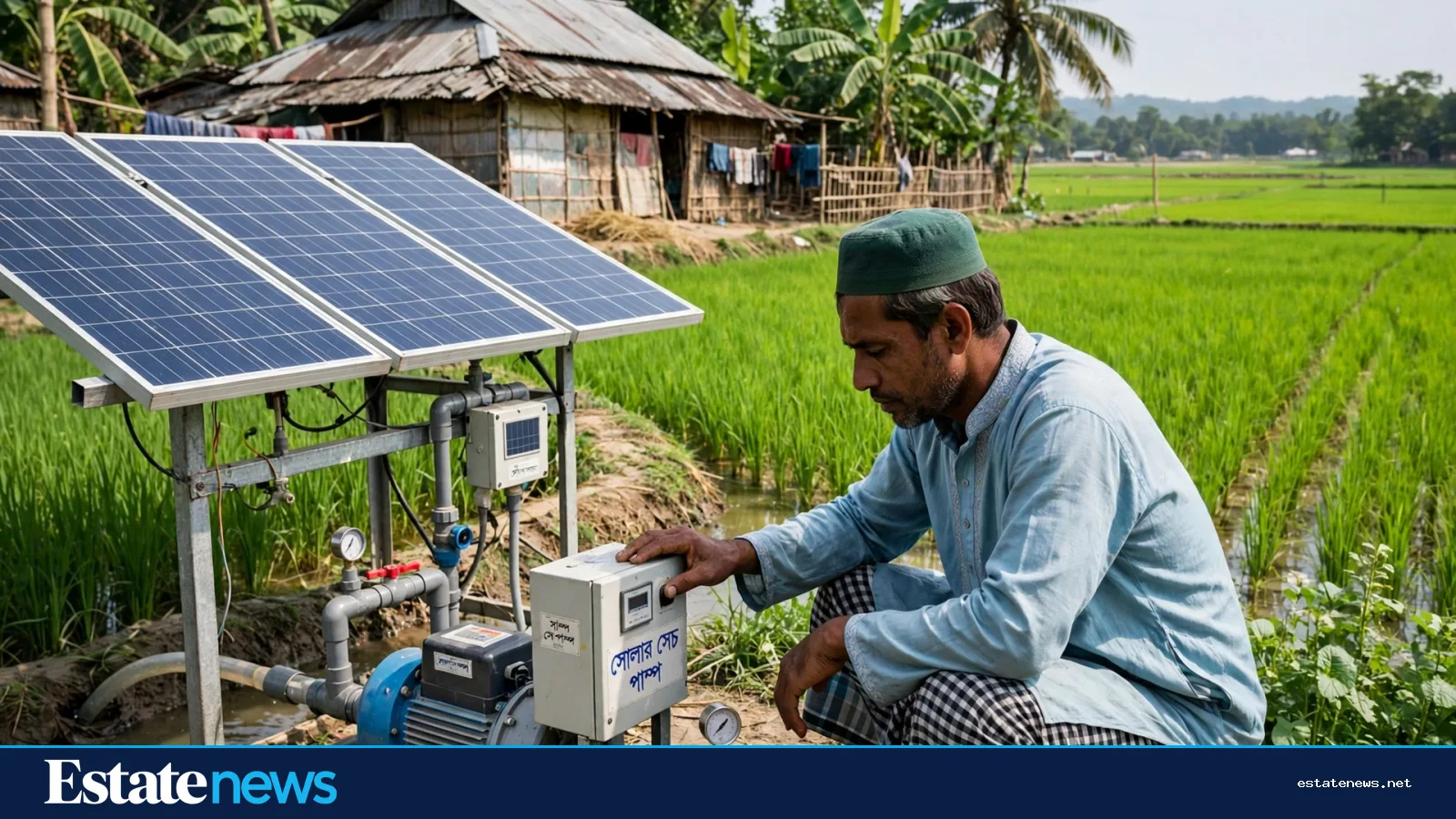
The biggest single plan sits in the fields. The government plans to convert 1 to 1.5 million diesel- and electricity-powered irrigation pumps to solar within 18 months, according to announcements made at the COP31 climate conference this month. A solar pump cuts a farmer's fuel bill and, in carbon terms, it cuts emissions that can be measured and sold.
The tree plan runs alongside it. The prime minister formally inaugurated a programme in June to plant 250 million trees over five years, including 20 million mangroves along the coastal belts in six months. A government climate finance report estimates the tree programme alone could bring in nearly $1 billion a year from carbon credits if it is carried through, according to World Bank estimates cited by Bangladesh Post. The Sundarbans, the world's largest mangrove forest, is named by Saimum as one of the country's biggest potential sources of carbon credits.
There is already one transaction to point to. The World Bank's Ci-Dev programme completed South Asia's first carbon transaction aligned with Article 6.2 of the Paris Agreement, paying $15.3 million for verified emission cuts from 3.3 million solar home systems between 2021 and 2024. IDCOL is using that revenue for rooftop solar for lower-income consumers and for solar irrigation pumps, and it has a clean-energy pipeline above $2 billion. Each megawatt of solar could generate $10,000 to $15,000 a year by avoiding about 900 tonnes of emissions, according to New Age.
What it means for a roof
For a flat owner, the connection is not abstract. Rooftop solar is the part of this market that touches a home directly. IDCOL is already channelling carbon revenue into rooftop solar for lower-income consumers, and the framework now being finalised is meant to let more small projects qualify, grouped together so that a single rooftop is not too small to bother with. Jean Pesme, the World Bank's country director, made the same point at the Dhaka event: group smaller projects together and larger investors will come.
The $1 billion figure is a potential, not a promise, and it will take years of verified projects to reach. But the pieces are now in place in a way they were not a year ago: a framework, a registry on the way, a first Article 6.2 transaction done, and a pump conversion programme that would create credits at a scale the early cookstove projects never could. Estate News covered the free-power deal for public buildings in "Your Roof, Their Panels: The 10 Percent Free Power Deal for Public Buildings", electric car charging for flat owners in "Your Next Car Plugs In: Where Dhaka Flat Owners Charge an Electric Car", and what drones actually do on building sites in "Drones Over Dhaka's Building Sites: What They Actually Do".