Some buildings are remembered for what they finished. Lalbagh Fort is remembered for what it did not. In the heart of old Dhaka stands an incomplete Mughal palace fortress — a place begun with palace ambition, left unfinished, and still, more than three centuries later, one of the city's most visited and most loved historic sites. Its incompleteness is not a footnote. It is the story.
Construction of the fort began in 1678, when Prince Muhammad Azam was viceroy of Bengal. His viceroyalty lasted only fifteen months, and the work he started was not completed by his successor, Shaista Khan. The fort therefore remains what its beginnings made it: a palace-fortress interrupted, its plan legible but its full design never realised. That interruption is part of why it moves visitors. Lalbagh does not present a perfected monument. It presents an intention — a palace, gardens and water laid out for a courtly life that never fully arrived.
A death that changed the place

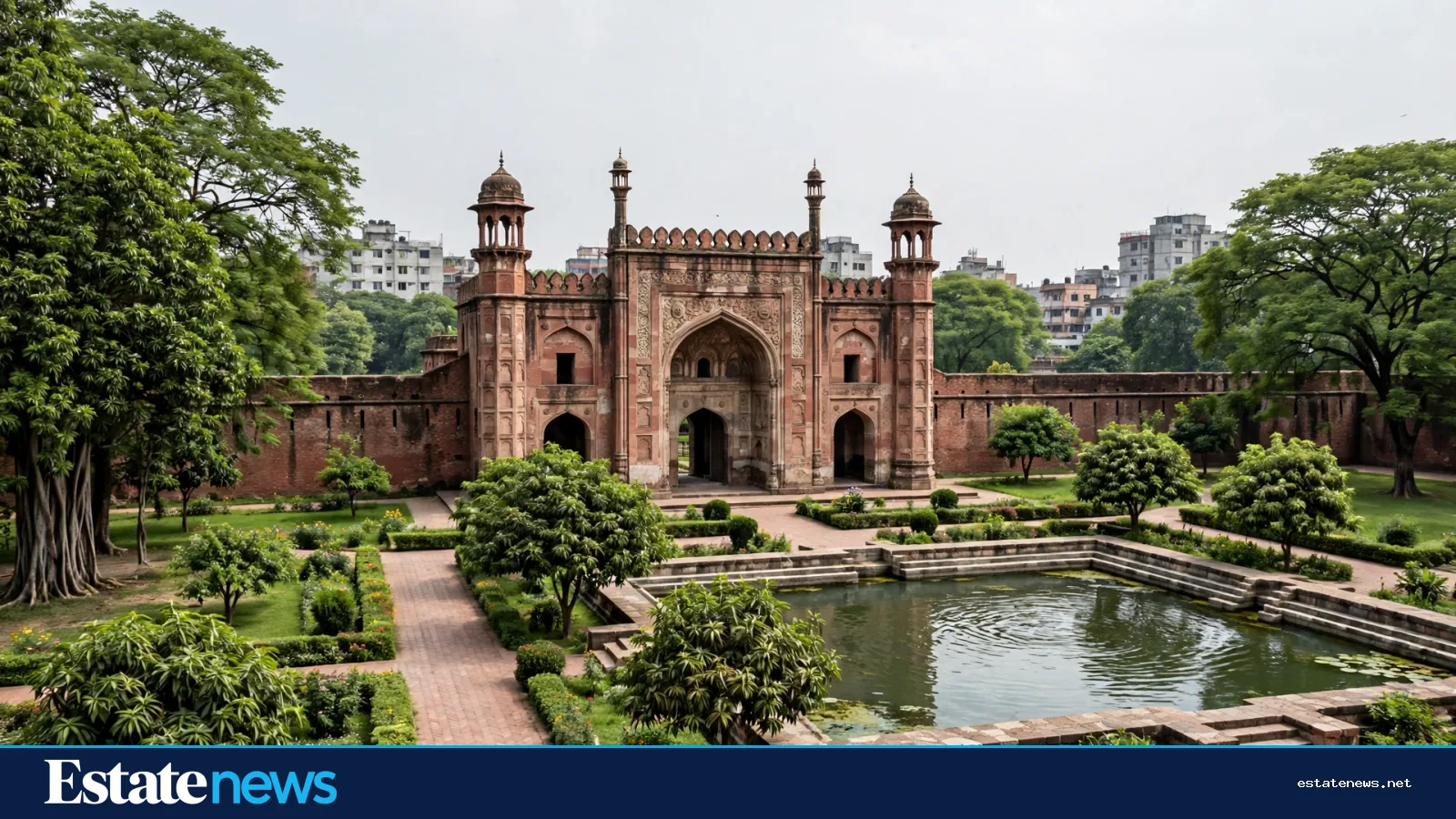
The human centre of the fort's story is a death. Shaista Khan's daughter Bibi Pari — whose name is also given as Iran Dukht — died there in 1684. Her tomb stands within the fort today as one of its three main survivals, alongside the mosque and the Diwan-i-Aam, the hall of public audience. Three buildings, then, carry the core of what remains: a place of prayer, a place of mourning, and a place where a ruler met the public. Between them they describe, in miniature, the life a Mughal palace-fortress was meant to hold — faith, family and public duty, set within walls and gardens.
The southern gateway, rising three storeys, gives the fort its public face: a tall, formal entrance that announces a palace rather than a mere garrison. Gateways matter in Mughal architecture because they stage arrival — the passage from the city's streets into an ordered world within. At Lalbagh, that passage survives even though the palace behind it does not, and walking through it still feels like entering a different order of space.
What the ground itself revealed
The present area of the fort is 18 acres. That figure alone understates what the site contains, because much of its story has been recovered from below the surface. Excavations by the Department of Archaeology have revealed 26 or 27 structures, together with evidence of a water supply system, sewerage, roof gardens and fountains, and a square tank measuring 71.63 metres on each side.


Those findings change how the fort should be read. Lalbagh was not only walls and gateways. It was a working landscape of water and gardens: water brought in, stored, displayed in fountains and tanks, and drained away; gardens planted not only at ground level but on roofs; a palace precinct designed around the movement and sound of water. For a city like Dhaka, which still struggles with water — too much in the monsoon, too little managed well in the dry season — that is a striking inheritance. The Mughal builders treated water as something to design with, not merely to defend against or dispose of.
What Lalbagh teaches Dhaka today
That is the first lesson Lalbagh still teaches: build for water, gardens and public life together. A housing project that treats open space as leftover land, or drainage as an afterthought, will feel the difference every monsoon. A neighbourhood that plans its water, its shade and its shared spaces from the start — as Lalbagh's designers did within their walls — gives its residents something that no single building can provide alone.
The second lesson is about incompleteness itself. Dhaka is a city of unfinished and adapted buildings, of plans revised mid-course and uses changed over time. Lalbagh dignifies that condition. It shows that an unfinished place can still become a public treasure, if what survives is cared for and opened to the city. The fort's value today lies less in the palace that was never finished than in the gardens, tomb, mosque, audience hall and gateway that remain — and in the public life that gathers around them.
The third lesson is pride without pretence. Lalbagh does not need a finished story to matter. Its interrupted history is honestly part of its appeal: a prince's brief viceroyalty, a successor who did not complete the work, a daughter mourned within its walls, and a garden-and-water landscape recovered by archaeologists centuries later. Heritage, at its best, is not a polished legend. It is a real place, with real gaps, still standing in the middle of a living city — and still teaching that city how to build with water, greenery and public dignity in mind.
Follow Estate News on Facebook for daily property, market and money updates: https://www.facebook.com/profile.php?id=61593817347872