Fifty-five ships that were meant to bring liquefied natural gas to Bangladesh never came. Suppliers have cancelled 55 LNG cargoes since 18 March, amid the Middle East crisis, forcing the government to buy gas at higher prices from the international spot market. The crisis cost the government an additional $4.12 billion between March and September, Prime Minister's Adviser on Finance and Planning Rashed Al Mahmud Titumir said on Saturday 28 November, at the inaugural session of the fourth Bangladesh Energy Conference at the Bangladesh Military Museum in Dhaka.
The subsidy bill tells the same story from the other side. LNG import subsidies have reached around Tk 34,000 crore since the government took office in February, Titumir said. When a contracted cargo is cancelled, the gas still has to come from somewhere, and the somewhere is the spot market, where prices move by the day and a buyer in a hurry pays more. The extra $4.12 billion is the price of that hurry, counted over seven months.
Why the cargoes stopped

The cancellations trace back to the war and the shipping crisis in the Middle East, and to the uncertainty over the Strait of Hormuz, through which much of the region's gas travels. QatarEnergy, the world's largest LNG exporter, has extended force majeure notices to Asian buyers, including Bangladesh, and told clients it cannot deliver cargoes while the strait remains closed. The disruption has hit the whole region, and Bangladesh, which buys most of its LNG under long-term contracts, has felt it in cancelled deliveries and higher spot purchases. Brent crude, the global oil benchmark, settled at $95.44 a barrel on Friday, down 1.2 percent on the day but up 3.1 percent on the week, and OPEC+ meets today, Sunday 29 November, to set output policy for 2027. That meeting, and what it means for fuel prices, is covered in "Brent Hits $96.57 as OPEC+ Meets Sunday on 2027 Supply".
What it costs a flat


Gas is not an abstract import for a Dhaka household. It cooks the food, heats the water and, through the power plants, runs the lift and the lights. When the government pays Tk 34,000 crore in subsidies to keep gas flowing, that money comes from the same budget that builds roads, schools and hospitals. When the subsidy cannot cover the gap, the pressure lands on tariffs, on power cuts, or on the price of a cylinder. The energy crisis is a housing cost, even when it arrives dressed as a shipping schedule.
The 10,000 MW answer
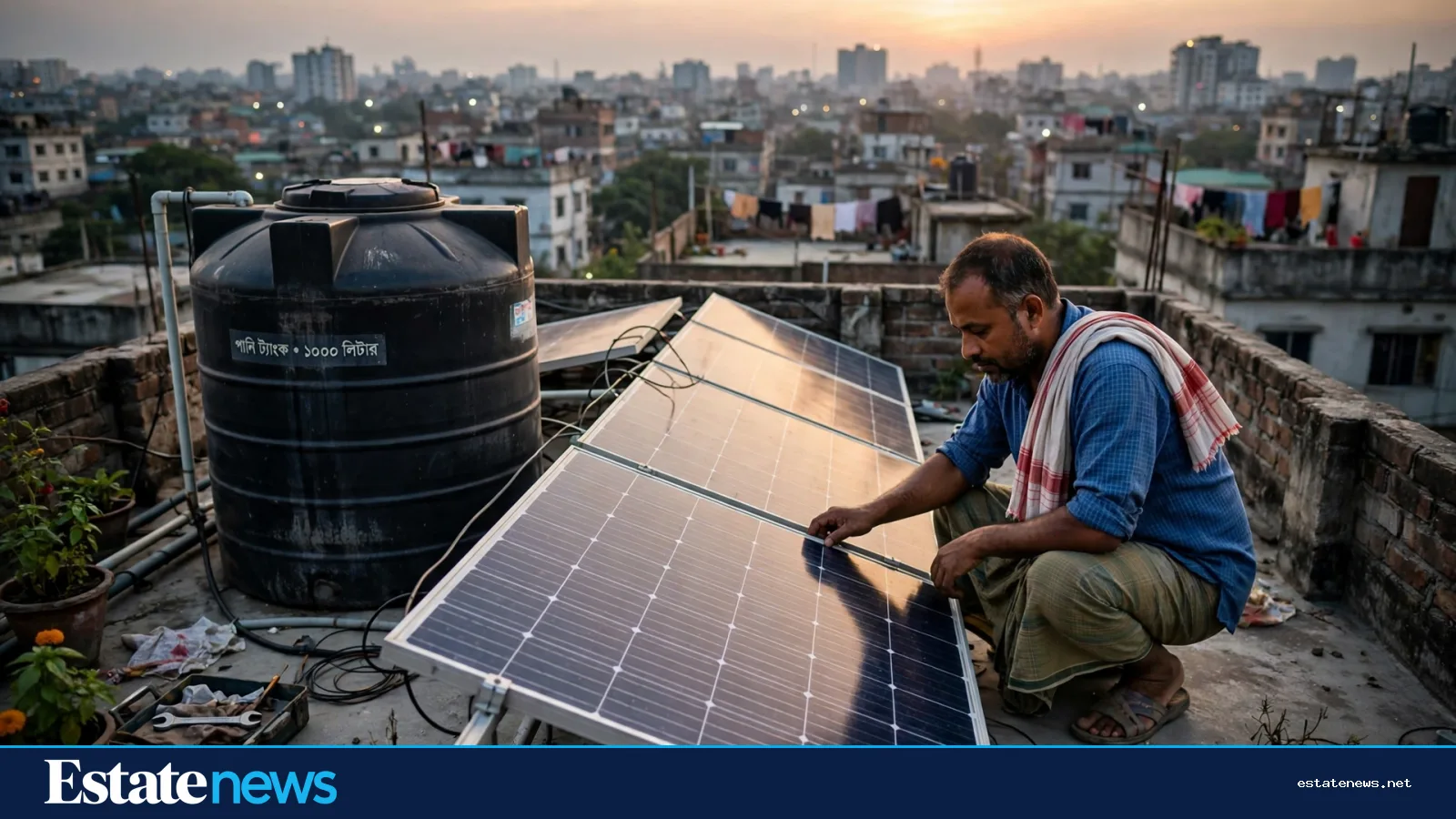
The government's answer, as Titumir set it out at the conference, is to build its way out of imported gas. Bangladesh targets more than 10,000 MW of renewable energy capacity by 2030, including 5,500 MW from rooftop solar, 4,000 to 5,000 MW from ground-mounted solar, and 450 to 500 MW from wind, waste-to-energy, floating solar and agricultural solar. The rooftop share is the part that touches a flat directly: panels on a residential roof, feeding the building below. The public-building scheme that offers free power in exchange for roof space is explained in "Your Roof, Their Panels: The 10 Percent Free Power Deal for Public Buildings".
A target is not a delivery, and 2030 is four years away. The cargoes cancelled this year will not come back, and the $4.12 billion is already spent. What the conference offered is a direction of travel: fewer ships to wait for, more power made at home, and a roof that earns its keep. The week's market news, from tariffs to Terminal 3, is gathered in "Bangladesh Market Wrap, 27 November: Tariffs, Terminal 3, the Thin Market".