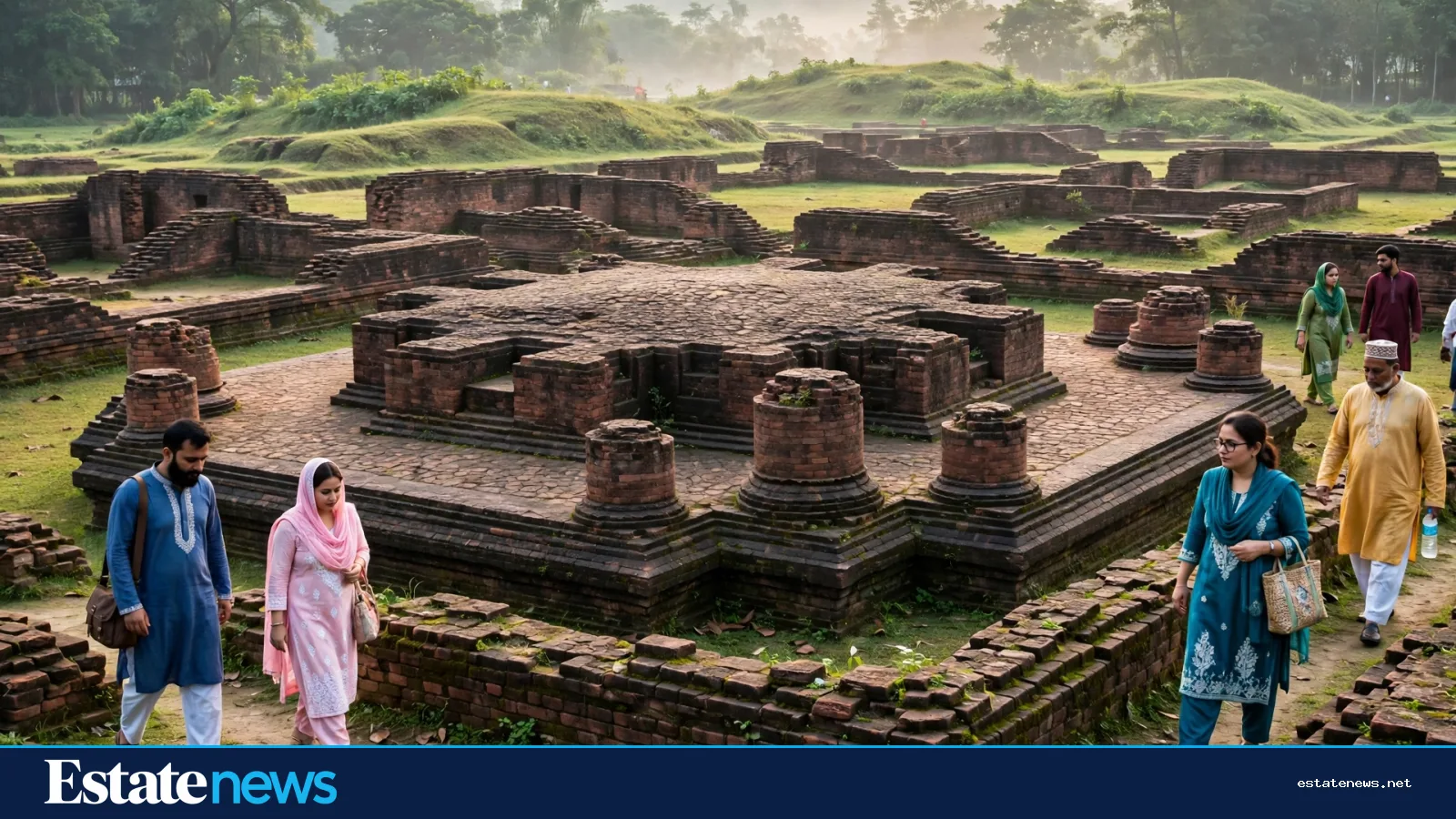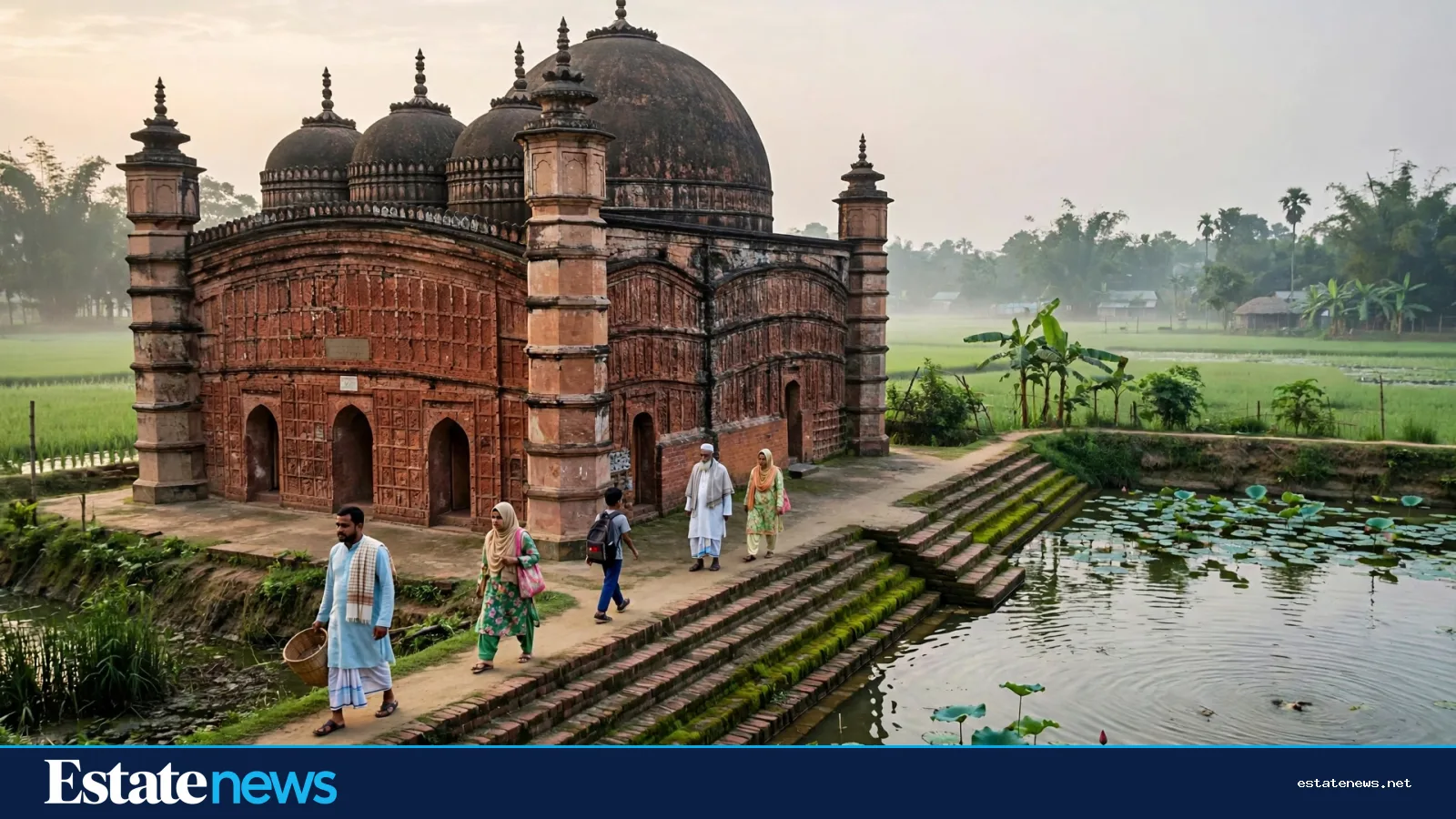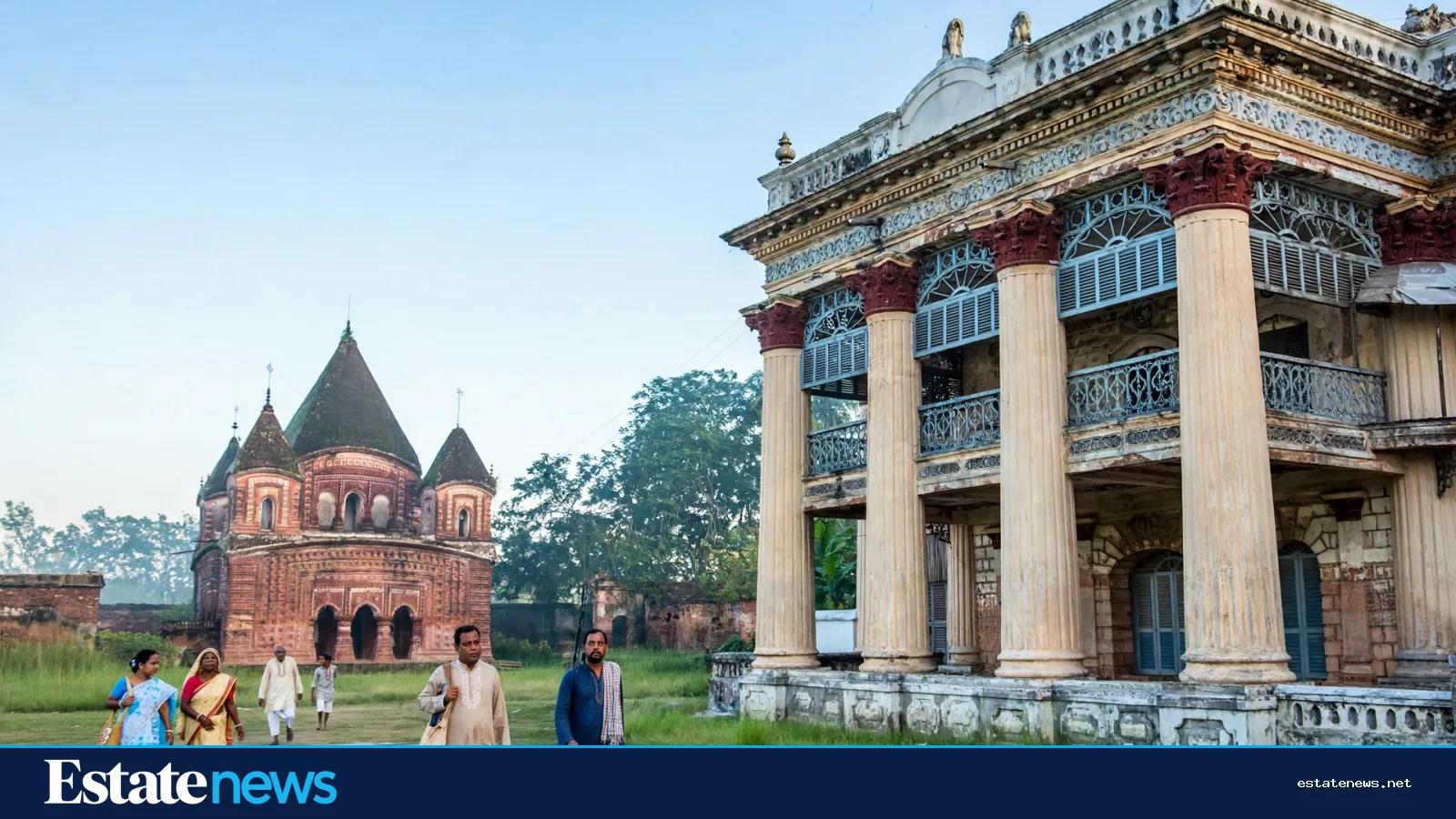
The bus from Rajshahi city takes the Dhaka highway east, and after about 32 kilometres the road reaches a small town where the skyline is not made of towers. It is made of temple spires. Brick spires rise over the bazaar, over the ponds, over the fields. This is Puthia, and for two centuries its queens and zamindars built here as if the town itself were a single work of art.
Puthia is a temple town in the plain sense. Palaces, temples, ponds and a moat stand within walking distance of one another, built by one family across generations. The Puthia Raj estate was among the oldest zamindari families of Bengal. The palace at the centre of it, the Panch Ani palace, is a two-storey mansion in the Indo-Saracenic revival style, raised in 1895 by Maharani Hemanta Kumari Devi in honour of her mother-in-law, Maharani Sarat Sundari Devi.
A family that divided, then built to outdo itself

A government brochure traces the estate to a grant of the Lashkarpur zamindari to the ascetic Vatsacharya, whose son Pitambar took it forward. Local tradition says Nilambar of Puthia received the title of raja from the Mughal emperor Jahangir, who reigned from 1605 to 1627. That is legend, not inscription.
In 1744 the estate was split among four sons, and the largest share, five annas out of sixteen, went to the branch that built the Panch Ani palace. The split set the branches against one another in a long, friendly contest, fought in brick. Each branch raised temples and houses to outdo the others, and the town filled with spires. The zamindari system itself ended with the East Pakistan Estate Acquisition Act of 1950, but the buildings stayed, and the town kept the shape the rivalry gave it.
The palace the visitor sees today is the product of that later age. Hemanta Kumari Devi built it in 1895, a two-storey colonial-style mansion with fluted Corinthian columns and a central pediment. Today the palace houses a small museum that tells the history of Puthia and the country around it.
The temples that carry the town's name


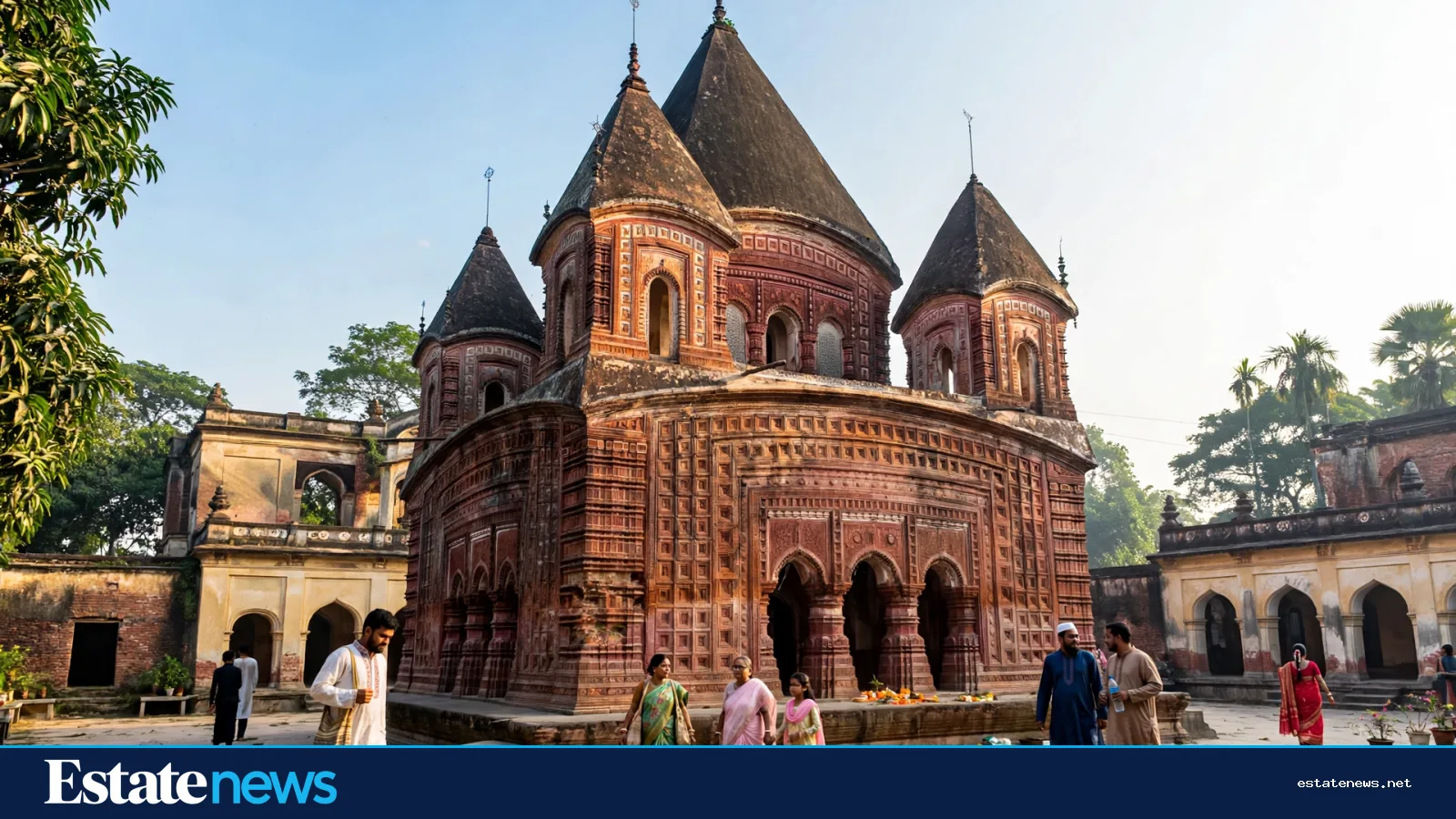
The finest building in Puthia is not the palace. It is the Boro Govinda temple, the Pancha Ratna Govinda temple, inside the palace courtyard. Built between 1823 and 1895 by one of the queens of the Puthia royal family, it is a large square temple of brick on a raised platform, about 12.25 metres to a side, with five decorated spires. The outer walls carry fine terracotta panels in red, showing scenes from the Ramayana and the love of Radha and Krishna. Inside, a square sanctum holds a Krishna image that local Hindus still worship. Unlike the Kantajew temple that inspired it, its spires survived the great earthquakes of 1886 and 1897.
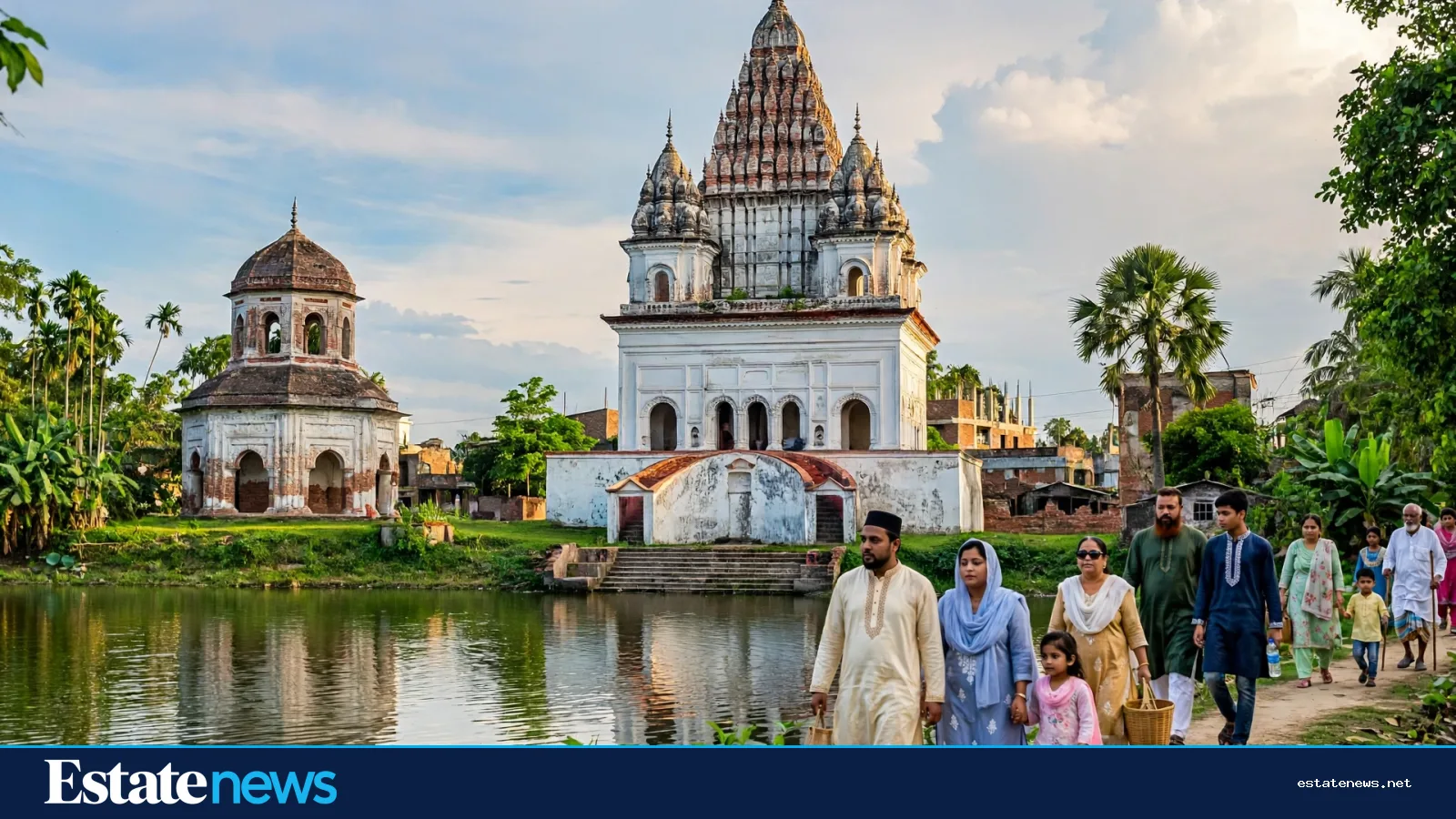
A short walk away stands the Boro Shiva temple, on the northern edge of the old citadel, above the Shiv Sagar lake. It was built between 1823 and 1830 by Rani Bhubanmayee Devi, the widow of Raja Jagat Narayan Ray, and it is the largest Shiva temple in Bangladesh. Its sanctum holds a Shiva linga carved from black basalt, also described as the largest in the country.
South of the palace stands the Dol Mandir, built in 1778 by Bhubanendra Narayan. Four storeys rise over the bazaar, each smaller than the one below, with seven arches on each side at the lowest stage, five above it, three higher still, and a single arch at the top, finished with a dome. Behind the palace stands the small do-chala Choto Anhik Mandir. West of the palace lake, three more temples stand side by side, including the Bara Ahnik temple, believed from its plan and terracotta to date from the seventeenth or eighteenth century. The whole group is now protected, and the Department of Archaeology looks after the site.
What a visitor finds in Puthia today
Puthia rewards a slow morning. The temples and the palace all sit around the Shyam Sagar and the Shiv Sagar, and the walk between them passes ponds, fields and the bazaar. The Govinda temple's terracotta is best seen in the morning light, and the Shiva temple from across its lake, where the spires reflect in the water. The buildings are old brick in a wet climate, and terracotta needs steady care.
Why a temple town still matters
Puthia matters for more than its age. It shows how a single family, over two centuries, turned a farming estate into a town of temples, and how the women of that family were the builders of its finest work. A palace kept as a museum, temples still in worship, ponds and fields still in daily use: the terracotta panels on the Govinda temple have outlasted the family that paid for them by more than a century, and they will outlast this generation too, if the care continues.