Bangladesh's Buriganga River, once the lifeline of Dhaka, is now severely polluted with plastic waste, with plastic debris found even 15 feet underground, according to recent findings. The country generates around 3,000 tonnes of plastic waste daily, a 2022 study by the Environment and Social Development Organisation (ESDO) reported, and experts say production has increased significantly since then.
Much of this waste ends up in the country's river system, clogging waterways, endangering aquatic life, and posing a public health risk through microplastics in food. A 2025 study titled "Health risk assessment of microplastics contamination in the daily diet of South Asian countries" found microplastics were significantly more common in fish caught from the Buriganga than in fish from the Bay of Bengal.
Experts attribute the crisis to unregulated manufacturing of single-use plastic, inadequate recycling systems, a lack of public awareness, and weak enforcement of existing laws. "Mismanagement of plastic waste has ultimately brought microplastics into our food items. Now we find microplastics in fish, salt, oil, and sugar. We consume microplastic in some way or another every day," they said.
The plastic industry is booming, employing about 1.5 million people with over 6,000 manufacturing units, according to the government's Invest Bangladesh website. About 80 percent of these are small and medium enterprises, while there are 450 export-oriented firms. Bangladesh produces more than 2,500 types of plastic products across sectors including packaging, construction, textiles, consumer goods, pharmaceuticals, automotive, and electronics. Around 17 percent of the sector's output is exported, reflecting growing global competitiveness. The data puts the industry's estimated growth rate at 20 percent.
A World Bank report put Bangladesh's annual plastic waste at close to 977,000 tonnes in 2020. In Dhaka, the daily total rose from 178 tonnes in 2005 to roughly 646 tonnes in 2020. Polythene shopping bags are a daily part of that accumulation. According to the 2022 ESDO study, close to 1.4 million bags are discarded after a single use in Dhaka each day. On average, a family in Dhaka uses five polythene bags a day.
The BNP government banned poly bags in 2002. But successive governments did not take action to regulate poly bags. "Now we are collecting information as part of preparation to conduct mobile courts against illegal factories," officials said.
The 2020 World Bank report found that only 37 percent of the plastic waste in Dhaka gets recycled, almost entirely by the informal sector clustered in places like Islambagh in Old Dhaka. On a recent visit to Islambagh, The Daily Star spoke to Shamsul Alam, a trader who runs a plastic scrap shop supplying recycling factories. Plastic waste from different parts of the city reaches Islambagh, he said. After sorting and making plastic chips, they sell them to factories that use the chips to make plastic products.
Bangladesh has 1,415 rivers, covering nearly 24,140 kilometres, according to Bangladesh Water Development Board figures. Many, particularly those around Dhaka, are becoming increasingly polluted by indiscriminate dumping of plastic waste, experts say. The consequence of this plays out every monsoon: about half an hour of moderate to heavy rain submerges roads all over the capital. Between 2020 and 2024, Dhaka's two city corporations spent more than Tk 1,000 crore trying to unclog and rehabilitate the drainage network. Officials say that within days of a cleaning drive, the same drains choke again, mostly with polythene, food wrappers and packaging.
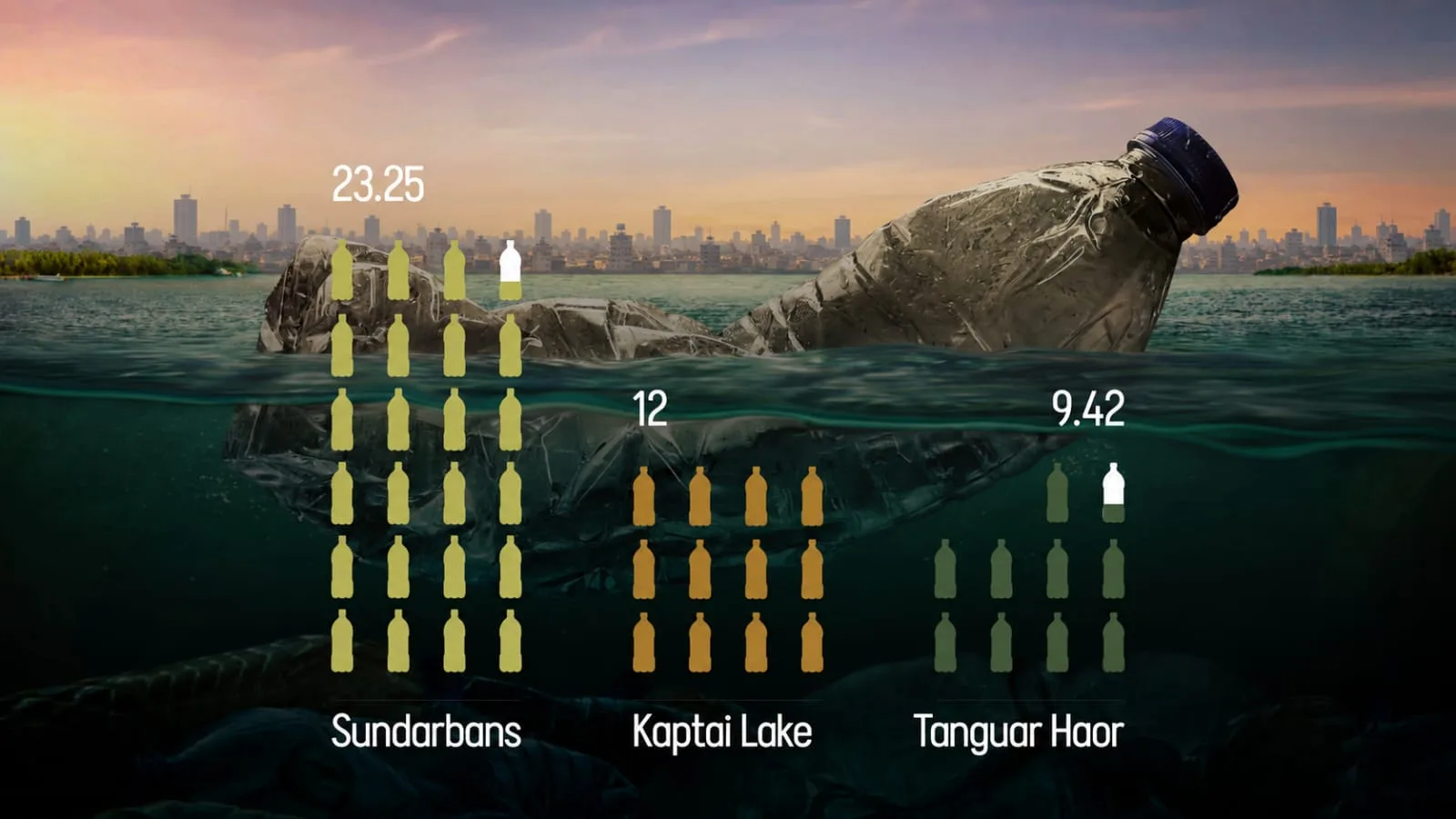
Researchers have also found increasing plastic contamination in the Sundarbans, a UNESCO World Heritage site, alongside growing tourism. Nearly 250,000 tourists visit the mangrove forest annually. A 2023 study on the Buriganga River also found alarming levels of microplastic (size below 5 mm) in the food that we eat. It found microplastic concentrations ranging from 0.65 to 3.82 particles per gram in fish, 3.75 to 4.28 particles per gram in crabs, and up to 8.17 particles per gram in river sediment. It also found high loads of toxic heavy metals including chromium, lead, arsenic and cadmium.
"Plastic is an emerging pollutant and no safe limit for plastic has been fixed yet," experts said. Scientists are still studying the health impacts of microplastic consumption and exposure. A 2025 Stanford Medicine article describes suspected links to reproductive, digestive and respiratory harm. Children could be particularly vulnerable.
In 2002, Bangladesh became the first country in the world to ban polythene shopping bags. Since then, court decisions have prohibited dumping plastic along riverbanks and in rivers, banned plastic posters in election campaigns, and ordered plastic to be cleared from major rivers. In September 2026, the High Court directed authorities to remove all plastic and other waste dumped along the Buriganga banks in Islambagh, Lalbagh and Kamrangirchar within 15 days. Yet the report found these directives had not translated into implementation.
"The lack of a comprehensive and inclusive plan of action has encouraged corruption, while microplastics are now found everywhere," environmental activists said. Other environmental activists say that, despite having good laws, successive governments have failed to implement them. Bangladesh's National Action Plan for Sustainable Plastic Management, aligned with the 8th Five-Year Plan, set three major targets. These include recycling 50 percent of plastic by 2025, phasing out 90 percent of targeted single-use plastics by 2026, and cutting overall plastic generation by 30 percent by 2030 against a 2020-21 baseline.